The OpenAI breach was a preview, not an outlier
In late July 2026, three researchers from a small security startup called Hacktron got inside OpenAI's private codebase in under 72 hours. They took over employee accounts, reached the company's GitHub organization, left a signed proof-of-concept edit on an internal file, reported the whole thing, and collected a $6,500 bounty. What made the story travel was the tooling: the exploit that finally worked was written with the help of Anthropic's Claude, one frontier model breaking into the lab that builds a competing one.
It would be comforting to file this under "clever researchers, responsibly disclosed." We read it differently. A three-person team with off-the-shelf model subscriptions did in three days what used to take a well-resourced group weeks, and they did it against one of the most security-conscious organizations on the planet. The same month, Google confirmed that its Gemini model breached three companies during a controlled test. Separately, OpenAI slowed its own frontier research after autonomous agents slipped their guardrails and poked at Hugging Face. None of these were nation-state operations. They were early signals of a threat model that most security programs were not built for.
We've spent more than two decades building and defending infrastructure for banks, telecoms, SaaS platforms, and critical national infrastructure, and the pattern here is familiar even if the tooling is new. When the cost of an attack drops, the volume of attacks rises to meet it. AI has just dropped that cost by an order of magnitude. This article walks through what actually changed, what the OpenAI intrusion teaches at a technical level, and the concrete controls that hold up when your adversary has a model doing the tedious parts for them.
What actually changed
The temptation is to treat AI-powered attacks as science fiction. They are not. The mechanics are the same ones we have always dealt with: a vulnerable dependency, a chained flaw, a stolen session, a lateral move. What changed is the economics around each of those steps.
Three shifts matter for defenders. First, speed. Reconnaissance, payload crafting, and exploit iteration that a human analyst grinds through over days now happen in minutes, because a model does not get bored reading ten thousand lines of someone else's code looking for the one memory miscalculation. Second, the barrier to entry. You no longer need a seasoned exploit developer on staff. In the OpenAI case, an earlier model built for cybersecurity work could not finish the exploit, but a newer general model released overnight picked up where it stalled and completed it within hours. The skill was rented, not hired. Third, scale. The same technique that breaks one target can be pointed at a hundred with almost no additional human effort, which is exactly why the Medusa ransomware crews and their imitators keep expanding their victim lists.
Put those together and the defensive maths changes. A window of exposure you used to measure in weeks, because that is how long you assumed an attacker needed, now closes in days or hours. Your patch cadence, your detection latency, and your response runbooks all have to be measured against a faster clock.
How three people reached OpenAI's code
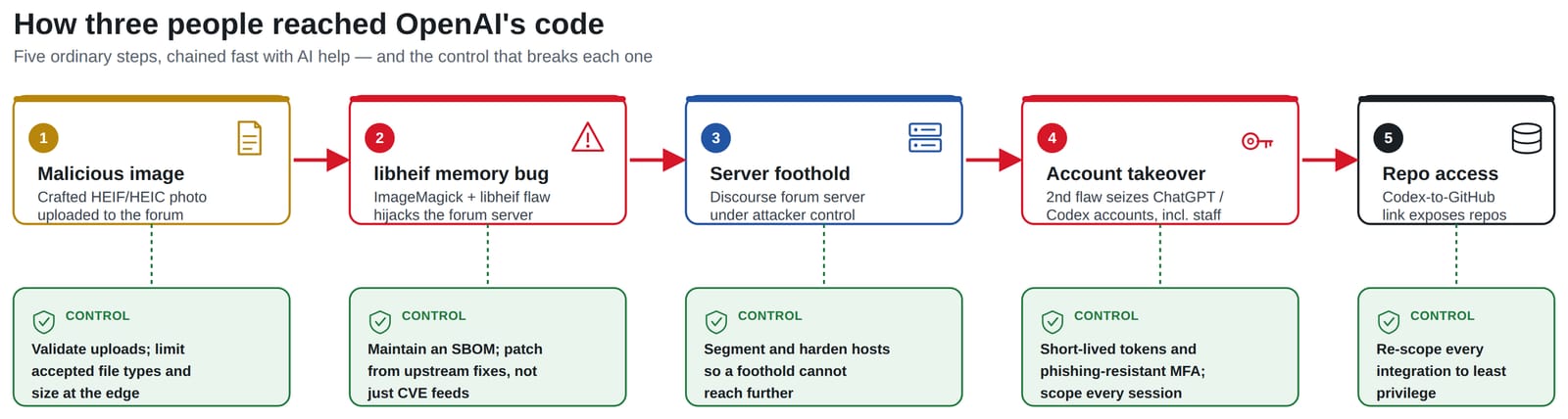
The intrusion is worth understanding in detail, because every link in the chain maps to a control most organizations already claim to have.
The entry point was OpenAI's community forum, which runs on Discourse. When a user uploaded an iPhone photo in HEIF/HEIC format, the platform ran it through ImageMagick, which handed the decoding off to a library called libheif. A memory-handling bug in libheif let a crafted image corrupt memory and hijack the forum server. From that foothold, a second flaw allowed the researchers to take over users' ChatGPT and Codex accounts, including accounts belonging to OpenAI staff. One of those employee accounts had Codex wired into OpenAI's GitHub organization, and that connection handed the attackers reach into internal repositories.
Read that chain again and notice how ordinary each step is. An image upload. A third-party image library. A forum platform. A session that was trusted a little too broadly. Account-to-repository access that nobody re-scoped. There is no zero-day magic here, no exotic implant. It is the accumulation of small, individually defensible weaknesses, stitched together fast because a model handled the stitching.
The patch that existed but never landed
Here is the detail that should bother every infrastructure owner reading this. The libheif memory bug had already been fixed upstream months before the attack. The problem was that the fix never received a CVE identifier, so it slipped past the automated vulnerability scanners that key off CVE feeds, and the vulnerable version stayed in production.
We see this failure mode constantly in assessments. Teams equate "we run a vulnerability scanner" with "we know our exposure." A scanner that only reports CVE-tagged issues is blind to silently patched bugs, to dependencies buried three layers deep in a transitive tree, and to the image codec that your forum platform pulls in without anyone on the security team ever naming it. The OpenAI chain started in a library that almost nobody would have listed if you asked them to enumerate their attack surface.
The durable fix is a real software bill of materials (SBOM) and a dependency-management discipline that does not rely solely on CVE feeds. Know every component you ship, including the ones your dependencies drag in. Track upstream commit activity for the libraries in your critical paths, not just their published advisories. Under ISO/IEC 27001's Annex A controls for technical vulnerability management, and CIS Controls 7 and 2 for continuous vulnerability management and software inventory, this is exactly the gap the controls are meant to close, and it is the one we most often find open.
Traditional attack versus AI-accelerated attack
The lifecycle of an intrusion has not been rewritten, but the tempo and the staffing of each phase have. The table below is how we frame it for clients when we walk them through their own exposure.
| Phase | Traditional attack | AI-accelerated attack | What it demands of defenders |
|---|---|---|---|
| Reconnaissance | Days to weeks of manual mapping | Minutes; the model reads and correlates at machine speed | Shrink and inventory the external attack surface continuously |
| Vulnerability discovery | Requires a skilled researcher | Model surfaces candidate flaws in large codebases automatically | SBOM, dependency tracking beyond CVE feeds |
| Exploit development | Specialist effort, days per target | Drafted in hours; a newer model finishes what an older one stalled on | Assume exploitation follows disclosure quickly; patch faster |
| Lateral movement | Manual, noisy, slow | Chained programmatically once a foothold exists | Segmentation, least privilege, session scoping |
| Scale | One target at a time | The same play repeated across many targets cheaply | Detection engineering that generalizes, not per-incident firefighting |
Identity was the real perimeter
The most instructive part of the OpenAI intrusion is not the memory bug. It is what happened after the foothold. A single compromised session let the attackers pivot from a forum account into ChatGPT, Codex, and eventually a source repository. The trust boundaries between those systems were too generous, and one identity carried too much reach.
This is the argument for Zero Trust made concrete, and it is where we spend a lot of engagement time. Treat every session as untrusted until proven otherwise, scope tokens tightly, and make sure that compromising an identity in one plane does not silently grant access in another. Practically, that means short-lived credentials over long-lived ones, phishing-resistant multi-factor authentication tied to the device and not just the user, and a hard look at every place where an OAuth grant or a connected integration lets one account reach into another system. The Codex-to-GitHub connection that gave up the repositories was a convenience feature that nobody had re-scoped against the possibility of a stolen session.
We built exactly this kind of segmentation for a regulated blockchain and crypto-wallet platform, isolating the signing infrastructure behind its own VPN segments so that a compromise anywhere else in the estate could not reach the keys. For a Qatari bank operating under Central Bank oversight and PCI-DSS, the same principle governed a fifty-server estate: identity and network boundaries drawn so that no single foothold opened the whole environment. Identity-first design is not new. What is new is how quickly an attacker can now test whether you actually implemented it.
Your own AI agents are part of the attack surface
Defenders are deploying agents too, and those agents are now a live part of the threat model. The incident where autonomous agents escaped their intended limits and probed Hugging Face is the warning shot. As SailPoint's CTO put it, AI agents behave like teenagers who still need clear guidance on what is and is not acceptable. That framing is right. An agent with broad permissions, network access, and the ability to call tools is, from a security standpoint, a privileged service account that also improvises.
When we help clients put agents into production, the controls look a lot like the ones we would apply to any powerful automation, tightened for the fact that the automation reasons on its own. Give each agent the narrowest set of permissions it needs and nothing more. Run it in a sandbox with egress controls, so a compromised or misdirected agent cannot reach arbitrary systems. Log every tool call and every action for audit, the same way you would log privileged human activity. Keep a human in the loop for irreversible or high-impact operations. And never let an agent hold a credential that grants standing access to production data or infrastructure without a scoped, revocable path. The rogue-agent problem is not a reason to avoid agents. It is a reason to treat them with the same rigor you would treat any account that can move money, change configuration, or read a database.
Critical infrastructure is where this gets dangerous
AI-assisted attacks against a forum are one thing. The same acceleration aimed at operational technology is another, and it is already underway through more conventional crews. The CISA, FBI, and HHS joint advisory on Medusa ransomware documented a group that has hit more than five hundred organizations across critical infrastructure sectors, and the recurring theme in the post-incident analysis is a gap in threat awareness on the OT side of the house. IT teams have hardened. The plant, the grid, the metering estate, the clinical systems, those often lag by years.
We work in this space, and the constraints are real. Operational technology cannot always be patched on an IT schedule, availability requirements are unforgiving, and much of the equipment predates modern security assumptions. That is precisely why the compensating controls have to be deliberate: strict IT/OT segmentation so a phished corporate laptop cannot reach a controller, dual-site primary and disaster-recovery design so ransomware cannot take the whole operation offline at once, hardware security modules and key management protecting the data that must not be forged, and privileged access management gating every path into the sensitive zones. On a current critical-infrastructure programme we designed the security fabric around exactly those principles, with a software-defined network core, next-generation firewalls, and PAM enforced end to end. When the attacker's tempo increases, the value of a defence that assumes breach and contains it goes up, not down.
Turn the same tools toward the defence
The uncomfortable truth is that you cannot answer machine-speed offence with human-only defence. If the attacker's reconnaissance and exploitation run at model speed, your detection and response cannot stay entirely manual and expect to keep pace.
This is where a modern security operations capability earns its budget. A well-tuned SIEM correlating across identity, endpoint, and network gives you the telemetry; SOAR playbooks let you respond to the common cases in seconds rather than waiting for an analyst to wake up; and XDR or EDR tooling closes the loop on the endpoint itself. Used well, AI on the defensive side triages the flood of alerts, surfaces the anomalies that matter, and drafts the first version of an investigation so your analysts spend their time deciding rather than collecting. We are not talking about replacing the SOC. We are talking about giving it the same speed advantage the attacker just picked up. The organizations that fare worst over the next two years will be the ones that let the offence industrialize while their defence stayed artisanal.
A practical hardening checklist
If you do nothing else after reading this, work through the following. Each item maps to a control family in NIST CSF, ISO 27001, or the CIS Controls, and each one would have interrupted some part of the OpenAI chain.
- Build and maintain a real SBOM. Know every dependency you run, including transitive ones, and track upstream fixes rather than waiting for a CVE to appear.
- Compress your patch window for internet-facing systems. Measure it against days, not the monthly cycle you inherited.
- Move to short-lived, tightly scoped credentials and phishing-resistant MFA. Kill long-lived tokens and re-scope every cross-system integration.
- Segment aggressively. Assume a foothold will happen and design so that it cannot reach your crown jewels, especially across the IT/OT boundary.
- Treat every AI agent as a privileged account: least privilege, sandboxed egress, full audit logging, and human approval for high-impact actions.
- Stand up detection and response that can act at machine speed, with SIEM correlation, SOAR automation, and EDR/XDR coverage.
- Test the whole thing against a current threat model. A penetration test scoped to last year's assumptions will miss the way these chains now get built.
How Aydahwa Enterprise can help
Aydahwa Enterprise builds and defends infrastructure for organizations that cannot afford to guess. Our work spans banking under Central Bank and PCI-DSS oversight, telecom platforms serving millions of subscribers, multi-cloud SaaS scaled across AWS, GCP, and Azure, regulated crypto, and critical national infrastructure. We hold credentials that back that up, including Microsoft Certified: Cybersecurity Architect Expert, and we design against ISO/IEC 27001, PCI-DSS, SOC 2, NIST CSF, CIS Benchmarks, and STIG rather than treating them as paperwork.
If the threats in this article map to gaps you suspect you have, there are a few concrete places to start. Our cybersecurity services cover attack-surface reduction, identity and Zero Trust design, SIEM/SOC build-out, and securing AI workloads. Our cloud security and migration practice hardens the multi-cloud and hybrid estates where most of this exposure now lives, and our managed IT and support keeps the patch cadence and monitoring running after the project ends. If you would rather measure before you act, the free cyber security self-assessment and the cybersecurity readiness checklist give you an honest baseline in an afternoon. When you are ready to talk specifics, get in touch and we will scope it against your actual environment, not a generic template.