Ten systems, ten places a request can be broken
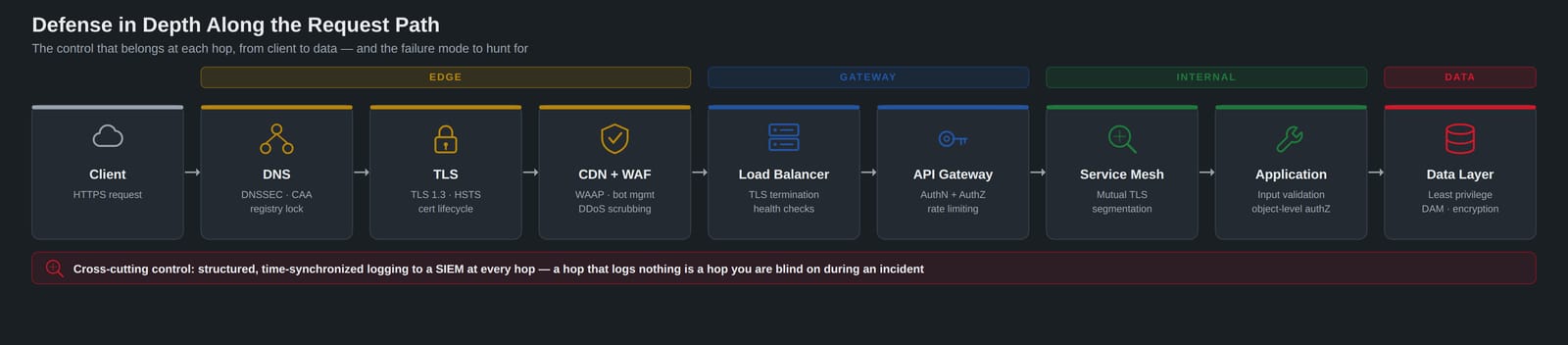
A web page that loads in under a second has usually put a single user request through about ten separate systems on its way to the database and back. DNS resolves a name. TLS negotiates a session. A content delivery network answers what it can. A web application firewall inspects what is left. A load balancer picks a backend. An API gateway decides who the caller is and what they are allowed to do. A service mesh carries the call to the right internal service. The application runs its logic. A cache shortcuts the repeat work. The data layer finally answers.
Engineers usually study that path for performance, because each layer absorbs traffic before passing the rest along, and the whole thing behaves like a funnel. We look at the same path for a different reason. Every one of those hops is a control point, and every one is also a place where a control can be missing, misconfigured, or quietly turned off during an incident. Defense in depth is the practice of putting the right control at each hop so that no single failure exposes the system behind it.
In our engagements across banking, telecom, and critical infrastructure, the breaches that hurt rarely trace back to a missing firewall. They trace back to one hop where a control was assumed to exist and did not, or existed but logged nothing, so nobody saw the request get through. This article walks the request path the way an attacker experiences it, names the control that belongs at each hop, and points out the blind spot we find there most often.
The edge: DNS, TLS, and the first line that faces the internet
The journey starts before the request has fully left the browser. The client resolves a hostname through DNS, opens a TLS session, and reaches whatever sits at the edge of your network. Three controls matter here, and each has a failure mode we see repeatedly.
DNS is an identity boundary, not just a lookup
DNS decides where your users and your machines actually connect. If an attacker can poison a resolver or hijack a record, TLS and every control behind it are answering to the wrong destination. The controls that hold: DNSSEC to sign responses, CAA records to constrain which certificate authorities can issue for your domains, registrar and registry locks to stop unauthorized transfers, and monitoring for changes to your zones. The blind spot is ownership. DNS is often run by whoever set it up years ago, outside the security team's view, with shared credentials and no change alerting. We have watched a registrar-level takeover do more damage than a firewall gap ever could.
TLS everywhere, and terminated where you can see it
Transport encryption protects the request in transit and, done properly, proves the server's identity to the client. Use TLS 1.3, disable legacy protocol versions and weak ciphers, enable HSTS so browsers refuse to downgrade, and manage certificate lifecycles with automation rather than a spreadsheet and a calendar reminder. The common weakness is not the cipher suite. It is an expired certificate that takes down a payment path at 2 a.m., or a wildcard certificate and its private key copied onto a dozen hosts, any one of which can leak it.
The CDN and WAF absorb the volume, then hand off the hard cases
A content delivery network answers static traffic close to the user and shields the origin. In front of the origin, a web application firewall inspects requests for injection, path traversal, and known exploit patterns, while bot management and DDoS scrubbing shed automated abuse before it reaches your compute. This is where the funnel narrows most sharply. The trade-off is real: aggressive rules block attacks and occasionally block customers, so tuning is continuous work, not a one-time install. The blind spot is treating the WAF as the whole security program. A WAF filters known-bad shapes of traffic. It does not understand your application's business logic, and it will happily pass a perfectly formatted request that abuses a broken authorization check downstream.
The gateway: deciding who is calling and what they may do
Past the edge, a load balancer spreads traffic across healthy backends, and an API gateway becomes the first place the request is treated as an identity rather than a packet. This hop carries more security weight than any single component in most architectures, because it is where authentication and authorization decisions are centralized.
Authentication belongs here: validate tokens, verify signatures and expiry on every request, and integrate with your identity provider through OAuth 2.0 and OpenID Connect rather than rolling your own session scheme. Authorization belongs here too, at least at the coarse level, so that an unauthenticated or under-privileged caller is stopped before it reaches a service. Rate limiting and quota enforcement live at the gateway to protect everything behind it from a single abusive client. Request and response validation against a schema closes off a class of malformed-input attacks.
The failure we correct most often is the gateway that authenticates but does not authorize. The caller proves who they are, the token is valid, and then the request sails through to a service that assumes the gateway already checked whether this particular user should see this particular record. That gap, broken object-level authorization, is one of the most exploited weaknesses in production APIs, and no amount of edge filtering catches it because the request is well formed and the identity is genuine.
Inside the perimeter: service-to-service trust and the secrets that grant it
Once a request is inside, it usually becomes several requests. The gateway calls a service, which calls two more, which read from a cache and a database. For a long time the industry treated this internal zone as trusted ground: get through the edge, and the network was flat and friendly. Attackers know this, and lateral movement inside a soft interior is how a single compromised service becomes a full breach.
The control that changes this is mutual TLS between services, usually delivered by a service mesh such as Istio or Linkerd, so that each service proves its identity to the others and east-west traffic is encrypted and authenticated rather than assumed. Network segmentation and micro-segmentation limit what a compromised workload can even reach. This is the practical shape of zero trust described in NIST SP 800-207: no implicit trust based on network location, every hop re-verified.
Behind service identity sits the question of secrets. Services authenticate with credentials, and those credentials have to live somewhere. A secrets manager or vault, short-lived and automatically rotated tokens, a privileged access management system for human and administrative access, and a hardware security module or key management service for the keys that protect data at rest, together decide whether a stolen credential is a minor event or a catastrophe. The blind spot we find on nearly every assessment is the long-lived secret: an API key or database password hardcoded into a container image, checked into a repository years ago, still valid, shared across environments, and rotated by nobody.
The data layer: the last control, and the one that decides the blast radius
The request finally reaches the data. This is the hop where the difference between an incident and a disaster is decided, because everything before it is about keeping attackers out, and this layer is about limiting what they can take if they get in.
Encryption at rest protects the stored data, but only against the narrow case of stolen media, so it is necessary and rarely sufficient on its own. The controls that shape the blast radius are least-privilege database accounts scoped to exactly what an application needs, database activity monitoring that records who queried what, data loss prevention on the paths where data leaves, and tokenization or field-level encryption for the highest-sensitivity fields such as cardholder data under PCI-DSS. The pattern we correct most often here is the application that connects to its database with a single high-privilege account capable of reading every table, so that one compromised service exposes the entire dataset rather than the slice it needed.
The control at every hop, side by side
The walkthrough above maps cleanly to a single table. This is the version we hand to architecture and operations teams when we review a request path, with the standard or framework that governs each control and the failure mode to hunt for.
| Hop | Primary control | Standard / reference | Common failure mode |
|---|---|---|---|
| DNS | DNSSEC, CAA records, registry lock | NIST CSF PR.DS, ISO 27001 A.8 | Unmonitored zone, shared registrar credentials |
| TLS / transport | TLS 1.3, HSTS, automated cert lifecycle | PCI-DSS Req. 4, CIS Benchmarks | Expired certs, wildcard key sprawl |
| CDN / WAF / DDoS | WAAP rules, bot management, rate-based DDoS defense | OWASP, NIST CSF DE.CM | Treated as the entire security program |
| Load balancer | Health checks, TLS termination policy, header hygiene | CIS Benchmarks | Backends reachable directly, bypassing the LB |
| API gateway | Token validation, coarse authorization, rate limits | OAuth 2.0 / OIDC, PCI-DSS Req. 8 | Authenticates but does not authorize |
| Service mesh (east-west) | Mutual TLS, micro-segmentation | NIST SP 800-207 (Zero Trust) | Flat internal network, implicit trust |
| Secrets / identity | Vault, short-lived tokens, PAM, HSM/KMS | ISO 27001 A.8, PCI-DSS Req. 3 & 8 | Long-lived hardcoded credentials |
| Application | Input validation, object-level authorization, RASP | OWASP ASVS | Trusting the gateway to have checked everything |
| Data layer | Least-privilege accounts, DAM, DLP, field encryption | PCI-DSS Req. 3 & 10, NIST CSF PR.AC | Single high-privilege app account |
| Every hop | Structured logging to a SIEM, time-synchronized | PCI-DSS Req. 10, ISO 27001 A.12 | A hop that passes traffic but logs nothing |
Where defense in depth actually breaks
Layered security fails in a few predictable ways, and none of them is a missing product. The most common is the edge-heavy stack with a soft center: a strong WAF, a capable DDoS service, and behind them a flat network where any compromised workload can reach the database directly. The controls look impressive on a diagram and collapse the moment an attacker gets one foothold inside.
The second is duplicated controls that create false confidence. Two teams each assume the other layer is handling authorization, so the gateway defers to the service and the service defers to the gateway, and nobody actually checks. Redundancy is good when it is deliberate and bad when it is an accident nobody owns.
The third, and the one that turns a contained event into an unbounded one, is the logging gap. A request passes through a hop that enforces nothing and records nothing, so when you investigate, that segment of the path is dark. We treat structured, time-synchronized logging at every hop as a control in its own right, not an afterthought, because a control you cannot observe is a control you cannot prove worked. Clock drift between hops alone can make a SIEM correlation useless, which is why time synchronization sits in the same conversation as the security controls themselves.
Auditing your own request path
Reviewing an architecture against this model does not require a large program. It requires walking the path hop by hop and asking a specific question at each one. We use a version of the following sequence on assessment engagements:
- Trace a real request end to end and list every system it touches. If your diagram and your traffic disagree, trust the traffic.
- At each hop, name the control that is supposed to be enforcing something. If you cannot name it, that is a finding.
- Confirm the control is actually on. A WAF in detection-only mode, a mesh with mTLS set to permissive, or an authorization rule scoped to nothing are controls in name only.
- Check whether any hop can be bypassed. Backends that are directly reachable, or an internal API exposed to the internet, quietly cancel the layers in front of them.
- Verify that each hop produces logs, that those logs reach a central SIEM, and that the clocks agree. If a hop is silent, assume you will be blind there during an incident.
- Map each control to the framework you are accountable to, whether that is ISO 27001, PCI-DSS, NIST CSF, or the CIS Benchmarks, so the review doubles as evidence for your next audit.
Run that sequence and the gaps announce themselves. In almost every review we have done, the problem was not that the organization lacked security tools. It was that the tools were stacked at one or two hops and thin everywhere else, and the request path had a stretch nobody was watching.
How Aydahwa Enterprise Can Help
Aydahwa Enterprise designs and reviews the full request path for organizations that cannot afford a soft interior, including banks, telecom operators, and critical-infrastructure operators. Our team holds the Microsoft Cybersecurity Architect Expert certification and works to ISO 27001, PCI-DSS, SOC 2, NIST CSF, and CIS Benchmarks, and we have built and hardened these architectures under regulators including central-bank oversight in the banking sector.
A typical engagement starts with the walkthrough above: we trace your real request path, map the control and the blind spot at each hop, and hand you a prioritized remediation plan tied to the framework you report against. From there we can implement the missing layers, from zero-trust segmentation and service-mesh mTLS to API gateway authorization, secrets management, and SIEM coverage that leaves no hop dark.
If you want a fast read on where you stand, start with our free cybersecurity self-assessment and the cybersecurity readiness checklist. To review a specific architecture, see our cybersecurity services and cloud security and migration work, or contact us to walk your request path together.