The memory in your AI system is a data store, and it belongs to your security program
A large language model does not remember anything on its own. It answers each request from its trained weights plus whatever text is placed in front of it for that one call. Everything that feels like memory — the assistant recalling your name, your project, the database you picked three days ago, is the application around the model storing that information and re-injecting it into the next prompt. The model is stateless. The application is not.
That distinction sounds academic until you trace where the "memory" physically lives. It lives in conversation logs, in vector databases, in user-profile tables, in cache layers, in the summaries a background job writes after every session. Those are data stores. They hold whatever your users typed, including the things they should never have typed. And in most of the AI projects we have reviewed over the past two years, nobody drew a trust boundary around any of them. The application team treated memory as a product feature. The security team never got told it existed.
This article is about closing that gap. The mechanics of LLM memory are well understood by the engineers building it; what tends to be missing is the security and governance view of the same architecture. We will walk the memory stack layer by layer, name the real threats that land on each one, and map them to controls you can actually implement against frameworks you already run — ISO/IEC 27001, PCI-DSS, NIST CSF, CIS Benchmarks, and the data-protection regimes that now apply in most jurisdictions, including the UAE PDPL and GDPR.
What "memory" actually refers to
The word gets used for several different things, and they carry very different risk. Keeping them separate is the first step, because you cannot protect a data store you have merged conceptually with three others.
Trained memory is the model's weights — general knowledge baked in during training. A normal API call does not rewrite it, so a user telling the model "my card number is…" does not teach the base model that fact. This layer is not where your sensitive data leaks from in a typical deployment.
Working memory is the context window: the system instructions, the current message, recent turns, retrieved documents, tool definitions, and the space reserved for the answer, all loaded for a single response and cleared afterward. It is transient, but it is also where every other layer's data converges at inference time. If you are logging full prompts for debugging — and most teams are — you are persisting the entire context window to a log store, which quietly becomes one of your most sensitive assets.
Persistent application memory is everything that survives the call: the conversation history in a database, the embeddings in a vector store, the extracted facts in a profile service. This is the layer that matters most for security, because it accumulates, it is queried, and it is almost always under-governed.
When an application "remembers" across sessions, a background process is deciding what to write into that persistent store, and a retrieval process is deciding what to pull back into a future context. Both of those decisions are now part of your attack surface and your compliance scope.
The persistent memory layer is a new data-governance surface
Start with the unglamorous problem, because it is the one that will show up in an audit first. Once your application writes conversation content to a durable store, you have created a repository of user-generated data with no natural expiry. Users paste API keys into chat windows. They describe their medical situation to a support bot. In a banking context, they type account details a call-centre agent would have been trained never to record. Your memory layer captures all of it, verbatim, and keeps it until someone designs a retention policy, which in the systems we assess usually nobody has.
Treat these stores the way you would treat any other database holding regulated data, because that is what they are. Concretely, that means classifying the data they hold, encrypting it at rest and in transit with keys you control, putting real access control in front of the retrieval path rather than assuming the application layer is the only caller, and logging access for the same reasons you log access to a payments database. Under ISO 27001 this is straight Annex A territory — asset management, access control, cryptography. Under PCI-DSS, if cardholder data can land in a prompt, the memory store is in scope for the assessment whether you intended it to be or not.
Retention and erasure deserve their own attention. A long-term user profile that stores "durable preferences" is, in data-protection terms, a profile of an identified person. The right to erasure does not stop at your primary user table. If a user asks to be deleted, the deletion has to reach the vector store, the conversation archive, and every summary that mentions them, or the request has not actually been honoured. Design the memory layer so that a user identifier is attached to every stored fragment from day one. Retrofitting that attribution after the store is full of un-keyed embeddings is painful, and we have watched teams spend a quarter doing exactly that.
Memory poisoning: prompt injection that persists
Ordinary prompt injection is a single-shot attack — the malicious instruction sits in one input and is gone after the response. Memory poisoning is worse, because the injected content gets written into the persistent store and then retrieved into future contexts, possibly for a different user. It is prompt injection with a shelf life. OWASP tracks it as LLM04, Data and Model Poisoning, in its 2025 Top 10 for LLM Applications, and it is one of the more under-appreciated risks in agentic systems.
The mechanism is direct. If your application extracts "facts" from conversations and stores them as durable memory, an attacker crafts input designed to be extracted as a fact. Something like an instruction disguised as a preference, phrased so the summarizer records it and the retriever later serves it back into a privileged context. In a multi-user or agent-to-agent system, poisoned memory written by one actor can steer the behaviour the model produces for another. The model is not compromised. The data it was handed is.
The defences are the ones we apply to any untrusted-input pipeline, adapted to this setting. Treat everything written to memory as untrusted by default. Validate and sanitize content before it is stored, not only when it is displayed. Keep a clear provenance record on every memory entry — who wrote it, in what session, from what source — so a poisoned entry can be traced and purged. Separate memory by trust level, so that facts derived from an anonymous end user never share a retrieval namespace with facts an administrator or an internal system established. And apply least privilege to what memory a given model call is even allowed to see. Most agents are handed far more memory scope than the task in front of them requires.
Cross-tenant and cross-session leakage in vector stores
Vector-store-backed memory is where semantic retrieval happens: past conversation fragments are turned into embeddings, and a new question retrieves the fragments whose meaning is closest. It is an elegant way to give a model relevant history without stuffing the whole transcript into every prompt. It is also, done carelessly, one of the cleaner ways to leak one customer's data to another.
The failure is almost always the same. Retrieval runs a similarity search across the embedding space and returns the closest matches — but the closest matches by meaning are not filtered by ownership unless you explicitly filter them. If tenant A and tenant B both discuss invoice reconciliation, a query from A can retrieve B's fragment because the two are semantically neighbours. OWASP added Vector and Embedding Weaknesses as LLM08 in the 2025 list precisely because this class of mistake is common in retrieval-augmented systems.
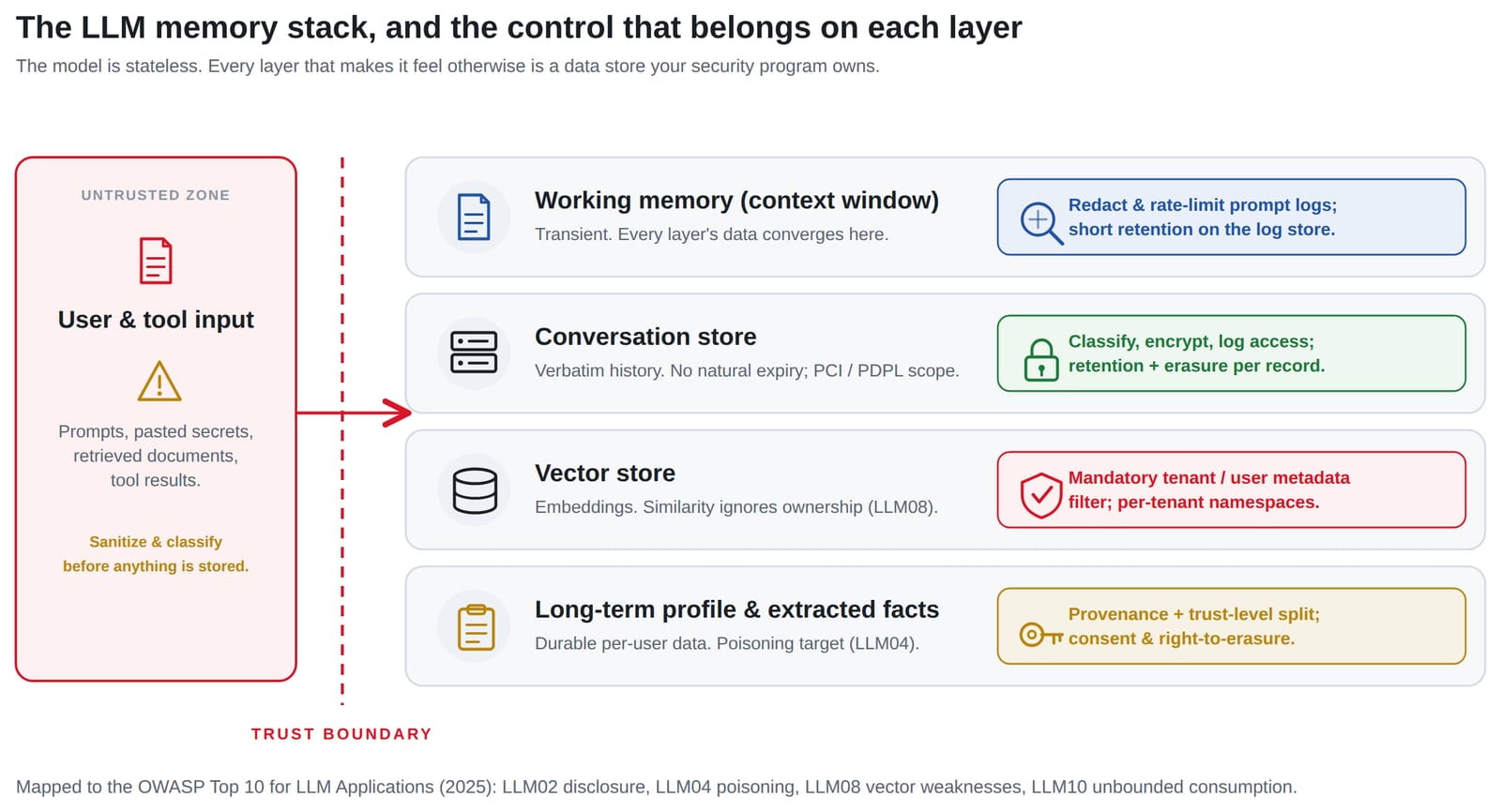
Enforcing isolation is not optional, and it cannot rely on the model's good behaviour. Every retrieval query must carry mandatory metadata filters — tenant ID, user ID, project ID — applied at the datastore level so that the similarity search only ever runs within the caller's own partition. For strong isolation, separate the embedding namespaces or indexes per tenant rather than relying on a filter clause a future code change might drop. Add metadata to every stored fragment at write time, because a filter can only match on metadata that exists. Then test the isolation the way an attacker would: seed one tenant's store with a marker string and confirm no other tenant's queries can ever surface it. In our engagements this test is where the gap gets found, not in code review.
Sensitive information disclosure starts at ingestion
OWASP's LLM02, Sensitive Information Disclosure, is often discussed as a model-output problem — the model saying something it should not. In a system with memory, the more durable version of the problem is what gets written in. Once a secret is stored in the memory layer, every future retrieval is a fresh chance to disclose it, and every backup and log now contains it too.
The control point is the write path. Redact and classify content before it enters persistent memory, not after. Detection of secrets, payment data, and personal identifiers at ingestion time keeps the highest-risk data out of the store entirely, which is far cheaper than trying to scrub it later. For the working-memory layer, be deliberate about prompt logging: full-prompt debug logs are enormously useful and enormously sensitive, so they need the same redaction, retention limits, and access controls as the memory store itself. A verbose log left at debug level in production has ended more than one clean audit.
Where each risk lands, and what stops it
| Memory layer | What it holds | Primary risk | Control |
|---|---|---|---|
| Working memory (context window) | Full prompt, retrieved docs, tool results | Exposure via prompt/debug logging (LLM02) | Redact and rate-limit logs; treat log store as sensitive; short retention |
| Conversation store | Verbatim message history | Regulated data with no expiry; PCI/PDPL scope | Classify, encrypt, key-per-record retention and erasure, access logging |
| Vector store | Embeddings of past fragments | Cross-tenant / cross-session leakage (LLM08) | Mandatory tenant/user metadata filters; per-tenant namespaces; isolation testing |
| Extracted facts / summaries | Structured "durable facts" | Memory poisoning, persistent injection (LLM04) | Sanitize on write; provenance; trust-level separation; least-privilege retrieval |
| Long-term profile | Durable per-user preferences | Consent, erasure, profiling obligations | User-keyed entries; consent tracking; erasure that reaches every store |
| Context growth over a session | Ever-larger reprocessed history | Cost and denial-of-wallet (LLM10) | Bounded context windows; per-user token quotas; anomaly alerting |
One point on that last row. As a conversation grows, the application reprocesses more tokens on every turn, and cost climbs with it. OWASP calls this class Unbounded Consumption, LLM10. An attacker who can force very long contexts can run up a bill or exhaust capacity — a denial-of-wallet attack rather than a data breach, but a real operational risk that belongs in the same threat model. Bounded windows and per-user quotas are the boring, effective answer.
A practical checklist for securing the memory layer
- Inventory every place memory is persisted — conversation stores, vector databases, profile tables, caches, and prompt logs. You cannot govern what is not on the diagram.
- Classify the data each store can hold, and bring the high-sensitivity stores into scope for ISO 27001, PCI-DSS, and your local data-protection regime deliberately, not by accident.
- Attach a user, tenant, and project identifier to every stored fragment at write time, and make retrieval filters on those identifiers mandatory at the datastore level.
- Redact secrets and personal data on the write path, before content enters persistent memory, and apply the same discipline to full-prompt debug logs.
- Treat all memory content as untrusted input: sanitize on write, record provenance, and separate memory by trust level so anonymous input cannot poison privileged context.
- Apply least privilege to retrieval — give each model call only the memory scope its task needs.
- Build erasure that reaches every store, and prove it with a deletion test, not a policy document.
- Bound context length and set per-user token quotas to cap both cost and denial-of-wallet exposure.
- Test tenant isolation adversarially with seeded marker data, and repeat the test in CI so a future change cannot silently reintroduce leakage.
How Aydahwa Enterprise can help
We build and secure production systems for regulated environments — banking, telecom, government, and critical national infrastructure — where a data-governance gap is not a theoretical finding but a reportable one. The memory layer inside an AI application is new territory for most security programs, but the disciplines that secure it are not new: data classification, encryption and key management, tenant isolation, least privilege, input validation, and retention that maps to real regulatory obligations. Our team holds the Microsoft Cybersecurity Architect Expert certification and works to ISO/IEC 27001, PCI-DSS, SOC 2, NIST CSF, and CIS Benchmarks, and we have carried those standards into cloud and container platforms across AWS, Azure, and GCP.
If you are putting an LLM-backed application into production and want the memory and retrieval layer reviewed before it becomes an audit finding, we can help. Start with our free cybersecurity self-assessment or the cybersecurity readiness checklist to see where you stand, read more about our cybersecurity services and cloud security and migration work, and contact us to talk through your specific architecture. If you need ongoing support hardening and monitoring these systems, our managed IT and support services cover that too.