A patched bug still took down a frontier AI lab
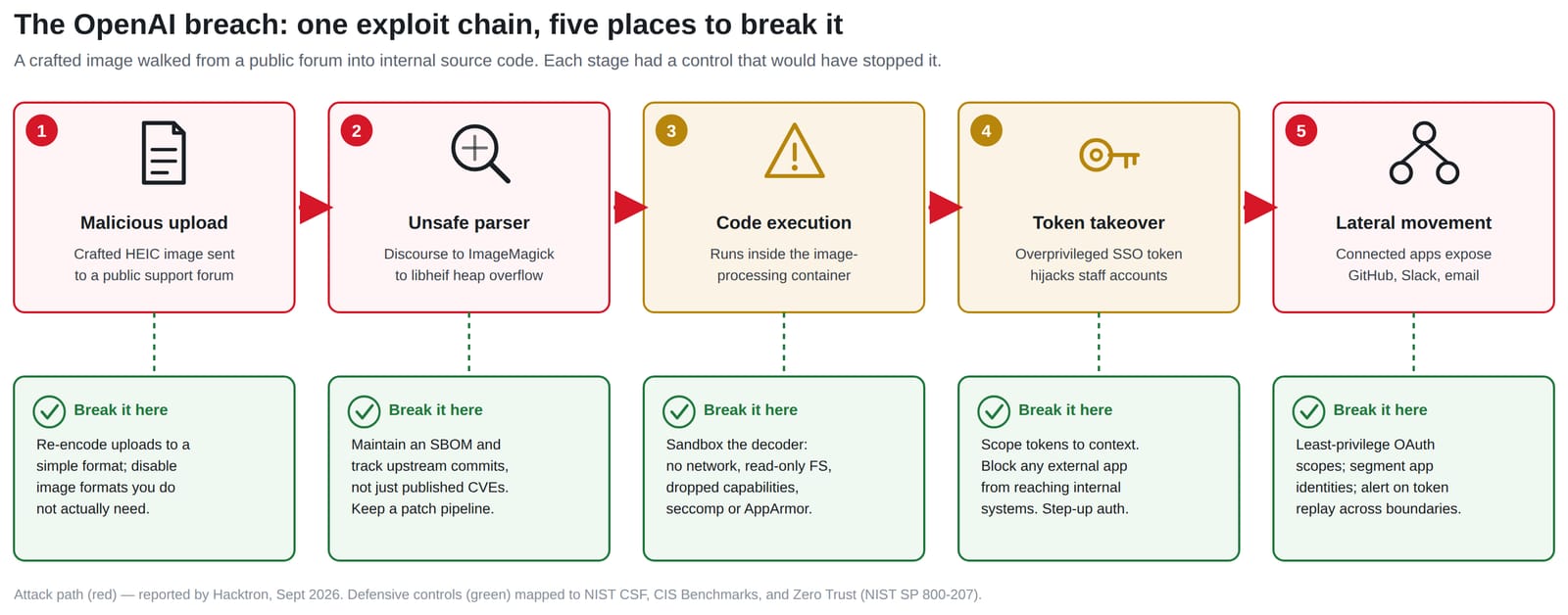
In September 2026, a small team of researchers at Hacktron walked from a single image upload on a public support forum all the way into OpenAI's internal source code. The entry point was not a zero-day in some exotic system. It was a heap overflow in libheif, an open-source image-decoding library, that upstream maintainers had quietly fixed roughly a year earlier without ever assigning it a CVE. The forum ran Discourse, Discourse handed HEIC uploads to ImageMagick, ImageMagick called libheif, and that was enough to get remote code execution on the server. From there an overprivileged sign-in token did the rest: forum login tokens carried full API access to the associated ChatGPT and Codex accounts, so taking over the forum meant taking over employee accounts, and those accounts were wired into GitHub, Slack, and email. The proof of impact was a pull request opened in an internal OpenAI repository.
We have spent 25 years building and defending infrastructure for banks, telecoms, and critical national infrastructure, and this incident is worth studying precisely because nothing about it was novel. Every link in the chain is a failure mode we assess for on standard engagements. The uncomfortable part is how ordinary each weakness was, and how completely they combined. This is the pattern that turns a medium-severity finding into a board-level event, and it is getting more common, not less.
Why this matters more in 2026 than it did in 2020
The attack surface underneath most applications keeps growing. Black Duck's 2026 Open Source Security and Risk Analysis report found that the number of known open-source vulnerabilities per codebase jumped roughly 107 percent year over year, a doubling the researchers tie directly to AI-accelerated code generation pulling in more dependencies faster than teams can vet them. At the same time, the class of bug that started this breach is the one that refuses to go away: Microsoft and Google have both reported for years that around 70 percent of their serious security vulnerabilities are memory-safety issues in C and C++ code, and image and media parsers written in those languages sit directly in the path of untrusted input.
There is a second shift. The Hacktron team built their working exploit with help from a large language model, iterating on the crash until it became reliable code execution. That is the part every defender should sit with. The skill and time once required to weaponize a memory-corruption bug is dropping, which means the window between a silent upstream fix and a working public exploit is shrinking. Silent patches were always a poor security control, because a capable adversary can reverse-engineer the diff. Now the adversary has an assistant that never gets tired of trying.
The exploit chain, broken down
It helps to see the whole path as a sequence of small, individually survivable mistakes. No single control failure here was catastrophic on its own. The catastrophe was the chain.
Stage one: untrusted input reaches unsafe code
A forum let anonymous users upload images, and those images were decoded server-side by a stack of C libraries. HEIC and HEIF are complex container formats that support rotation, cropping, alpha channels, and thumbnails. Almost no forum needs any of that, yet the full parser was exposed anyway. This is the oldest lesson in application security stated in a modern form: any code that parses attacker-controlled data is your attack surface, and the more capable the parser, the larger that surface.
Stage two: code execution with no blast wall
The overflow produced remote code execution inside the process handling the upload, and there was no meaningful boundary between that process and the rest of the environment. A decoder that should have been running in a stripped-down, network-isolated sandbox was instead running with enough reach to matter. When the first line of defense is "the parser will not crash," you have no defense.
Stage three: an identity token that carried too much
This is the link that turned a server compromise into an organizational one. The forum's sign-in tokens granted full API access to the connected ChatGPT and Codex accounts. A public, internet-facing community property held credentials capable of acting on internal identities. In our assessments this is one of the most common and most dangerous patterns we find in single sign-on deployments: a token minted for a low-trust context that is accepted, unchanged, by high-trust systems.
Stage four: lateral movement through connected tools
Once an employee account was under control, the integrations did the attacker's work. GitHub access exposed internal repositories. The same identity fabric reached toward Slack and email. Nothing here required a second exploit. The connected-app model that makes modern engineering productive is also a pre-built lateral-movement network, and it runs at the speed of OAuth.
Which controls would have broken the chain?
This is exactly the situation defense in depth was built for. Any one of the following controls, properly enforced, would have stopped the attack before it reached internal code. That redundancy is the point of layered security, and it is how we design environments under ISO/IEC 27001, PCI-DSS, and NIST CSF: assume any single control will fail, and make sure the next one catches it.
| Link in the chain | Control that breaks it | Framework anchor |
|---|---|---|
| Unpatched dependency (libheif) | SBOM plus continuous dependency scanning; track upstream commits, not just published CVEs | NIST SSDF, CIS Control 2 (software inventory) |
| Untrusted image reaches full parser | Restrict accepted formats; re-encode uploads to a simple format before deep processing | OWASP input validation |
| RCE with no isolation | Decode in a sandbox: read-only filesystem, no network, dropped capabilities, seccomp or AppArmor profile | NIST SP 800-53 SC-7, CIS Benchmarks |
| Overprivileged SSO token | Scope tokens to context; deny external-app sessions any path to internal systems; re-authenticate for privileged actions | Zero Trust (NIST SP 800-207) |
| Session token stolen from a process | Short-lived tokens, memory-only storage, binding tokens to device or client posture | NIST CSF PR.AC, PCI-DSS 8 |
| Lateral movement via integrations | Segment integration identities; least-privilege OAuth scopes; log and alert on anomalous token use | NIST CSF DE.CM, CIS Control 6 |
Managing dependency risk beyond the CVE list
The libheif bug had been fixed upstream for about a year, and the fix was never labeled a security issue, so most downstream consumers never knew to prioritize it. A vulnerability scanner keyed only to published CVEs would have shown this component as clean. That is the trap. Real dependency management means maintaining a software bill of materials for everything that touches untrusted input, watching upstream repositories for security-relevant commits even when they are not flagged as such, and having a patch pipeline that can actually move when something lands.
We build this into infrastructure-as-code so it is enforced rather than remembered. Terraform and Ansible pin and roll versions, CI/CD gates block builds with known-vulnerable components, and container base images are rebuilt on a schedule rather than left to drift. Tools like Trivy, Grype, OWASP Dependency-Check, or Snyk belong in that pipeline, but the tool is the easy part. The discipline is owning the response when a scan turns red at an inconvenient time.
Identity is where a server incident becomes a company incident
If there is one control worth over-investing in after reading the OpenAI post-mortem, it is identity boundaries. A forum should never hold a credential that can act on an internal engineering account. That is a zero-trust failure in the plainest sense: trust was inherited across a boundary where it should have been re-established.
In the banking environments we have secured under Qatar Central Bank, PCI-DSS, ISO 27001, and STIG requirements, the design principle is unforgiving. External and internal identity contexts are separated, high-value actions demand step-up authentication regardless of an active session, privileged access runs through a PAM layer with session recording, and tokens are short-lived and scoped to exactly what the caller needs. Applied here, a stolen forum token would have opened a forum, and nothing else. The blast radius would have ended at stage three.
Detection buys you the time the perimeter cannot
Prevention will fail eventually, so the question becomes how fast you see it. In this chain there were signals available at almost every stage: an image-processing worker suddenly making outbound connections, a sign-in token from a forum being replayed against internal APIs, a service account opening a pull request it has never touched before. A SIEM tuned to behavioral baselines, fed by good telemetry and paired with SOAR playbooks for automated containment, turns those signals into a response measured in minutes. OpenAI's own remediation is the encouraging half of this story: they scoped down the token permissions within about 14 hours, and the platform vendor added image-processing sandboxing within two days. Fast, decisive incident response is a capability you build before you need it, not during the event.
A practical checklist for this quarter
If you own security for an organization that runs on open-source components and connected SaaS, and nearly everyone now does, these are the actions worth taking before the next chained exploit finds you.
- Build or refresh an SBOM for every service that parses untrusted input, and confirm your scanning watches upstream commits, not only assigned CVEs.
- Isolate every media and document parser in a sandboxed, network-restricted process with dropped privileges and a seccomp or AppArmor profile.
- Audit your SSO and OAuth token scopes. Prove that no external or public-facing property can mint or reuse a token that reaches internal systems.
- Enforce short-lived tokens and step-up authentication for privileged actions, and route privileged access through a PAM layer.
- Map your connected-app graph so you know, today, what an attacker inherits when one employee account is taken over.
- Tune SIEM detections for token replay across trust boundaries and for service identities behaving out of pattern, and rehearse the containment playbook.
How Aydahwa Enterprise can help
The OpenAI incident is a clean illustration of what we assess and remediate every day: dependency hygiene, secure architecture, zero-trust identity, and the detection and response layer that catches what prevention misses. Aydahwa Enterprise brings certified expertise, including Microsoft Cybersecurity Architect Expert credentials and hands-on delivery against ISO/IEC 27001, PCI-DSS, SOC 2, NIST CSF, CIS Benchmarks, and STIG, across banking, telecom, cloud, and critical national infrastructure.
If you want to know where your own version of this chain is hiding, start with our free cyber security self-assessment and the cybersecurity readiness checklist. For hands-on work, our cybersecurity services cover architecture reviews, zero-trust and identity design, and SOC/SIEM build-out, while our cloud security and migration practice hardens the multi-cloud and container platforms where these dependencies actually run. Managed and project support is available through IT support and managed services. When you are ready to close the gaps before someone else finds them, get in touch.