
APIs carry the business, and that is exactly why they get attacked
Every payment that clears, every SIM that activates, every login that succeeds moves through an API. That is not a slogan. In a bank, the internet-banking front end is a thin shell over a stack of APIs into core banking, card processing, and fraud scoring. In a telecom SaaS platform, provisioning, rating, and billing are all API calls between services that were never meant to be seen by a human. When we scaled a global multi-tenant telecom platform roughly tenfold across AWS, GCP, and Azure, the traffic that mattered was almost entirely machine-to-machine. The web UI was a rounding error next to the API volume behind it.
Attackers understand this better than most boards do. The 2026 State of AI and API Security data puts numbers on what those of us in the field have watched happen: nearly half of organizations report their API footprint grew between 51% and 100% in a single year, and only about a quarter say their existing tooling is very effective at stopping attacks against it. When the attack surface doubles and the defenses stay flat, the gap gets filled by someone. Usually not you.
This article is a working view of API security for regulated and high-volume environments, drawn from banking, telecom, and SaaS work under PCI-DSS, ISO 27001, and central-bank oversight. It names the failure modes we actually see, the controls that hold up in production, and where the newest pressure, autonomous AI agents calling APIs at machine speed, changes the calculation.
The attacks that matter are boring, and that is the problem
There is a persistent myth that API breaches come from exotic zero-days. They rarely do. Roughly 80% of documented cloud intrusions trace back to long-standing, well-understood weaknesses, not novel technique. The OWASP API Security Top 10 has stayed remarkably stable for a reason: the same handful of authorization and configuration mistakes keep shipping to production.
The single most exploited class is broken object-level authorization, what OWASP calls BOLA. The API authenticates you correctly, confirms you are a real logged-in user, and then hands over object number 4471 because you asked for it, without checking that 4471 belongs to you. Change the ID in the URL and you are reading someone else's account. We have found this in payment histories, in billing records, in support tickets containing full customer PII. It is trivial to exploit, hard to spot in a scanner, and it is the number-one API risk on the list because it is everywhere.
Close behind it sit broken authentication and broken function-level authorization. Broken authentication is the token that never expires, the JWT signed with a weak or shared secret, the OAuth flow that accepts a token minted for a different audience. Broken function-level authorization is the admin endpoint that checks whether you are logged in but never checks whether you are an admin, so any authenticated user can call the delete-user or issue-refund function directly. None of these require a clever exploit chain. They require an attacker to read your API documentation and try the obvious thing.
The failures that scale quietly
Three more from the OWASP list deserve specific attention because they fail silently rather than loudly. Unrestricted resource consumption is the absence of rate limiting and payload caps, an open door to both denial of service and brute-force enumeration. Unrestricted access to sensitive business flows is subtler: the API works exactly as designed, but the design never anticipated the same legitimate call being made ten thousand times a minute to scrape inventory, snap up limited stock, or test stolen card numbers. And improper inventory management, shadow and deprecated endpoints nobody remembers, is the one that keeps senior engineers up at night. You cannot protect an endpoint you forgot you published. In estates we have assessed, the v1 API that was supposedly retired two years ago is still live, still unauthenticated, and still connected to production data.
What holds up: defense in depth, applied to APIs
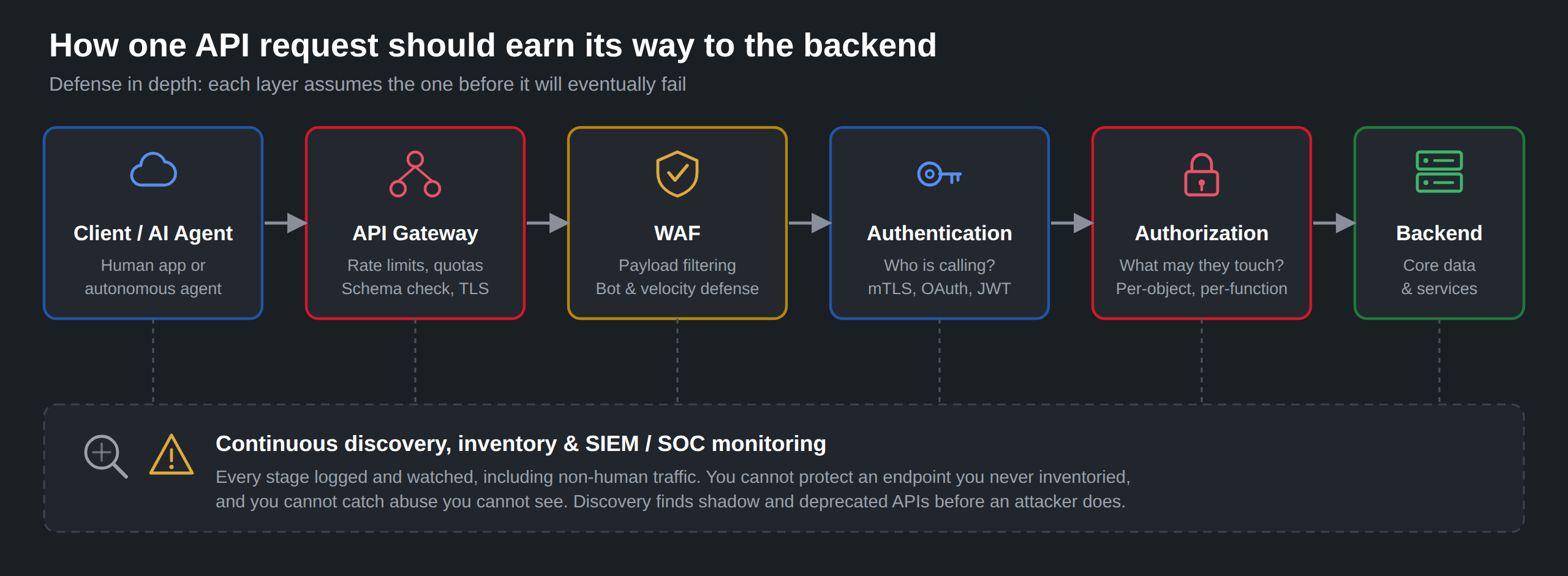
No single control secures an API. A web application firewall will not fix broken authorization logic, and perfect authorization code will not stop credential stuffing. The approach that survives contact with real traffic is layered, with each layer assuming the one in front of it will eventually fail. The diagram below shows how a single API request should be forced to earn its way to the backend.
The gateway is your control point, so use it
Every API of consequence should sit behind a managed gateway, not be exposed directly from the application server. The gateway is where you enforce the controls that do not belong in business logic: per-client rate limiting and quotas, request and response schema validation so malformed or oversized payloads are rejected before they reach code, TLS termination with modern ciphers, and consistent authentication. Pushing these into the gateway means they are applied uniformly, and a developer cannot forget to add them to a new endpoint. In banking work under PCI-DSS, we treat the gateway as an in-scope control and document it as such, because it is the boundary where cardholder-adjacent traffic is inspected and logged.
Authentication and authorization are two different jobs
Conflating identity with permission is the root of the BOLA and BFLA problems. Authentication answers who is calling. Use short-lived tokens, validate the signature, the issuer, the audience, and the expiry on every request, and prefer mutual TLS for service-to-service calls where you control both ends. Authorization answers what this caller is allowed to touch, and it has to run on every object and every function, at the resource level, inside the application, on the server. A caller proving they are a valid user tells you nothing about whether account 4471 is theirs. That check is code you have to write and test deliberately; no gateway does it for you, because only your application knows the ownership model.
Discovery before defense
You cannot secure what you have not inventoried, and improper inventory management is on the OWASP list precisely because most organizations do not have a current, accurate list of their own APIs. Continuous API discovery, watching real traffic to find endpoints that documentation missed, is the unglamorous foundation everything else rests on. Every shadow endpoint, every undocumented parameter, every deprecated version still answering requests is a control gap. We start API assessments here, not with a scanner, because the scanner only tests what you point it at.
The AI agent problem is an API problem
The reason API security moved up the board agenda in 2026 is autonomous agents. AI systems do their work by calling APIs, continuously, at machine speed, with credentials that often carry broad scope because whoever provisioned them wanted the agent to "just work." The security data on this is stark. Nearly half of organizations, 48.9%, say they cannot monitor machine-to-machine traffic at all and are effectively blind to non-human activity. A similar share, 48.3%, cannot reliably tell a legitimate AI agent from a malicious bot. Almost half have delayed production releases because they were not confident they could secure APIs exposed to autonomous systems.
The point worth internalizing is that securing AI does not start with the model. It starts with the APIs the model reaches through. An agent with an over-scoped token and no rate limit is a BOLA and resource-consumption incident waiting for a prompt that goes sideways. The controls that contain it are the ones above, applied with the assumption that the caller may be non-human, may be compromised, and will act far faster than a person could. That means scoped, short-lived credentials per agent, hard quotas, anomaly detection on machine traffic patterns, and the ability to revoke a single agent's access without taking down the platform. Boards have noticed: 78.6% of security leaders now report increased executive scrutiny of AI-related risk, and most of that risk lands on the API layer whether the org has named it that way or not.
Mapping controls to the real risks
It helps to lay the primary OWASP API risks against the control that actually addresses each one, and the layer where that control lives. Buying a single product almost never covers the column.
| OWASP API risk | Primary control | Where it lives |
|---|---|---|
| Broken Object Level Authorization (BOLA) | Per-object ownership checks on every request | Application code |
| Broken Authentication | Short-lived signed tokens, mTLS, audience validation | Gateway + identity provider |
| Broken Function Level Authorization | Role checks on every privileged function | Application code |
| Unrestricted Resource Consumption | Rate limits, quotas, payload size caps | API gateway |
| Sensitive Business Flow Abuse | Behavioral limits, bot and velocity detection | Gateway + WAF + monitoring |
| Security Misconfiguration | Hardening baselines, CIS Benchmarks, TLS enforcement | Platform + gateway |
| Improper Inventory Management | Continuous API discovery and versioning policy | Discovery tooling + governance |
| Unsafe API Consumption | Validate and constrain data from third-party APIs | Application code |
The compliance angle is not separate from the engineering
In regulated sectors the API is where compliance and engineering meet, and treating them as separate workstreams is how gaps open. PCI-DSS cares directly about how payment APIs authenticate, encrypt data in transit, log access, and segment cardholder data, requirements that map almost one-to-one onto the controls above. ISO 27001 frames it as access control, cryptography, and logging and monitoring objectives that your API architecture either satisfies or does not. NIST CSF gives you the identify-protect-detect-respond structure that makes API discovery, gateway enforcement, and SIEM integration parts of one story rather than three tools bought in isolation. CIS Benchmarks give you the concrete hardening baseline for the gateway, the container platform, and the operating system underneath.
When we ran a 50-plus server banking estate under Qatar Central Bank oversight against PCI-DSS, ISO 27001, CIS, and STIG at once, the work that made an auditor comfortable was not a pile of separate documents. It was showing that one set of API controls, enforced at the gateway and in code, and evidenced in the SIEM, satisfied all four frameworks together. Compliance became a byproduct of an architecture that was correct, rather than a parallel exercise in paperwork.
A practical order of operations
If you are starting from an estate that grew faster than its security did, which describes most fast-moving organizations, the sequence matters more than the tool list. This is the order we work in:
- Inventory everything. Discover live APIs from real traffic, not from documentation. Flag every shadow, deprecated, and unauthenticated endpoint. You cannot protect what you have not found.
- Put a gateway in front of everything. Route all external and sensitive internal APIs through a managed gateway and enforce TLS, authentication, rate limiting, and schema validation there.
- Fix authorization in code. Add per-object and per-function authorization checks server-side, and test them deliberately, including the "change the ID" case that scanners miss.
- Constrain machine identities. Give every service and every AI agent its own short-lived, narrowly scoped credential, with hard quotas and independent revocation.
- Instrument and watch. Feed API logs into a SIEM, build detection for machine-to-machine anomalies, and make sure the SOC can see non-human traffic, not just user sessions.
- Map to your frameworks. Tie each control to the PCI-DSS, ISO 27001, NIST CSF, or CIS requirement it satisfies, so the same work produces both security and audit evidence.
None of these steps is glamorous, and that is the point. The organizations that get breached through their APIs are almost never undone by something clever. They are undone by an endpoint nobody inventoried, an authorization check nobody wrote, and a token that never expired.
How Aydahwa Enterprise can help
Aydahwa Enterprise builds and hardens the API and cloud infrastructure that regulated, high-volume businesses run on. Our experience spans banking estates under central-bank and PCI-DSS oversight, global multi-tenant telecom SaaS platforms scaled across AWS, GCP, and Azure, and critical-infrastructure environments where downtime is not an option. We assess API estates against the OWASP API Security Top 10 and your applicable frameworks, design gateway and Zero Trust architectures that hold up under machine-speed traffic, and stand up the SIEM and monitoring that lets your team see non-human activity before it becomes an incident.
If you want to know where your own API surface stands, start with our free cybersecurity self-assessment or work through the cybersecurity readiness checklist. To go deeper, our cybersecurity services and cloud security and migration teams handle API assessment, gateway design, and compliance mapping as one engagement, and our managed IT support keeps those controls current as your platform grows. When you are ready to talk specifics, get in touch and we will scope it against your estate, not a template.