One API Call, A Dozen Trust Decisions
Think about what happens when a checkout page asks an internal API for a customer's order. To the developer it is one line of code. Underneath, the client resolves a hostname through DNS, which usually hands back the address of a load balancer rather than a specific server. The operating system decides how the packets leave the host. They cross a local network, maybe an ISP, maybe three or four routers, until they reach the destination. A TCP handshake sets up the connection, a TLS handshake secures it, and only then does the actual HTTP request go across. A load balancer picks a healthy instance, forwards the request, the service does its work, and the response comes back along the same path.
Every one of those hops is a place where something is trusted. The load balancer trusts that the caller is allowed to reach it. The service trusts that the load balancer already checked. The database trusts that the service in front of it did its job. In most networks we have audited over the years, nobody wrote those trust assumptions down. They were inherited from a network diagram drawn a decade ago, when everything that mattered lived inside one data centre and a firewall at the edge felt like enough.
That assumption is what Zero Trust exists to kill. And the place it lives or dies is not the login screen. It is the network layer, in the quiet machine-to-machine traffic that no user ever sees.
Why The Perimeter Model Ran Out Of Road
The classic design is castle-and-moat. Build a hard boundary, put a firewall and a VPN concentrator on it, and treat anything inside as friendly. For twenty years that was a reasonable trade. The applications were in your building, the users were at their desks, and the moat was the internet.
Three things broke it. Workloads moved to the cloud, so there is no single inside any more. Staff, contractors and managed-service partners connect from everywhere, so the VPN became a permanent fixture rather than an occasional bridge. And attackers learned that the moat only has to be crossed once. After an attacker phishes a laptop or exploits one exposed service, a flat internal network hands them the whole estate. The 2024 Verizon Data Breach Investigations Report has for years put stolen credentials and lateral movement at the centre of major intrusions, and in our own incident work the pattern is depressingly consistent: the initial foothold is small, the blast radius is enormous, and the reason is always the same. Once you are inside, the network trusts you.
A traditional VPN makes this worse than people expect. It authenticates a device once, drops it onto the corporate network, and then gets out of the way. From that moment the connection has broad reach and almost no ongoing scrutiny. We have spent a good part of the last decade unwinding exactly these setups for clients in banking and telecom, where a single over-privileged VPN tunnel was the difference between a contained incident and a regulator-reportable one.
What Zero Trust Means Where The Packets Actually Move
Zero Trust is not a product, and it is not a login prompt with more steps. NIST codified it properly in Special Publication 800-207, and the core idea is blunt: trust is never granted because of where a request comes from. Being on the corporate network, or inside the VPC, buys you nothing. Every request is authenticated, authorised and encrypted on its own merits, and access is granted for that request only.
Translating that into network terms means three concrete mechanisms have to be in place. They are not optional extras. If any one is missing, you have bought the marketing and skipped the architecture.
Identity, checked at a policy decision point
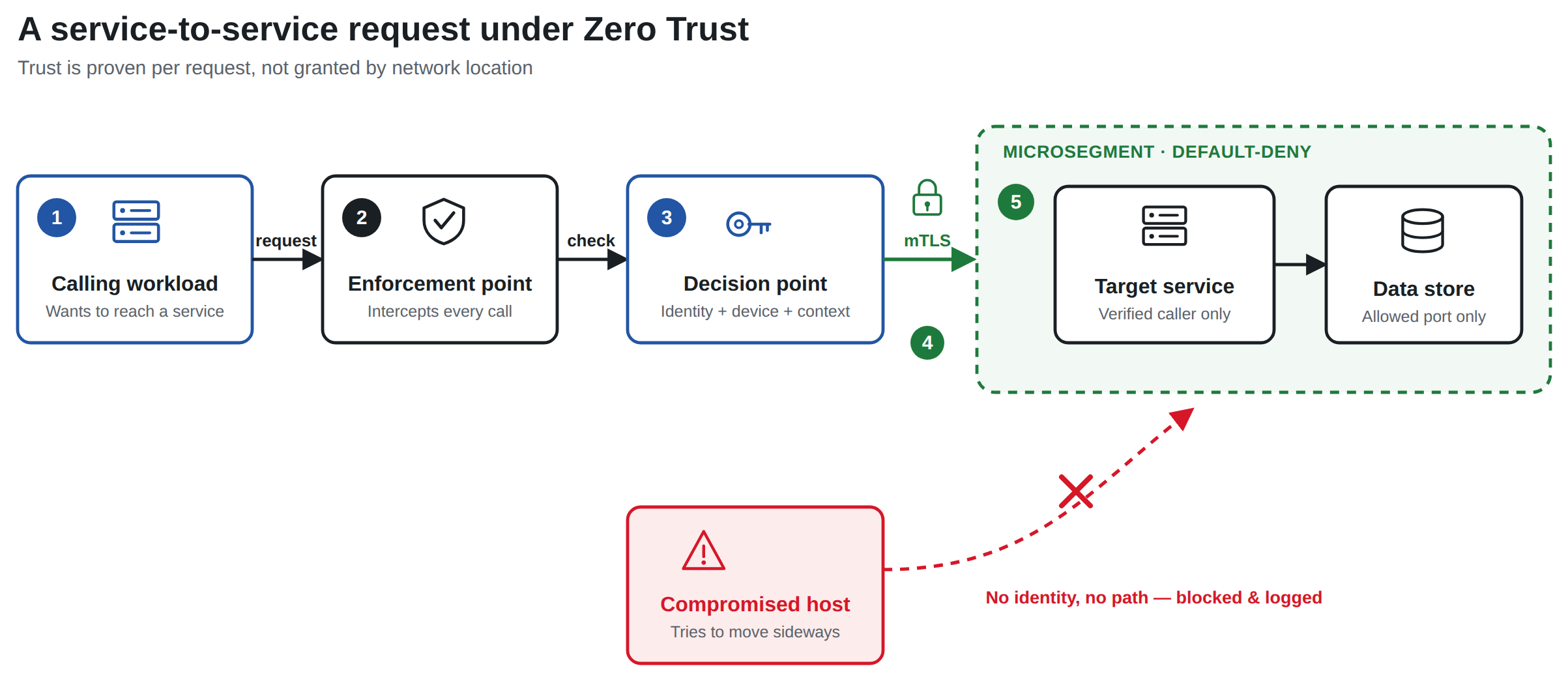
In an 800-207 design, requests pass through a policy enforcement point, and the decision to allow them is made by a separate policy decision point that evaluates identity, device posture and context every time. The enforcement point is the bouncer; the decision point is the manager who actually knows the rules. Crucially, this happens per request, not once per session. A workload that was allowed to reach the payments service at 09:00 is re-evaluated at 09:05, because the context, the token, or the device state might have changed.
mTLS and the identity of a service
Users are not the only things that need identity. Services do too. Mutual TLS is how a service proves who it is to another service, rather than relying on the fact that it happens to be calling from the right subnet. Instead of a network address as the credential, each workload carries a short-lived cryptographic identity, issued and rotated automatically. Frameworks like SPIFFE and SPIRE exist precisely to give workloads a verifiable identity that a policy engine can reason about. Once mTLS is in place, a compromised host cannot simply impersonate a trusted service by sitting in the right IP range.
Microsegmentation of east-west traffic
Most security spending has historically gone on north-south traffic, the flow between the internet and the data centre. The traffic that actually carries an attacker across your estate is east-west, service to service, inside the perimeter. Microsegmentation shrinks the zone of implicit trust down to the smallest workable unit, often a single workload, so that the order service can talk to the payments service on exactly the ports it needs and nothing else can talk to either. Done well, an attacker who lands on one host finds every neighbouring door locked and every attempt logged.
The diagram below traces a single service-to-service call through this model, and shows what happens when a compromised host tries to move sideways.
 Castle-And-Moat Versus Zero Trust, Side By Side
DimensionPerimeter / castle-and-moatZero Trust network
Basis for trust
Network location (inside = trusted)
Verified identity + device posture + context
When trust is evaluated
Once, at connection time
Continuously, per request
Service-to-service auth
Implicit, based on IP/subnet
Mutual TLS with short-lived workload identity
East-west traffic
Largely unrestricted
Microsegmented, default-deny
Remote access
Broad VPN tunnel onto the LAN
Per-application ZTNA broker
Blast radius of one compromise
Often the whole internal estate
Contained to one workload's allowed paths
Primary logging focus
Perimeter firewall
Every access decision, north-south and east-west
Retiring The Flat VPN: ZTNA And SASE
The remote-access half of this story is where most organisations feel the change first. Zero Trust Network Access replaces the broad VPN tunnel with a broker that grants access to a specific application, for a specific authenticated identity, and never exposes the wider network at all. The user reaches the one thing they are entitled to reach. Everything else stays invisible, which also means it stays unscannable by anything that lands on their device.
Bundle that with the networking and inspection stack and you get SASE, Secure Access Service Edge, which pushes policy enforcement out to the edge close to the user instead of hauling all traffic back to a central chokepoint. For distributed teams and multi-cloud estates, this is the difference between security that people route around and security that sits naturally in the path.
This is not a fringe idea waiting for validation, and the capital following it says as much. In May 2025 the Chinese zero-trust vendor Enlink closed its sixth funding round, and its EnSDP platform has been named in Gartner and IDC market reports for three consecutive years while ranking in the top two of its domestic market. What is worth noticing is not the vendor but the architecture the money is chasing: a single stack that folds identity authentication, network access, endpoint threat detection and data-leak prevention together, built on an SDP and SASE dual engine, with AI-driven behaviour analytics layered on top for anomaly detection. Analysts and investors are betting that identity-centric, software-defined network access is the default shape of enterprise security, not a niche. That matches what we see on the ground across the Gulf, where new build-outs increasingly start from a Zero Trust assumption rather than retrofitting one later.
Where Zero Trust Projects Actually Go Wrong
The failures are rarely about the concept. They are about execution, and they repeat.
The most common is a half-migration. A team stands up a shiny ZTNA broker for remote users, declares Zero Trust achieved, and leaves the east-west traffic inside the data centre exactly as flat as it was. The perimeter has moved a few metres; the lateral-movement problem is untouched. If an attacker still gets a free run once they are inside a workload, you have improved your remote access and very little else.
The second is certificate and identity lifecycle. mTLS is powerful right up until a certificate rotation job fails silently at 3am and a payment flow goes dark. Short-lived credentials are the correct answer, but they demand real automation and real observability. We have been called into more than one outage that was, at root, an expired workload certificate nobody was watching.
The third is logging that stops at the firewall. If your telemetry only covers north-south traffic, your SOC is blind to exactly the movement Zero Trust is meant to expose. Every access decision, including the machine-to-machine ones, needs to reach your SIEM in a form an analyst can actually query. Aligning that telemetry to a framework such as the NIST Cybersecurity Framework or the CIS Controls keeps it honest and audit-ready rather than a pile of logs nobody reads.
The fourth is treating compliance as the goal instead of a by-product. PCI-DSS has required network segmentation of the cardholder data environment for years, and a proper microsegmentation design satisfies that far more convincingly than a VLAN and a hopeful diagram. ISO 27001 controls around access management fall into place naturally once identity is doing the work. But if segmentation exists only to pass an audit, it will be built to the letter and bypassed in practice.
A Pragmatic Rollout Order
Zero Trust is not a weekend cutover, and any vendor who tells you otherwise is selling. The sequence that has worked for the estates we have migrated looks like this:
- Map the real traffic. Before touching policy, discover what actually talks to what, east-west included. You cannot segment flows you have not measured, and the map is almost always a surprise.
- Fix identity first. Consolidate to a strong identity provider with phishing-resistant MFA for people, and a workload identity scheme for services. Everything downstream leans on this.
- Replace remote VPN with per-application ZTNA. This is the highest-visibility win and it removes the broadest standing risk, the flat tunnel onto the LAN.
- Introduce mTLS between services, starting with the crown-jewel paths, payments and customer data, and automate certificate issuance and rotation from day one.
- Microsegment east-west traffic incrementally, moving from a default-allow to a default-deny posture one zone at a time, verifying against your traffic map as you go.
- Wire every access decision into the SIEM, map it to NIST CSF or CIS Controls, and rehearse the detections you now expect to see.
- Review and tighten on a schedule. Zero Trust policy that is set once and never revisited drifts back toward implicit trust as exceptions accumulate.
None of these steps require ripping out the network in one go. They are additive, and each one reduces risk on its own, which is what makes the programme survivable for a business that still has to keep trading while it changes.
How Aydahwa Enterprise Can Help
We have spent more than twenty-five years designing and securing infrastructure across banking, telecom and critical national infrastructure, which means we have built the flat networks Zero Trust replaces and we know exactly where the bodies are buried. Our work is grounded in real frameworks, not slideware: NIST SP 800-207, the NIST Cybersecurity Framework, ISO 27001, PCI-DSS and CIS Benchmarks, delivered by architects who hold credentials such as Microsoft Cybersecurity Architect Expert.
If you are weighing up a Zero Trust programme, our cybersecurity services cover the assessment, architecture and segmentation design; our cloud security and migration practice handles the ZTNA and SASE side for hybrid and multi-cloud estates; and our managed IT support keeps the certificate lifecycles, identity plumbing and telemetry running once the project is live. If you would rather start by understanding where you stand, the free cybersecurity self-assessment and the cybersecurity readiness checklist are a sensible first hour. When you are ready to talk specifics, get in touch and we will map your traffic before we recommend a single product.