DNS is the first thing that runs and the last thing anyone protects
Every connection your business makes starts with a DNS lookup. Before a payment clears, before a customer reaches your portal, before one microservice talks to another, a name has to resolve to an address. When that resolution is slow, wrong, or unavailable, none of the security controls layered above it get a chance to do their job. The request either lands somewhere it shouldn't, or it never lands at all.
We have built and operated DNS at national scale, including a nationwide high-availability resolution platform for a mobile carrier serving millions of subscribers across xDSL, 3G, and 4G networks. That work taught us something most security programmes learn the hard way: DNS is treated as plumbing until the day it takes the whole business offline, and by then the options are limited. This guide covers what enterprises get wrong about DNS, the attacks we see against it in real assessments, and the architecture and controls that keep it both available and trustworthy.
Why DNS falls through the cracks
DNS has an ownership problem. It sits at the seam between networking, infrastructure, security, and whoever registered the domain years ago on a corporate credit card. In many organisations we assess, no single team can say with confidence which authoritative provider serves a given zone, who holds the registrar login, or whether the account has multi-factor authentication enabled. The records themselves accumulate over a decade of product launches, marketing campaigns, and abandoned pilots, and nobody prunes them.
That neglect matters because DNS is simultaneously a critical dependency and an exposed attack surface. It is a dependency because everything downstream relies on it resolving correctly. It is an attack surface because the protocol was designed in an era that assumed a cooperative internet, and much of that trusting design is still in production. An attacker who controls or corrupts your DNS does not need to breach your firewall. They can simply point your name at their infrastructure and let your own customers walk in the door.
Every record type is also an exposure
The common record types are familiar to anyone who has run a zone file: A and AAAA map names to IPv4 and IPv6 addresses, CNAME aliases one name to another, MX directs mail, NS delegates authority, PTR handles reverse lookups, SRV advertises services, and TXT carries everything from SPF and DKIM policy to domain-verification tokens. What gets missed is that each of these records is also a piece of information you are publishing to the entire internet, and in some cases a lever an attacker can pull.
A dangling CNAME pointing at a decommissioned cloud bucket is an invitation for subdomain takeover. An overly broad SPF record weakens the email authentication it was meant to strengthen. A TXT record left over from a service you stopped using three years ago tells an attacker exactly which vendors you once trusted. Reverse (PTR) records and zone data leak internal naming conventions that make reconnaissance trivial. The zone file is not just configuration. It is a public map of your estate, and it should be reviewed with the same discipline you apply to an external firewall ruleset.
| Record type | Legitimate use | Security consideration |
|---|---|---|
| A / AAAA | Map a name to an IP address | Stale records point users at reassigned IPs an attacker may now control |
| CNAME | Alias one name to another | Dangling aliases to deprovisioned services enable subdomain takeover |
| NS | Delegate a zone to authoritative servers | Weak registrar or delegation controls allow full zone hijacking |
| MX | Route inbound mail | Tampering redirects mail; pairs with SPF, DKIM, and DMARC in TXT |
| TXT | SPF, DKIM, DMARC, verification tokens | Loose SPF and orphaned tokens weaken email trust and leak vendor history |
| CAA | Restrict which CAs may issue certificates | Missing CAA lets any CA issue a certificate for your domain |
The attacks we actually see
DNS threats are not theoretical, and they are not new. The techniques below account for the majority of DNS-related incidents we investigate or design against.
Registrar and account hijacking
The highest-impact attack rarely touches your DNS servers at all. It targets the registrar or DNS provider account. A phished administrator credential, a social-engineered support call, or a reused password from a breach dump gives an attacker control of the zone, and from there they can repoint records, reissue certificates, and intercept mail. The 2019 wave of state-linked DNS hijacking campaigns worked exactly this way. The defence is boring and effective: registrar lock, hardware-backed MFA on every account, a very short list of people who can make changes, and change alerting.
Cache poisoning and spoofing
Recursive resolvers cache answers for efficiency. If an attacker can inject a forged response before the legitimate one arrives, they poison that cache and every downstream client gets the wrong address until the record expires. Source-port randomisation and DNSSEC validation raise the cost of this attack substantially, which is why unvalidated resolvers remain a liability.
Subdomain takeover
When a team spins up a cloud service, points a subdomain at it with a CNAME, then tears down the service but forgets the DNS record, the name now resolves to infrastructure the provider can hand to anyone. An attacker claims that endpoint and serves content from your trusted subdomain. We find dangling records in almost every external assessment we run, and each one is a phishing page or cookie-theft vector waiting to be used.
Tunnelling and exfiltration
DNS is allowed out of nearly every network, which makes it an ideal covert channel. Malware encodes stolen data into query names and ships it out one lookup at a time, or uses DNS for command-and-control beaconing. Because the traffic looks like ordinary resolution, it slips past controls that never inspect it. Detecting it requires actually logging and analysing query patterns, which most organisations do not do.
Denial of service against authoritative servers
In 2016 a large managed DNS provider was knocked offline by a botnet, and with it went Twitter, Spotify, Reddit, and a long list of household names, none of which had been attacked directly. Their mistake was depending on a single DNS provider. If your authoritative DNS has one provider and that provider has a bad day, your business has a bad day, regardless of how resilient everything else in your architecture is.
| Attack | What it exploits | Primary controls |
|---|---|---|
| Registrar / account hijack | Weak account security at the registrar or provider | Registrar lock, hardware MFA, least privilege, change alerting |
| Cache poisoning | Unvalidated recursive responses | DNSSEC validation, source-port randomisation, trusted resolvers |
| Subdomain takeover | Dangling records to deprovisioned services | Record lifecycle process, regular zone audits, decommission checks |
| DNS tunnelling / C2 | Unrestricted, uninspected outbound DNS | Query logging, protective DNS with RPZ, anomaly detection in the SIEM |
| Authoritative DDoS | Single-provider dependency | Dual providers, anycast, secondary DNS, sensible TTLs |
Building DNS that stays up
Resilience in DNS is mostly about refusing to accept single points of failure, and DNS has more of them than teams expect. The registrar is one. The authoritative provider is another. The zone-signing key is a third. Resilient design removes each one as a way to take the service down.
For authoritative DNS on anything business-critical, we design for at least two independent providers serving the same zone, so the loss of either one degrades performance rather than causing an outage. Anycast puts copies of the authoritative servers in many locations, absorbing volumetric attacks and keeping latency low for a geographically spread user base. Secondary DNS keeps a warm copy of the zone with a second operator ready to answer. TTLs deserve deliberate thought as well: long TTLs reduce query load but slow down failover, while short TTLs give you agility at the cost of more traffic. The nationwide carrier platform we built ran authoritative and caching tiers on clustered infrastructure precisely so that a node, a site, or a link could fail without subscribers ever noticing a resolution gap.
Hardening the resolution path
Availability keeps DNS answering. Integrity makes sure the answers are true. DNSSEC is the mechanism that lets a resolver verify a response was signed by the zone owner and not forged in transit. It is worth doing, but it is not a checkbox. The signing keys are cryptographic material that belong in an HSM or a managed KMS, with rotation and rollover planned so a key event never breaks the zone. We treat DNSSEC key management with the same rigour as any other production key hierarchy, because a botched rollover fails the zone as completely as any attacker could.
Beyond signing, a few controls carry a lot of weight. CAA records constrain which certificate authorities may issue for your domain, closing off a whole class of mis-issuance. Protective DNS, using response policy zones, blocks resolution to known-malicious domains at the resolver, stopping malware before it ever reaches its command server. Split-horizon DNS keeps internal names off the public internet where they belong. Encrypted transport, DoH and DoT, protects queries from eavesdropping and tampering, though it cuts both ways: the same encryption that protects your users also lets malware and unmanaged devices bypass inspection, so enterprise resolvers should offer encrypted DNS on your terms rather than letting endpoints reach arbitrary external ones.
DNS as a detection source, not just a dependency
DNS query logs are one of the richest and most underused telemetry sources in the enterprise. Almost every meaningful action a host takes begins with a name lookup, which means resolver logs capture beaconing to command-and-control infrastructure, algorithmically generated domains, tunnelling, and connections to newly registered or low-reputation domains. Piping resolver and firewall DNS logs into a SIEM, then building detections for these patterns, turns a passive dependency into an active early-warning system. In our SOC design work we consistently find that DNS-based detections catch intrusions that endpoint tooling missed, because the malware still has to resolve a name before it can do anything useful. The one discipline this requires is retention: forensic value depends on having enough history to reconstruct what a compromised host was doing weeks before you noticed.
A reference architecture for secure, resilient DNS
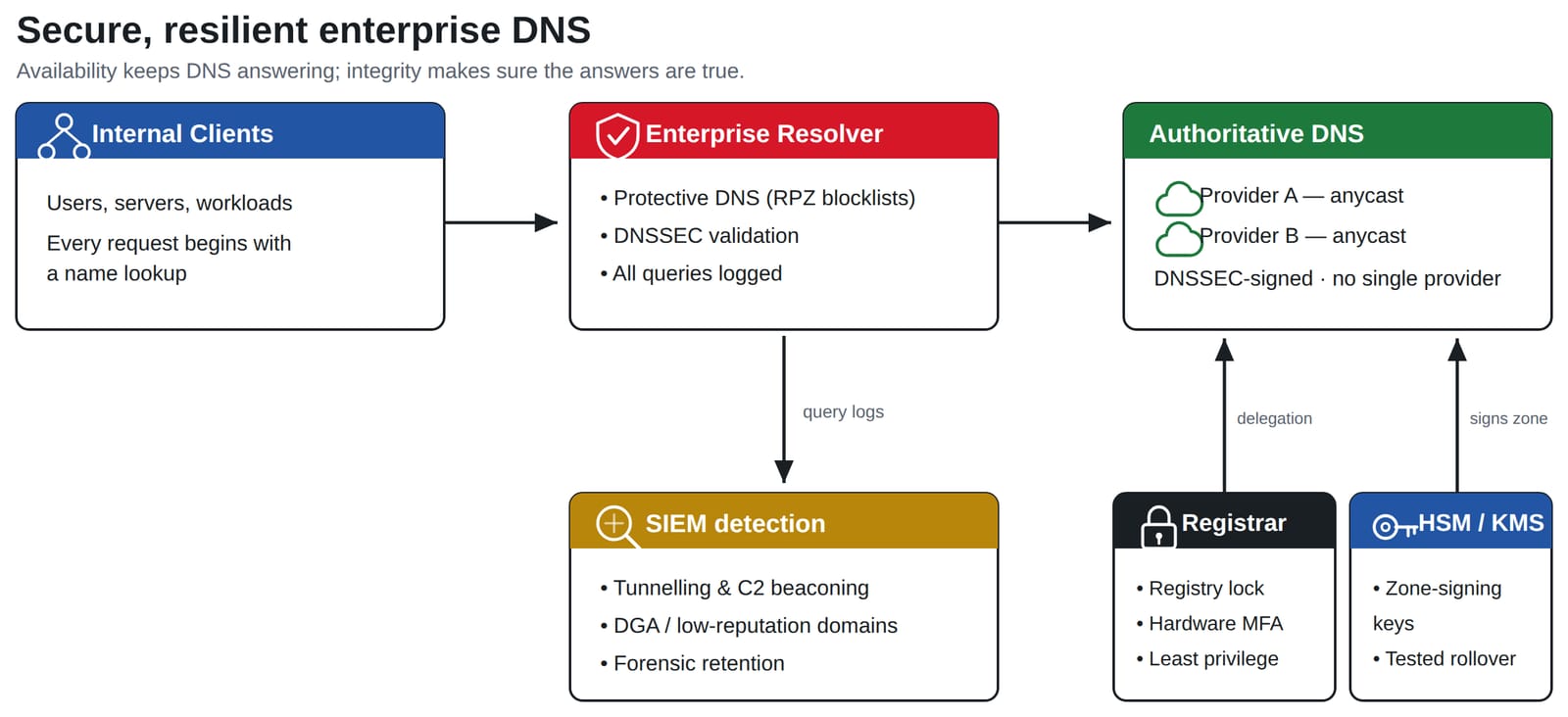
The pieces above fit together into a layered design. Internal clients resolve through hardened enterprise resolvers that enforce response policy zones and log every query to the SIEM. Public names are served by two independent authoritative providers using anycast, with the zone DNSSEC-signed using keys held in an HSM. The registrar account is locked and protected with hardware MFA. The diagram below shows how these controls sit along the resolution path.
A DNS security and resilience checklist
- Inventory every domain and zone, and confirm which team owns the registrar and provider accounts.
- Enable registrar lock and hardware-backed MFA on every registrar and DNS provider account, with least-privilege access.
- Serve business-critical zones from at least two independent authoritative providers, ideally with anycast.
- Audit zones on a schedule for stale, orphaned, and dangling records, and tie DNS cleanup to every decommission.
- Sign zones with DNSSEC, holding keys in an HSM or managed KMS with tested rollover procedures.
- Publish CAA records to restrict certificate issuance to your approved authorities.
- Deploy protective DNS with response policy zones to block malicious resolution at the resolver.
- Tune TTLs deliberately, balancing query load against failover speed for each record's role.
- Log all DNS queries to the SIEM, retain them long enough for forensics, and build detections for tunnelling, beaconing, and DGA activity.
- Enforce email authentication (SPF, DKIM, DMARC) and keep the underlying TXT records tight and current.
Where DNS controls map to the frameworks
These practices are not extras. They map directly onto the standards regulated organisations already answer to. NIST CSF covers DNS under asset management, protective technology, and continuous monitoring. ISO/IEC 27001 pulls it into network security controls and supplier management, since your DNS provider is a supplier your entire business depends on. PCI-DSS brings DNS into scope wherever it supports the cardholder data environment and its segmentation. CIS Benchmarks and Controls call out secure DNS configuration and DNS-layer filtering explicitly. Treating DNS as a governed control rather than background infrastructure is what turns an audit finding into an audit strength.
How Aydahwa Enterprise Can Help
Aydahwa Enterprise has designed and run DNS where downtime was measured against millions of subscribers and where regulators reviewed every control. We bring that operational experience to enterprises that need their name resolution to be both always available and always trustworthy, drawing on real credentials across banking, telecom, and critical national infrastructure, and against frameworks including ISO 27001, PCI-DSS, NIST CSF, and CIS Benchmarks.
Our cybersecurity services cover DNS hardening, DNSSEC deployment, protective DNS, and DNS-layer detection engineering as part of a broader defence-in-depth programme. Through our cloud services we architect resilient multi-provider DNS for cloud and hybrid estates, and our managed IT and support team keeps it running once it is in place. To gauge where you stand today, start with our free cybersecurity self-assessment and the cybersecurity readiness checklist. When you are ready to review your DNS architecture in depth, get in touch and we will walk through it with you.