
The exposure you don't know about is the one that gets you
Most breaches we investigate do not start with a clever zero-day. They start with something the organisation forgot it owned: a staging server left reachable from the public internet, an API gateway spun up for a three-week pilot and never decommissioned, an S3 bucket that a contractor made "temporarily" public in 2023. The attacker did not need to be brilliant. They needed to be patient, and they needed a list. For years, building that list took an adversary real time and effort. That part has changed.
Attackers now point machine-learning tooling at the same reconnaissance problem defenders have always struggled with, and they enumerate exposed assets faster than most internal teams can inventory their own estate. Entrust reported that account takeover fraud alone was responsible for 31% of fraud losses, much of it driven by automated, AI-assisted credential and identity attacks. Anthropic, in a June 2026 letter to the US Senate Banking Committee, alleged a large-scale model-extraction campaign against its Claude system, a reminder that even a company's AI models are now part of the surface an adversary probes. When the people trying to break in have automation on their side, running an annual vulnerability scan and calling it asset management is no longer a defensible position.
This is where attack surface management, or ASM, stops being a buzzword on a vendor slide and becomes an operational discipline. We want to walk through what an attack surface actually consists of in 2026, what genuinely changes when attackers use AI, what the market data says about where the tooling is heading, and a practical lifecycle you can put in place without a seven-figure budget.
What your attack surface really contains now
Ask a network engineer to describe the attack surface a decade ago and you would hear about IP ranges, open ports, and a handful of public websites. That inventory was finite and mostly static. You could put it in a spreadsheet and it would still be roughly correct six months later. The estates we assess today do not behave that way.
A realistic modern attack surface includes public IPs and DNS records, yes, but also REST and GraphQL APIs (frequently undocumented), container images and orchestration endpoints, serverless functions, mobile apps and their backend calls, SaaS tenants configured by individual departments, third-party integrations with standing OAuth tokens, IoT and OT devices on flat network segments, and the data itself sitting in object storage. IDC, in its 2024 study of the attack surface management market, made the same point from the vendor side: beyond traditional IT assets like IPs, websites, and ports, mobile apps, mini-programs, APIs, containers, IoT devices, and enterprise data have all become internet-facing exposures that most organisations do not track well.
The category that catches almost everyone is shadow IT. A marketing team stands up a landing page on a cloud account nobody in security knows about. A developer opens a database port to debug a production issue on a Friday evening and forgets to close it. A subsidiary acquired last year still runs its own perimeter with its own forgotten hosts. None of these appear in the official CMDB, and every one of them is a live entry on the list an attacker is building. In our engagements across the UAE and wider GCC, the first external discovery pass almost always surfaces assets the client did not know were exposed. That gap between what you think you own and what is actually reachable is the real problem ASM exists to close.
What changes when the attacker has AI
It would be easy to overstate this. AI has not handed adversaries some magic skeleton key, and anyone selling that story is selling fear. The honest version is more specific and, in some ways, more concerning because it is grounded in ordinary economics: AI collapses the cost and time of the tedious work that used to slow attackers down.
Reconnaissance at machine speed
Enumerating an organisation's exposed footprint, correlating a leaked credential to a live login portal, fingerprinting software versions across thousands of hosts, and writing a plausible spear-phishing message tailored to a specific finance clerk all used to require analyst hours. Automated tooling now does the enumeration continuously, and generative models draft the social-engineering content at scale. The window between an asset becoming exposed and an attacker finding it has shrunk from weeks to, in some cases, hours. A quarterly scan cadence assumes an attacker who is also working quarterly. That assumption is gone.
Identity as the front door
The Entrust figure is worth sitting with: nearly a third of fraud losses tied to account takeover. AI makes credential-stuffing and identity spoofing both cheaper and more convincing, which is precisely why banks are moving on it. The UK Finance digital ID pilot, backed by Barclays, HSBC, Lloyds, NatWest, Santander and Nationwide, is a consent-led identity service aimed squarely at cutting exactly this kind of fraud. For most of our clients the lesson is narrower and immediate: your identity provider, your SSO endpoints, and your MFA configuration are part of the attack surface, and they deserve the same scrutiny as any exposed server.
Your models are now assets too
If your organisation has started deploying its own AI systems, whether a customer-facing assistant or an internal copilot, those models and their APIs are now part of what you have to defend. The distillation and model-extraction claims making news this year point to a surface that did not exist in most threat models two years ago: prompt-injection paths, unguarded inference endpoints, training data that can be leaked back out. You do not need to solve all of this at once, but you do need to add it to the inventory rather than pretend it sits outside security's remit.
The tooling market is consolidating around automation
The direction of the ASM market tells you what practitioners are actually buying, and it lines up with what we see in the field. IDC sized the China attack surface management market at 1.02 billion RMB for 2024, up 13.5% year on year, with vendors such as NSFOCUS, 360, Vul.Ai, DAS-Security and Chaitin Tech competing for share. The specific numbers matter less than the trend they represent, and that trend is a shift from point-in-time scanning toward continuous, automation-driven discovery.
IDC's analysts were direct about where the technology is going. Automation and intelligence are the core development direction: providers are folding AI agents into the workflow for risk assessment, incident and intelligence interpretation, automated remediation suggestions, and report generation, all with the goal of cutting the manual labour in security operations. Just as important, they noted that ASM is no longer sold as an isolated product. It is increasingly a capability that has to integrate with SIEM and SOC platforms, XDR, asset-security-management systems, and situational-awareness tooling. That last point is the one most buyers underweight. An ASM tool that produces a list nobody operationalises is shelfware. The value shows up only when discovery feeds detection and response.
A practical ASM lifecycle you can actually run
You do not need to buy the most expensive platform on the market to get most of the benefit. What you need is a repeatable loop that runs continuously rather than annually. We structure it in four stages, and we treat it as a closed loop because the estate never stops changing.
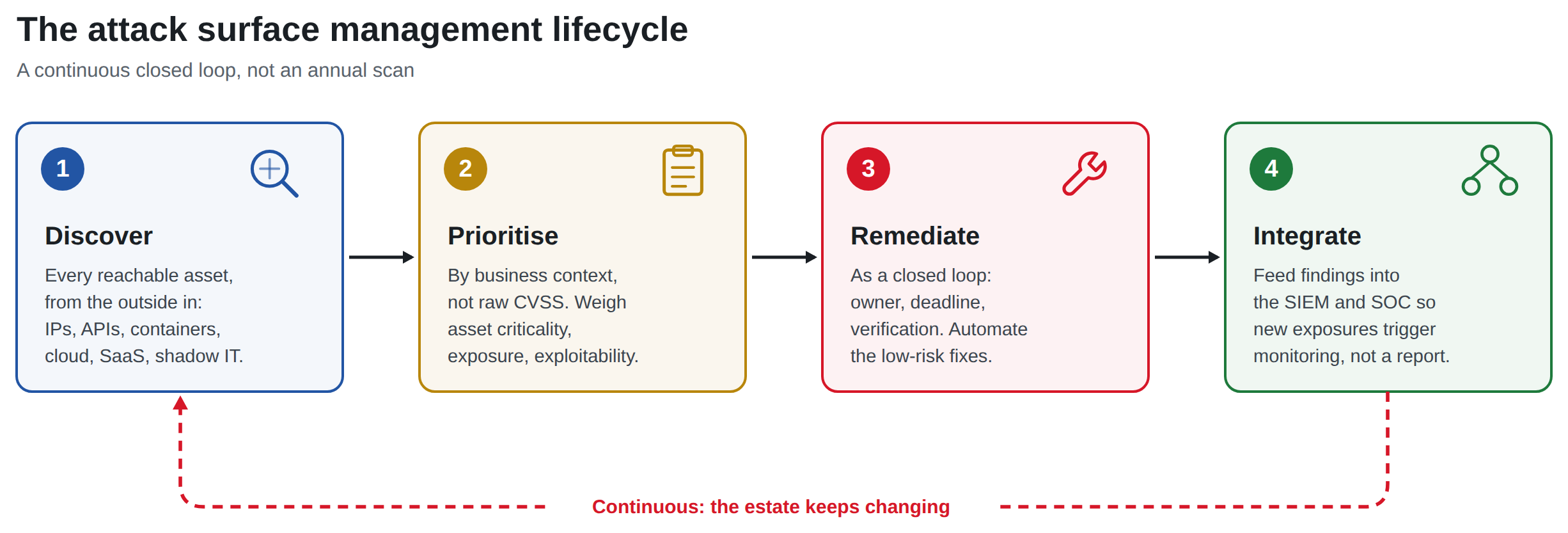
1. Discover everything reachable, from the outside in
Start where the attacker starts: outside your perimeter. External attack surface management (EASM) tooling and open techniques both apply here. Passive sources like Censys and Shodan, certificate-transparency logs, DNS enumeration, and disciplined use of nmap against your own ranges will surface far more than most teams expect. The goal is a live inventory of every asset that responds to the public internet, refreshed continuously, not a snapshot. Pair the outside-in view with an inside-out one using cyber asset attack surface management (CAASM) approaches that pull from cloud provider APIs, your CMDB, and endpoint tooling, so you can reconcile what is exposed against what you believe you own.
2. Prioritise by business context, not raw CVSS
A list of ten thousand findings sorted by CVSS score is close to useless. A high-severity vulnerability on an isolated test box matters far less than a medium-severity one on the payment gateway. Prioritisation has to weigh asset criticality, exploitability, and exposure together. IDC made this same point: ASM must evaluate asset criticality and prioritise vulnerabilities based on business scenarios, visualising asset and risk distributions so teams can immediately see high-value assets and high-risk vulnerabilities. In practice this means tagging assets by the business function they serve and by the data they touch, so the queue reflects real risk rather than scanner noise.
3. Remediate as a closed loop, not a ticket dump
Discovery without remediation is just anxiety with better dashboards. Every finding needs an owner, a deadline, and a verification step that confirms the fix actually landed. For repetitive, low-risk issues, such as a misconfigured header or a needlessly open port, automated remediation scripts (validated first in a controlled environment) take the load off the team. For anything touching production or high-value data, a human still signs off. The point is that the loop closes: an issue is found, assigned, fixed, and re-checked, and the inventory updates to reflect reality.
4. Integrate findings into detection and response
This is the stage that separates a real programme from a compliance exercise. ASM output should flow into your SIEM and SOC so that a newly discovered exposed asset triggers monitoring, not just a line in a report. When your detection team knows an asset exists, they can watch it. When they do not, that asset is a blind spot no matter how good the tooling around it is. Feeding discovery into detection is what turns a list into defence.
How this compares to what most teams do today
The gap between traditional vulnerability management and a modern ASM approach is not subtle once you lay it out.
| Dimension | Traditional vulnerability scanning | Continuous AI-driven ASM |
|---|---|---|
| Cadence | Quarterly or annual scans | Continuous discovery, near real-time |
| Scope | Known IPs and hosts in the CMDB | All reachable assets, including shadow IT, APIs, containers, SaaS |
| Prioritisation | Raw CVSS severity | Business criticality, exploitability and exposure combined |
| Remediation | Ticket handed off, often unverified | Closed loop with ownership, automation for low-risk fixes, verification |
| Integration | Standalone report | Feeds SIEM, SOC and XDR for active monitoring |
| Assumed adversary | Works on the same slow cadence you do | Automates reconnaissance and finds exposures in hours |
Where compliance and ASM reinforce each other
For clients working toward or maintaining certification, ASM is not a separate cost centre. It is the evidence engine for control requirements they already have to meet. ISO/IEC 27001 Annex A asks for an inventory of information and associated assets and clear ownership of them; a continuous discovery loop is how you actually satisfy that rather than maintaining a spreadsheet that drifts out of date within a month. The NIST Cybersecurity Framework's Identify function is, in large part, asset and exposure management by another name. The CIS Critical Security Controls put inventory and control of enterprise assets and software as Controls 1 and 2, the foundation everything else rests on, precisely because you cannot protect what you cannot see. And for anyone handling cardholder data, accurate scoping under PCI DSS depends entirely on knowing which systems are in scope, which is impossible without knowing what exists. Run ASM well and your audits get easier, because the inventory the auditor asks for is already live and defensible.
A starting checklist
If you are building this from a standing start, this is the order we recommend:
- Run an external discovery pass from outside your perimeter and reconcile it against your CMDB. Expect surprises.
- Extend discovery into your cloud accounts via provider APIs, and include APIs, containers, and SaaS tenants, not just servers.
- Tag every asset with a business owner and a criticality rating tied to the data it handles.
- Replace annual scanning with a continuous or at least monthly discovery cadence.
- Prioritise remediation by business impact and exploitability, not by CVSS alone.
- Define a closed-loop remediation process with owners, deadlines, and verification.
- Pipe discovery output into your SIEM and SOC so new exposures trigger monitoring.
- Add your identity endpoints and any deployed AI models to the inventory explicitly.
- Map the whole programme to your compliance obligations so it does double duty as audit evidence.
How Aydahwa Enterprise can help
We build and operate attack surface management programmes for organisations across the UAE and GCC, from the first external discovery pass through to continuous operation integrated with a working SOC. Our team brings hands-on infrastructure and security architecture experience across banking, telecom, and critical national infrastructure, along with certifications spanning ISO 27001, PCI DSS, SOC 2, NIST CSF, CIS Benchmarks, and Microsoft Cybersecurity Architect Expert, so the programme we design maps to both your threat model and your compliance obligations.
If you want to know where you stand before committing to anything, start with our free cyber security self-assessment or work through the cybersecurity readiness checklist. When you are ready to close the gaps, our cybersecurity services cover ASM, SOC/SIEM, and incident response, our cloud services team handles exposure across AWS, Azure, and GCP estates, and our managed IT support keeps the loop running day to day. To talk through your specific environment, get in touch and we will start with a discovery pass so the conversation is grounded in what is actually exposed, not what a brochure assumes.