The SIEM you buy is not the SIEM you get
A SIEM platform arrives as a promise: collect everything, correlate it, and surface the handful of events that matter before an attacker does real damage. Six months after the purchase order, a lot of security teams are looking at a different reality. The tool is ingesting terabytes, the licensing bill has doubled, analysts are muting alerts they no longer trust, and nobody can say with confidence whether the last suspicious login was caught or missed. The technology worked exactly as sold. The deployment failed anyway.
We've seen this pattern repeat across banking, telecom, and critical-infrastructure environments in the GCC, and the cause is almost never the product. Security information and event management has moved well past simple log aggregation. Cyber Magazine's 2026 roundups of leading SIEM platforms describe the current generation as the "central nervous system" for security operations, using machine learning and increasingly agentic AI to correlate telemetry across cloud, endpoint, and network in near real time. That capability is real. But a nervous system with no one trained to read its signals, and no muscles wired to respond, is just an expensive monitor. This is a guide to closing that gap, from selecting the right platform and deployment model to running it so it actually detects threats.
Where a SIEM fits in your security program
A SIEM sits at the detection and response layer of a security program. It collects log and event data from across the estate, normalizes it into a common format, correlates events against detection rules and behavioral baselines, and raises alerts for a human or an automated playbook to act on. That places it squarely inside the "Detect" and "Respond" functions of the NIST Cybersecurity Framework 2.0, and it is the practical engine behind several compliance obligations that regulated firms cannot avoid.
Three of those obligations show up in almost every engagement. ISO/IEC 27001:2022 expects logging and monitoring under Annex A controls 8.15 and 8.16, with evidence that events are recorded, protected, and reviewed. PCI-DSS v4.0 Requirement 10 is explicit about tracking and monitoring all access to cardholder data and system components, including daily log review and at least twelve months of retention. And CIS Controls v8 dedicates an entire control (Control 8) to audit log management. A SIEM is how most organizations satisfy all three at once, which is why the buying decision usually gets framed as a compliance line item. That framing is where the trouble starts, because a box-ticking SIEM and a threat-detecting SIEM are configured very differently.
Why most deployments underperform
The failure modes are consistent enough that you can predict them before a project kicks off.
Everything gets logged, nothing gets tuned. The instinct to "collect it all" feels safe and satisfies auditors, but raw volume without detection engineering produces noise, not visibility. Ingesting a firewall's every accept event while never writing a rule to catch lateral movement means paying premium licensing to store data you never query.
Detections ship at the default and stay there. Out-of-the-box correlation rules are a starting point calibrated for a generic environment, not yours. Left untuned, they generate false positives that train analysts to close alerts on reflex. The first real intrusion lands in the same queue as the thousandth false alarm.
There is no response wired to the detection. An alert that fires into an inbox nobody owns is not detection in any meaningful sense. Without runbooks, ownership, and an escalation path, mean time to respond is measured in the days it takes someone to notice, not the minutes the SIEM bought you.
Nobody staffs the thing. A SIEM assumes a security operations function behind it. Buying the platform without the analysts, or without a partner to run it, is the single most common reason a six-figure investment sits idle. Alert fatigue then finishes the job, as a small team stops reading a feed it can't keep up with.
Every one of these is an operating decision, not a product defect. That is good news, because operating decisions are the part you control.
Self-managed, co-managed, or outsourced: pick the model before the product
The most consequential choice is who runs the platform day to day, and it gets decided long before the vendor logo on the dashboard matters. Get the operating model wrong and even the best tool underperforms; get it right and a mid-tier SIEM outruns a premium one that nobody operates.
| Model | Who operates it | Control & customization | Cost shape | Best fit |
|---|---|---|---|---|
| Self-managed SIEM | Your in-house SOC | Full control over data, rules, and retention | High fixed cost: licensing plus a staffed 24/7 team | Larger enterprises with an existing SOC and strict data-residency needs |
| Co-managed SIEM | Shared between your team and a provider | You keep tenancy and policy; the provider tunes and monitors | Predictable subscription plus internal oversight | Regulated mid-market firms that want control without a full night shift |
| Managed detection & response (MDR) | An external SOC on your behalf | Lower day-to-day control, faster time to value | Operating expense, priced per asset or data volume | Lean teams needing 24/7 coverage quickly |
For most regulated mid-market organizations in the region, co-managed is the pragmatic middle. It keeps the log data and the compliance evidence inside your tenancy and jurisdiction, which matters for data-residency rules, while handing the relentless work of tuning, threat hunting, and after-hours triage to a team that does it every day. The decision should be made and documented before anyone sits through a product demo, because it changes which platforms even belong on your shortlist.
How to choose the platform
Once the operating model is set, the product evaluation gets far more focused. These are the criteria that actually separate platforms in practice, rather than the feature checkboxes every vendor can tick.
- Licensing model. SIEM pricing is usually tied to data volume (GB per day or events per second) or to the number of assets or users. Volume-based pricing punishes the "log everything" instinct and rewards disciplined source selection; asset-based pricing is more predictable but can be costly in high-device environments. Model your real ingest before signing, not the vendor's sample.
- Cloud and SaaS coverage. Your logs increasingly originate from Microsoft 365, AWS, Azure, GCP, and dozens of SaaS apps. Confirm native, supported connectors for the platforms you actually run, and check how cloud audit logs are priced, because they can dwarf on-premises volume.
- Detection content and MITRE ATT&CK mapping. A platform is only as good as its detections. Favor vendors that ship maintained, ATT&CK-mapped rule content and make it straightforward to write and version your own.
- Behavioral analytics (UEBA). Signature rules miss novel and insider activity. User and entity behavior analytics that baselines normal and flags deviation is where the machine-learning capability earns its keep, if it is tuned to your environment.
- Automation and SOAR. Look for built-in or tightly integrated orchestration so common responses (isolate a host, disable an account, enrich an alert) can run as playbooks rather than manual steps.
- Retention and search performance. Compliance sets a floor (PCI-DSS wants a year), but investigations need fast search across that window. Cheap cold storage you can't query quickly is a false economy during an incident.
Follow the data through the pipeline
Understanding how an event travels from a log source to a resolved incident makes it obvious where deployments break. The pipeline below is the shape every SIEM implements, whoever the vendor is. Weakness at any stage caps everything downstream: poor source selection starves correlation, and strong correlation with no response wired in still leaves the incident open.
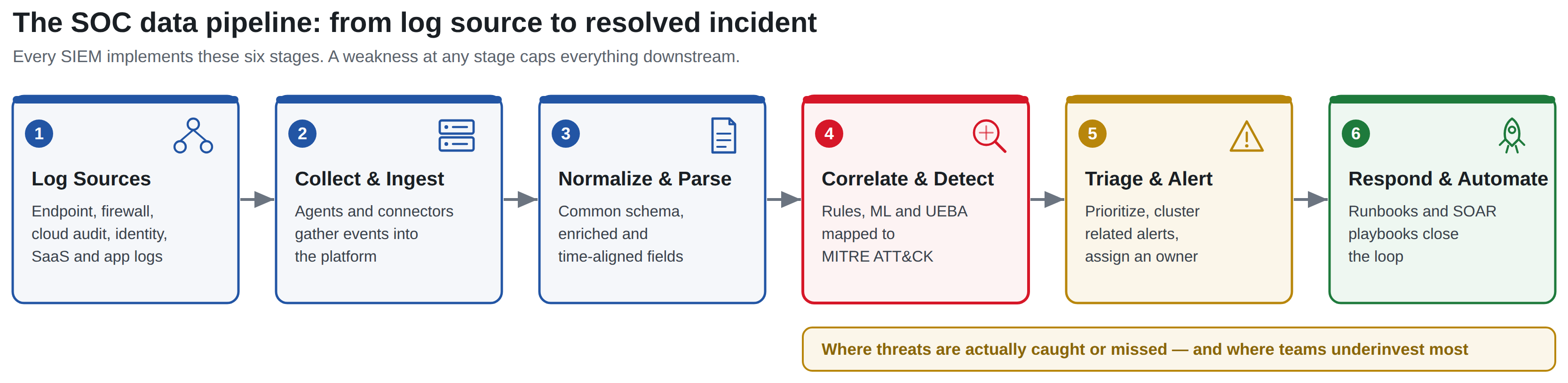
The stages that teams underinvest in are almost always the last two. Collection and storage are where budget goes because they are easy to specify. Correlation, triage, and response are where threats are actually caught or missed, and they depend on tuned detections and trained people far more than on the size of the license.
What AI actually changes, and what it doesn't
The 2026 marketing around SIEM leans hard on autonomous, agentic AI that promises to run the SOC on its own. There is a real capability underneath the pitch. Machine learning genuinely helps correlate high-volume telemetry, cluster related alerts into single incidents, and surface behavioral anomalies that static rules never would. Used well, it cuts the noise that drives analyst burnout and shortens the path from signal to decision.
What it does not do is remove the need for engineering and judgment. An AI model correlating events is only as trustworthy as the data feeding it and the detections framing it, and it will confidently escalate garbage if you feed it garbage. The same automation that can isolate a compromised host can isolate a production database if a playbook is careless. Treat AI features as a force multiplier for a well-run SOC, not a substitute for one. The organizations getting value from agentic SIEM capabilities are the ones that already had tuned detections, clean data sources, and response runbooks. AI made a working system faster; it did not rescue a broken one.
A phased rollout that actually lands
The difference between a SIEM that pays for itself and one that becomes shelfware usually comes down to sequencing. Trying to onboard every log source and enable every rule on day one is how projects stall. This order has worked repeatedly in our engagements.
- Scope the crown jewels first. Identify the systems whose compromise would actually hurt: the cardholder environment, domain controllers, core banking or billing systems, privileged identity infrastructure. Everything else is secondary.
- Onboard the highest-value log sources. Start with authentication, endpoint detection, firewall, and cloud audit logs for those crown-jewel systems. Resist the urge to boil the ocean; a focused feed you understand beats a complete feed you don't.
- Build detections mapped to MITRE ATT&CK. Prioritize the techniques most relevant to your threat model, banking fraud and credential abuse for a financial institution, and write or adapt detections for them explicitly.
- Tune relentlessly for the first ninety days. Treat false positives as bugs. Every alert that fires should be either actionable or suppressed with a documented reason. This is the phase most teams skip and later regret.
- Wire response into the detections. Attach runbooks and, where safe, SOAR playbooks so a fired alert has a defined owner and next action. An alert without a response plan is an unfinished detection.
- Measure MTTD and MTTR, and keep measuring. Mean time to detect and mean time to respond are the numbers that tell you whether any of this is working. Track them from the start and review them against real incidents and tabletop exercises.
Run this loop continuously rather than treating go-live as the finish line. Threats change, your estate changes, and detections decay; a SIEM is a program you operate, not a project you close.
How Aydahwa Enterprise can help
We build and run detection capabilities for organizations that carry real regulatory weight, banking, telecom, and critical national infrastructure among them, where a missed alert has consequences well beyond an audit finding. Our approach starts with the operating model and the crown-jewel scoping described above, not with a product demo, so the platform you end up with fits the team and the obligations you actually have.
That work is grounded in recognized standards and credentials: ISO/IEC 27001 information security management, PCI-DSS and SOC 2 assurance, the NIST Cybersecurity Framework, and CIS Benchmarks for hardening, led by practitioners holding certifications including the Microsoft Cybersecurity Architect Expert. Whether you need a co-managed SOC, help selecting and tuning a SIEM, or an honest assessment of where your current detection coverage has gaps, we can meet you where you are.
A good first step is to understand your current posture. Our free cybersecurity self-assessment and cybersecurity readiness checklist give you a quick, structured read on where you stand. From there, explore our cybersecurity services and managed IT support, or get in touch to talk through a SIEM or SOC engagement scoped to your environment.