The Foxconn breach and the question every board should be asking
When the Nitrogen ransomware group hit Foxconn earlier this year, the attackers claimed to have walked away with eight terabytes of confidential data. The headline wrote itself: another manufacturing giant, another extortion note. But the number that matters in a case like that is rarely the size of the leak. It is how long the business was down, whether the backups came back clean, and how much of the recovery had been rehearsed before anyone picked up the phone.
We spend most of our security budgets trying to keep attackers out. That work is necessary and it will never be finished. The uncomfortable truth from the last two years of incident data is that prevention alone stopped being the deciding factor a while ago. CrowdStrike's 2026 Financial Services Threat Landscape report describes AI-assisted intrusion tooling that compresses the time from initial access to encryption into hours, and it names financial services as one of the most heavily targeted sectors on the planet. For banks, utilities, and the vendors that serve critical national infrastructure, the interesting question is no longer only "can we be breached." It is "when someone gets in and reaches for the encrypt button, what happens next."
That question has an architecture behind it, and most of the answer is decided long before the incident. This article walks through the recovery design we build for clients in banking and critical infrastructure across the UAE and wider GCC, the numbers that justify each decision, and a checklist you can hold your own environment against.
Why prevention budgets grew and recovery stayed broken
Look at where the money went. Endpoint detection, email filtering, identity providers, and threat intelligence feeds have all matured. Recovery capability, in a lot of organisations, did not keep pace. The result shows up clearly once an attack lands.
Sophos found that only 54% of ransomware victims restored encrypted data from backups in 2025, the lowest figure in six years. Payment did not fill the gap either. Fortinet reported that just 4% of organisations that paid a ransom got all of their data back, and Halcyon's Q4 2024 data showed 84% of paying victims failed to fully recover. Paying is not a recovery plan. It is a receipt for a decryption tool that half-works.
The reason backups underperform is that attackers learned to go after them first. Veeam's data protection research found that 96% of ransomware attacks target backup repositories, and 76% of those attempts succeed at compromising at least some backup data. Sophos measured it independently and put the figure at 94% of attacks reaching for backups, with 39% resulting in complete backup loss. If your recovery plan is a backup job the attacker can see, authenticate to, and delete on their way through the domain, you do not have a recovery plan. You have a second target.
The cost curve makes the point in currency. Sophos put the median recovery at $375,000 when backups came through intact, and $3 million when they were compromised. That is an eight-fold multiplier that turns entirely on whether one part of your architecture held. The average recovery bill excluding any ransom sat at $1.53 million in 2025, and IBM's Cost of a Data Breach figure for total incident cost reached $5.08 million once downtime, legal, and remediation were counted. Average downtime after a ransomware event is still measured in weeks, roughly 24 days by most 2025 tallies. For a payments processor or a grid operator, 24 days is not a line item. It is an existential event.
The rule underneath a recovery that holds: 3-2-1-1-0
The old 3-2-1 backup rule, three copies of data on two types of media with one copy offsite, was written for a world of failing hard drives and floods, not adversaries who authenticate into your backup console. The version we deploy now extends it to answer ransomware directly. It is usually written as 3-2-1-1-0, and each digit earns its place.
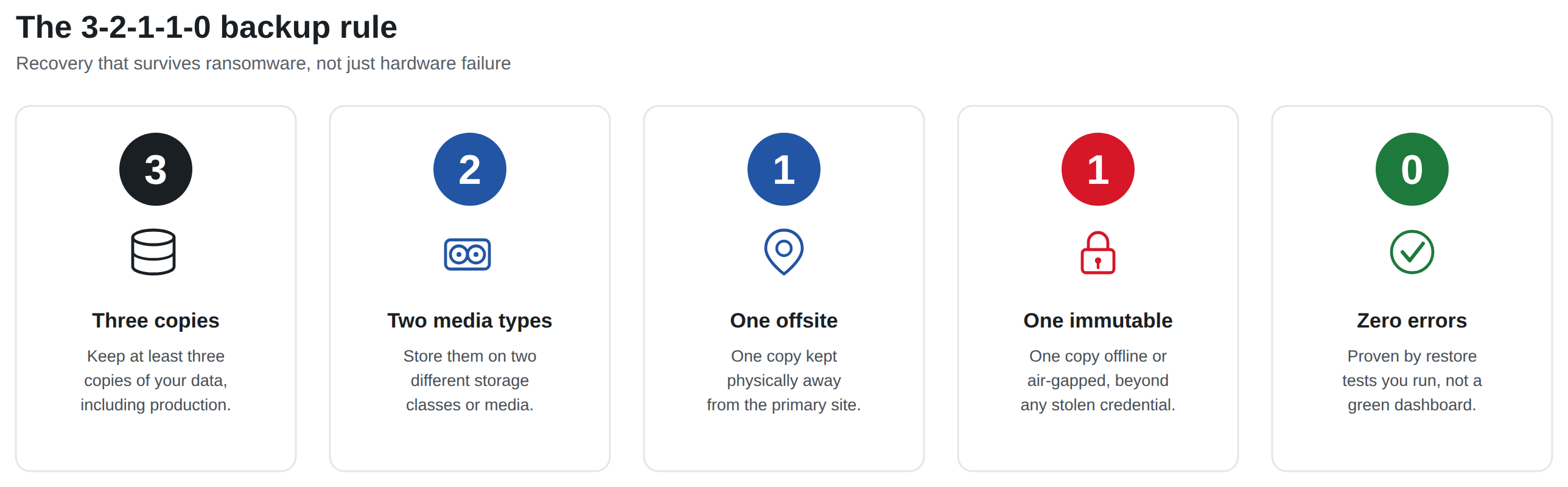 The first three digits are the classic discipline: keep at least three copies of your data, store them on two different media or storage classes so a single technology failure cannot take all of them, and keep one of those copies physically offsite. The two additions are what make it survive a modern attack. The extra "1" means one copy is kept offline or immutable and air-gapped, out of reach of any credential an attacker can steal inside your production domain. The "0" means zero recovery errors, proven by restore testing that you actually run, not a green backup dashboard you glance at.
Two of those five elements do the heavy lifting against ransomware, and they are worth separating out because teams frequently conflate them.
Immutability is not the same as encryption
An immutable backup uses write-once-read-many storage or object-lock so that, once written, a copy cannot be altered or deleted until a defined retention period expires, not by an administrator, not by a compromised service account, not by the ransomware operator holding domain admin. Cloud object storage with governance and compliance lock modes, purpose-built immutable appliances, and hardened Linux repositories with immutability flags all achieve this. The detail that catches people out is retention. An immutable copy with a seven-day lock is useless against an attacker who dwells for three weeks before triggering, which is a common pattern. Set the lock to cover your realistic detection window with margin.
Air-gap means the attacker's credentials do not reach it
An air gap can be physical, such as tape rotated out of the library, or logical, such as a backup target in a separate account or tenant with its own identity plane, no trust relationship to production, and network paths that are closed by default. The principle is the same in both forms. The identity that an attacker compromises to encrypt production must not be an identity that can also reach, authenticate to, or manage the protected copy. In cloud environments we build this with a dedicated backup account, separate credentials held outside the production identity provider, and object-lock that even the account's own root cannot shorten.
What a backup that survives ransomware actually looks like
The difference between a backup estate that saves you and one that becomes the attacker's second win is concrete, not philosophical. Here is the comparison we walk clients through.
Design elementBackup that fails under ransomwareBackup that survives
Access path
Reachable with production domain credentials
Separate identity plane, no trust to production
Mutability
Admin or service account can delete copies
Object-lock / WORM immutability, deletion blocked during retention
Isolation
Same network segment as file and app servers
Air-gapped copy, offline or logically isolated tenant
Retention window
Short, e.g. 7 days, shorter than typical dwell time
Covers detection window with margin, e.g. 30 to 90 days
Restore validation
Assumed from a successful backup job status
Scheduled restore tests with measured RTO and RPO
Recovery target
Restore straight back into production
Restore into an isolated clean room, scanned before promotion
Every row on the right side costs something, in engineering time, in storage, in the discipline to test. Every row also maps to the eight-fold cost difference between intact and compromised recovery. The economics are not subtle.
Recovering without re-infecting yourself
Having a clean copy is only half the job. Restoring it badly is how organisations get encrypted twice from the same intrusion. Fortinet's finding that 80% of ransom payers were hit again within twelve months is partly a story about attackers who never actually left, sitting inside the environment or the backups themselves. A restore that pipes a compromised image straight back into production can re-arm the same malware and hand the attacker their foothold back.
The recovery flow we build isolates every step until the data has been proven clean.
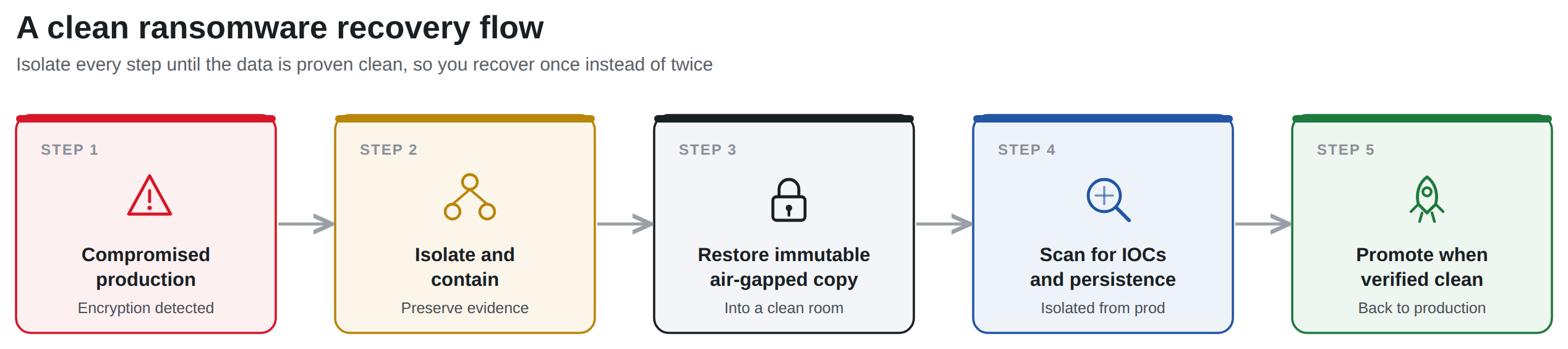 Production is isolated the moment an incident is confirmed, which contains the blast radius and preserves forensic evidence. The immutable, air-gapped copy is then restored into a clean-room environment that has no path back to the infected network. Inside that isolated environment, the restored systems are scanned for indicators of compromise, dormant persistence mechanisms, and the malware itself. Only once a system is verified clean is it promoted back into a rebuilt production estate. This sequencing is the difference between a recovery and a relapse, and it is also where most tabletop exercises fall apart, because teams discover they have no clean-room capacity provisioned and no runbook for standing one up under pressure.
How does this map to GCC regulation and critical infrastructure?
For organisations operating in the UAE and the Gulf, recovery capability is not only good practice. It is increasingly written into the compliance baseline. The UAE Information Assurance Standards, along with sector regulators such as the Dubai Electronic Security Centre and the financial supervisory frameworks that apply to firms in the DIFC and ADGM, all expect demonstrable business continuity and tested recovery, not just documented intent. PCI-DSS carries explicit requirements around backup security and access control for anyone handling cardholder data. ISO 22301 formalises the business continuity management system, and ISO 27001 Annex A controls cover backup, logging, and information transfer. NIST's Cybersecurity Framework puts Recover alongside Identify, Protect, Detect, and Respond as a first-class function for a reason.
Critical infrastructure adds a further constraint that pure IT environments do not face: the boundary between the corporate network and operational technology. In our critical-infrastructure engagements, including smart-grid and utility environments, the segmentation between IT and OT is often the single control that decides whether a ransomware event stays an office-network problem or becomes a safety and availability incident on the plant floor. Backups for OT historians and engineering workstations need the same immutability and isolation discipline as the data centre, and the recovery runbook has to account for systems that cannot simply be rebooted into a clean image mid-shift. The CIS Benchmarks give a concrete hardening baseline for the underlying operating systems on both sides of that boundary.
A recovery readiness checklist
Run your own environment against this. If you cannot answer yes with evidence to each item, that is your next quarter of work.
- At least one backup copy is immutable, using object-lock or WORM storage that no production credential can shorten or delete.
- At least one copy is air-gapped, offline or in a logically isolated account with a separate identity plane and no trust relationship to production.
- Immutable retention exceeds your realistic attacker dwell time, with margin. Thirty to ninety days is a common floor, not seven.
- Backup administration uses separate credentials and multi-factor authentication that are not part of the production directory.
- You run scheduled restore tests and measure actual recovery time and recovery point against agreed objectives.
- A clean-room recovery environment is designed and can be stood up on demand, isolated from the infected network.
- Restored systems are scanned for indicators of compromise and persistence before promotion to production.
- The IT-to-OT boundary is segmented, and OT backups follow the same immutability and isolation rules.
- An incident runbook assigns owners, decision authority, and communication paths, and it has been exercised as a tabletop in the last twelve months.
- Recovery capability is mapped to the regulatory frameworks you answer to, with evidence retained for audit.
How Aydahwa Enterprise can help
We build and test recovery architecture for banks, utilities, and critical-infrastructure operators across the UAE and GCC, grounded in real engagements rather than slideware. Our team holds certifications spanning ISO 27001, PCI-DSS, SOC 2 alignment, the NIST Cybersecurity Framework, CIS Benchmarks, and Microsoft Cybersecurity Architect Expert, and we have delivered enterprise security and critical-infrastructure work in banking, telecom, and utility environments.
If ransomware resilience is on your agenda, a practical starting point is our free cyber security self-assessment and the cybersecurity readiness checklist, which surface the gaps in prevention and recovery in about the time it takes to read this article. From there, our cybersecurity services cover recovery architecture design, immutable and air-gapped backup deployment, clean-room recovery, and tabletop exercises, while our cloud security and migration practice builds the isolated backup accounts and object-lock configurations that make immutability real in AWS, Azure, and GCP. For ongoing operations, our managed IT and support services keep restore testing and runbook rehearsal on a schedule rather than a wish list.
Recovery is the part of security that stays invisible until the day it is the only thing that matters. Build it before you need it. Talk to our team about a recovery readiness review for your environment.