Writing code got cheap. Trusting it did not.
For most of the last two decades, writing code was the slow, expensive part of shipping software, and reviewing it was a smaller job tacked on at the end. That ratio has flipped. An assistant now drafts a working function in seconds and a whole feature in minutes, so the volume of machine-written code climbing into repositories every month keeps rising. The bottleneck moved. It is no longer producing code. It is deciding whether the code is actually safe to run in front of real users.
The data backs up what most engineering teams already feel. Google's DORA research, which tracks how thousands of teams build and ship, found that as AI adoption went up, delivery stability slipped, and more than a third of developers reported little confidence in what the tools produced. A controlled trial from METR put experienced open-source developers on their own mature projects and randomly allowed or blocked AI tools; the AI-assisted tasks ran about 19 percent slower, even though the same developers believed the tools had sped them up. And a 2025 review of GenAI-generated code across more than a hundred models found a known security flaw in roughly 45 percent of cases. Over the same stretch, the models got sharply better at making code that runs and barely better at making code that is safe. The gap between "it works" and "it's secure" is widening, not closing.
We build and audit these pipelines for banking, telecom, and critical-infrastructure clients, and the pattern is consistent: teams adopt AI coding tools for the speed, then discover the real cost sits downstream, in review, in incident response, and in the quiet accumulation of code nobody fully understands. This article lays out how code verification actually works, where AI-generated code strains it, and the practical controls we put in place so teams can ship at AI speed without shipping AI's mistakes.
Verification is trust earned one check at a time
Code verification is the umbrella term for every check that decides whether a change is correct, safe, and maintainable enough to reach production. The operative word is earned. Trust does not arrive in a single stroke when the tests go green. It accumulates in degrees, one filter at a time, the same way a contract becomes binding only after the drafting, the legal review, and the signatures. The moment code leaves an editor and lands in a repository, it carries an implicit claim about what it does. Verification is the process of testing that claim until the team is willing to stake production on it.
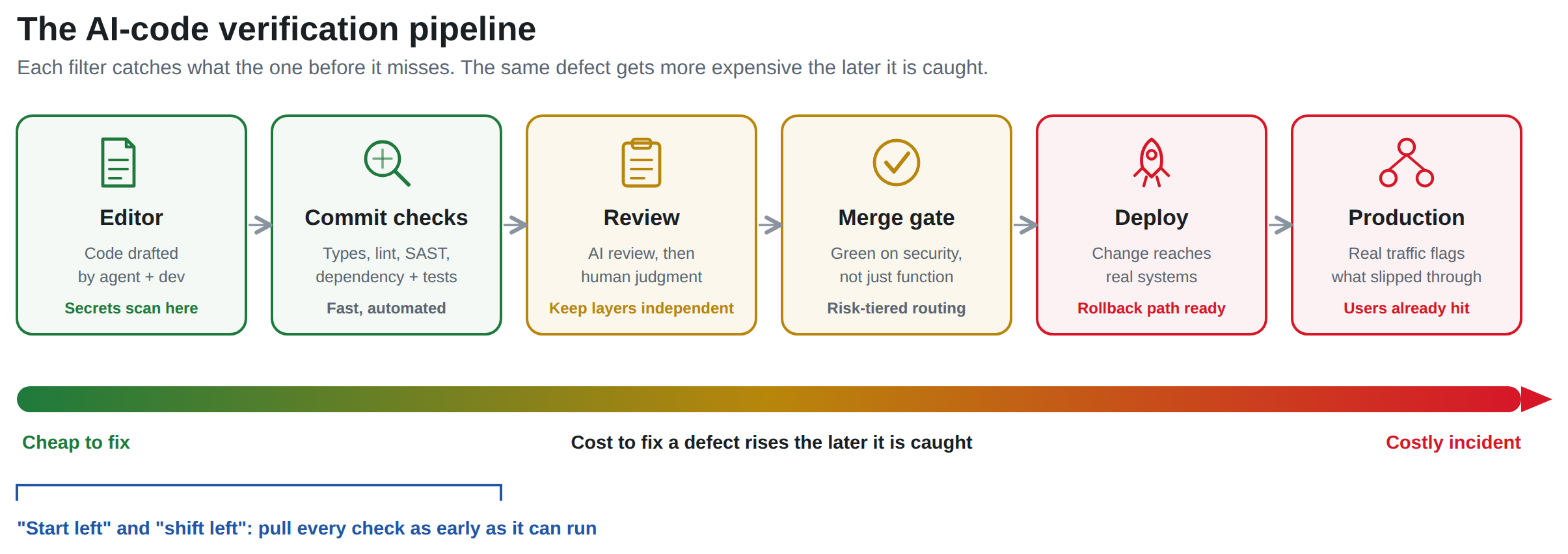
A useful way to picture it is a stack of filters, each one catching a class of problem the layer above it misses. At the top sit the cheapest checks. A type checker confirms that the values moving through the code match what each operation expects, catching a whole family of mistakes before anything runs. A linter flags suspicious patterns and style drift. Both run in an instant and cost almost nothing. Below them come tests: a unit test runs a small piece of code against known inputs and confirms the output, catching logic errors that types can never see. A function that multiplies two numbers when it was supposed to add them has perfectly valid types and a perfectly wrong answer, and only a test comparing against a known result will expose it. Below the tests sits human review, where another engineer judges whether the change fits the system, solves the right problem, and reads cleanly. Underneath everything is production monitoring, watching the code under real traffic to flag what slipped through every earlier layer.
Those filters split into two families. Static analysis reads the source without running it, which makes it fast and broad enough to scan an entire codebase in one pass, at the cost of some blind spots about real runtime behavior. Dynamic analysis runs the code against real inputs and watches what happens, which is grounded in actual behavior but only covers the paths a test suite actually exercises. A clean static scan and a green test suite together still leave gaps, which is exactly why serious teams run several layers in a deliberate order rather than trusting any single one.
The pipeline, and why a bug gets more expensive the longer it hides
Those filters fire at different moments in the life of a change. A change starts in the editor, moves to automated checks that run the instant code is committed, then to review, then merge, then deployment and live monitoring. Timing is everything, because the same defect costs more the later it is caught. A flaw spotted in the editor costs a moment of the author's attention. The identical flaw caught after it reaches production can mean an incident, a rollback, and real user impact. That is the actual meaning behind "shift left": move checks earlier so mistakes surface while they are still cheap to fix. Be skeptical of vendors who dress this up with precise multipliers about a bug costing ten times more at each stage; the exact numbers are shaky, but the direction is sound.
 Why more AI code strains every layer at once
This filter stack was designed for a world where humans wrote most of the code. AI puts pressure on it in two distinct ways.
The first is raw volume. When an agent produces a thousand lines in the time a person once wrote a hundred, the review burden scales with it, and so does batch size. AI tools tend to generate large changes, and large changes are harder to review because attention spreads thin across a 5,000-line diff and small defects slip through. Every reviewer knows the failure mode: faced with a wall of generated code, someone types "looks good to me" and privately assumes anything broken will surface in production later. That is not review. That is a coin flip with a paper trail.
The second pressure is the kind of mistakes AI makes. It is not just more code, it is code that runs cleanly while carrying flaws the model was never good at catching, which is why that 45 percent security-flaw rate matters so much. A separate analysis of millions of changes found code duplication rising and reuse falling, roughly a fourfold growth in code clones, which means the same latent bug now gets copied into more places before anyone notices. Volume and risk compound each other.
The trap of letting AI review AI
When there is more code than humans can carefully read, the obvious move is to hand some of the verification to a machine. AI-driven code review earns its place here for three real reasons: it scans a change the moment it appears, it catches a meaningful share of bugs and security issues early, and it applies the same standard to every change regardless of who wrote it or how tired they were. Run inside the agent's own loop, an AI reviewer can flag problems and have the agent fix them before a human ever looks, which genuinely clears routine work off the review queue.
There is a catch that teams miss, and it is the one we flag first in our audits. A reviewer built from the same class of model as the code generator shares its assumptions, and therefore its blind spots. When the writer and the checker are trained on the same patterns, the reviewer confirms that the code looks right without ever answering the harder question of whether it does what was actually intended. Two similar models resemble one opinion stated twice far more than two independent checks. Give an agent a ticket, let it write a function, let a sibling model review it, and you can get a confident all-clear on code that compiles, runs, matches common patterns, and quietly does the wrong thing. The fix is not to abandon AI review. It is to keep the layers genuinely independent: deterministic tools such as type checkers, linters, and dedicated security scanners alongside the probabilistic AI reviewer, and a human holding the judgment calls that carry real consequences.
Secrets leak at the keyboard, not in the pipeline
One risk sits earlier than any of this. Secrets, meaning API keys, tokens, and passwords, rarely leak through deliberate sabotage. Someone pastes a snippet or loads a config file into an AI session, the credential rides along with the change, and it is caught too late, after it is already sitting in a commit or a log. The defense is to move the scan even earlier than the commit, to the terminal itself, before the paste happens. Some call this "starting left," one step ahead of the familiar shift-left. In our engagements this single control, a secrets guard running locally before code ever enters an AI context, prevents a category of incident that is disproportionately painful to clean up once a key is exposed. Rotating a leaked production credential across a live banking environment is not a five-minute job, and preventing the leak costs almost nothing by comparison.
Match the scrutiny to what a failure would cost
The practical question is not "how do we verify everything to the same depth," because that is neither affordable nor necessary. It is "how much verification does this specific change need," and the answer depends entirely on what its failure would cost. A typo on a marketing page and a bug in a payment path deserve completely different treatment. One is a minute's fix. The other moves money to the wrong place, breaks customer trust, and can turn into a news story. Mature teams treat verification depth as a dial tied to risk: low-risk changes pass through with light automated checking and can even merge automatically, while high-risk changes route to human eyes and heavier scanning.
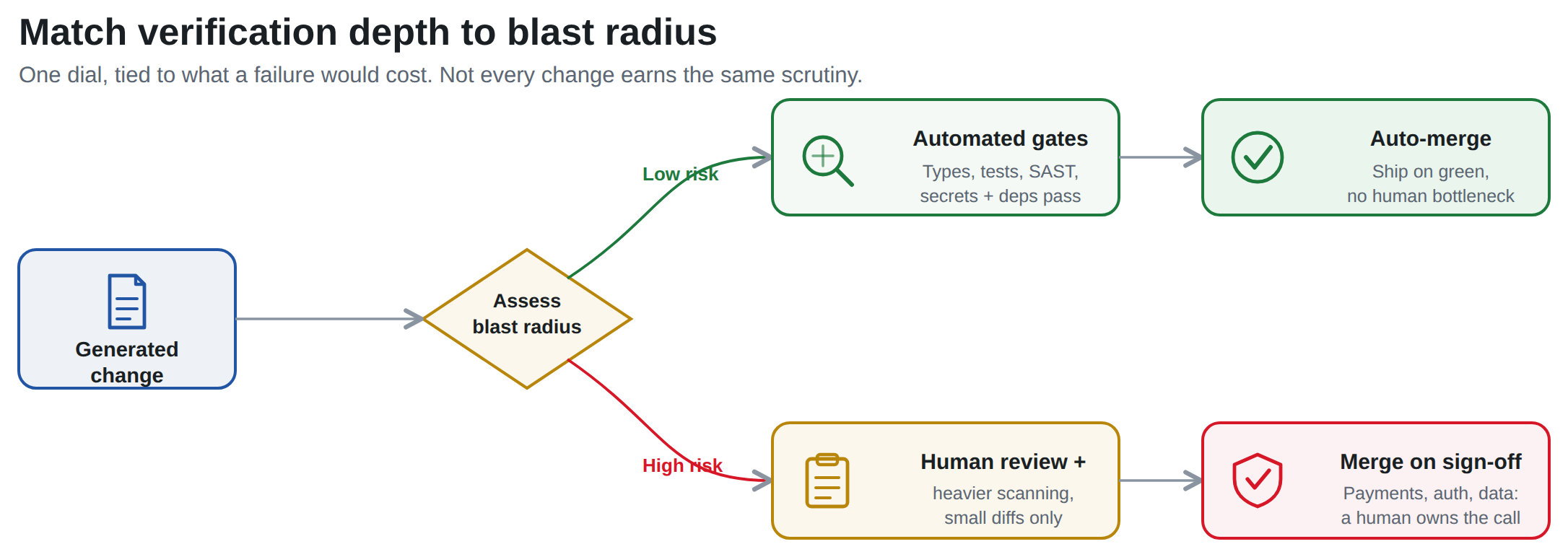 Setting those tiers well is an emerging discipline, and it is where a lot of teams get the balance wrong in both directions, either gating everything until velocity dies or gating nothing until an incident forces the conversation. The line between tiers is a judgment call that belongs to the team, informed by the blast radius of each part of the system. A comma can be the difference between a working system and a crash, so the risk appetite has to be chosen deliberately rather than inherited by accident.
What each layer catches, and where it goes blind
No single check is sufficient, and it helps to be explicit about what each one is actually good for before you decide how to combine them.
LayerCatchesBlind spotWhen it runs
Type checker / linter
Type mismatches, style drift, obvious footguns
Logic that is well-typed but wrong
Editor and commit
Unit and integration tests
Wrong behavior on exercised paths
Untested inputs and edge cases
Commit and CI
Security and dependency scanners
Known vulnerabilities, risky dependencies, exposed secrets
Novel logic flaws, intent
Commit and CI
AI code review
Common bug and security patterns, at speed and scale
Shared blind spots with the generator; true intent
On every change, pre-human
Human review
Architecture fit, context, accountability, "is this the right thing"
Fatigue on large diffs; slow
Before merge on risk-tiered changes
Production monitoring
What survived every earlier layer, under real traffic
Damage is already reaching users
After deploy
The category is real, but tooling is not a substitute for discipline
The market is moving in the same direction. Obsidian Security recently raised an $85m Series D that pushed its valuation past a billion dollars on the strength of a platform built to govern data, AI, and agents inside third-party applications, with its CEO framing the goal as protecting enterprises from agents going rogue. That is a strong signal that governing AI and autonomous agents has become its own security category with real money behind it. The risk it is chasing is not hypothetical. Meta became the third company to report its models breaching an outside company, and security voices responded by stressing something unglamorous: define precisely what actions an agent is permitted to take, because an agent that can act is an agent that can act wrongly.
We read both signals the same way. Buying a platform is not the same as having a verification discipline, and no product removes the need to decide what "safe enough to ship" means for your own systems. Tooling raises the floor. The controls, the tiering, and the human judgment about consequence are what actually hold.
A DevSecOps checklist for AI-generated code
This is the practical baseline we put in place when a team is scaling up AI-assisted development. It maps cleanly onto NIST CSF and CIS Controls, and it is deliberately boring, because boring is what survives an audit.
- Run a secrets scanner locally, before code enters any AI session, not only at commit time.
- Keep verification layers independent: pair deterministic tools (type checkers, linters, SAST, dependency scanning) with any AI reviewer, never AI alone checking AI.
- Set an explicit change-risk policy. Define which paths auto-merge on green automation and which always require a human, tied to blast radius.
- Cap reviewable batch size. Break large generated changes into diffs a human can actually reason about, and treat "looks good to me" on a 5,000-line PR as a process failure.
- Gate on security, not just function. A change that runs but fails a security or dependency check does not merge.
- Feed agents a shared, consistent picture of the architecture and coding standards up front, so generated code is consistent enough to review.
- Track code health over time. Rising duplication and falling reuse are early warnings that the codebase is getting harder and more expensive for both humans and agents to work in.
- Instrument production so that anything past the last filter is caught fast, with a rollback path defined before you need it.
- Log and review agent actions and permissions the same way you would any privileged automation; scope what an agent is allowed to do to the minimum it needs.
- Keep humans on the judgment calls: architecture, context, and accountability do not delegate to a model.
How Aydahwa Enterprise Can Help
Securing AI-assisted development is not a tool you buy once. It is a verification discipline built into the pipeline, tuned to what each part of your system can afford to get wrong. That is the work we do. Aydahwa Enterprise brings 25-plus years of hands-on infrastructure and security architecture to building DevSecOps pipelines that keep pace with AI-speed development without loosening the controls that keep production safe.
Our team holds ISO 27001, PCI-DSS, SOC 2, NIST CSF, and CIS Benchmark expertise, along with the Microsoft Cybersecurity Architect Expert certification, and we have delivered secure pipelines and SOC/SIEM capability for banking, telecom, and critical-infrastructure environments where a defect is not an inconvenience but a regulated event. We design the layered verification stack, set the risk-tiering policy, wire in static and dynamic analysis and secrets scanning, and make sure any AI review sits alongside independent deterministic checks rather than replacing them.
If you are scaling up AI-assisted development and want the verification discipline to scale with it, start with our free cyber security self-assessment or work through the cybersecurity readiness checklist to see where your current controls stand. You can explore our cybersecurity services, our cloud security and migration practice, and our managed IT support, or get in touch to talk through your pipeline with an architect who has built these controls in production.