
The attacker on the other side of your firewall now runs at machine speed
In our engagements over the last year, the character of the attacks we clean up after has changed. The reconnaissance is faster, the phishing lures are cleaner, and the malware adapts to the environment it lands in instead of failing on the first unexpected registry key. That is not a hunch. CrowdStrike's 2026 threat analysis reported an 89% rise in AI-enabled threats, with adversaries deliberately targeting software supply chains, AI ecosystems, and connected devices. Tom Kellermann, a veteran security researcher who tracks how AI has rewired the attack kill chain, described the newest tooling as turning AI agents into "APT attack dogs" — autonomous, tireless, and cheap to run.
That last word matters most. When an attacker hijacks someone else's model access to do the work, a technique the industry now calls LLMJacking, the marginal cost of an attack campaign drops close to zero. Cheap attacks get run more often, against more targets, including the mid-market companies that used to fly under the radar. For an IT leader signing off on next year's security budget, the practical question is not whether AI-driven attacks are coming. They are already in the logs. The question is which architecture actually holds up against an adversary that never sleeps and never runs out of attempts. Our answer, tested across banking, telecom, and critical national infrastructure clients, is Zero Trust — implemented properly, not as a slogan on a slide.
What an AI-driven attack looks like from the defender's chair
Strip away the marketing and an AI-driven attack is a familiar kill chain with the slow, human, error-prone steps replaced by automation. Reconnaissance that used to take a skilled operator days now happens in minutes: an agent scrapes your public footprint, maps your subdomains, cross-references breached credential dumps, and drafts a target list. Initial access is attempted through generated spear-phishing that reads like it came from a colleague, because the model was trained on the same corporate English your colleagues write. Once inside, malware built with AI assistance behaves less like a fixed payload and more like a small program that reasons about where it is and what to try next.
Three shifts make this genuinely different from the threats most perimeter defenses were designed for. First, speed. The window between a phished credential and lateral movement can be shorter than your SOC's alert triage time. Second, volume. Automation removes the human bottleneck, so a single operator can run hundreds of parallel intrusion attempts. Third, adaptability. Where a traditional exploit either works or gets blocked, an agentic attack can try a second and third approach without a human deciding to. CrowdStrike's own field data on Chinese espionage operations, summarized by their intelligence lead Adam Meyers, points the same direction: adversaries are industrializing, and the software supply chain and AI tooling itself are now primary targets rather than afterthoughts.
None of this requires exotic defenses. It requires assuming the attacker will get a foothold and designing so that a foothold does not become a breach.
Why the old perimeter model quietly stopped working
The castle-and-moat model made a reasonable bet for its era: put strong controls at the edge, trust what is inside. That bet fails on contact with three realities we see in nearly every assessment. Users and workloads live outside the moat now, spread across SaaS platforms, home networks, and multiple clouds. Identity, not network location, is the thing attackers actually steal. And an attacker moving at machine speed inside a flat internal network can reach a domain controller before anyone has read the first alert.
We still find flat networks in production at organizations that consider themselves mature. One compromised laptop in finance can, on paper, reach the backup servers, the hypervisor management plane, and the CI/CD runners that push code to production. In a manual attack that path takes time and mistakes, which gives defenders a chance. Against an automated adversary, the same path is walked in seconds. The perimeter did not fail because it was badly built. It failed because the thing it was guarding moved, and the attacker got faster.
Zero Trust, stated plainly
Zero Trust rests on one rule, coined by John Kindervag and now embedded in nearly every serious security framework: never trust, always verify. Every request to reach a resource is authenticated, authorized, and evaluated against context, regardless of where it comes from. There is no trusted interior. The internal network gets treated with the same suspicion as the open internet.
The authoritative reference is NIST SP 800-207, which defines the architecture in vendor-neutral terms, and it pairs naturally with the NIST Cybersecurity Framework, CIS Controls, and the identity requirements in ISO 27001 and PCI-DSS. In practice, Zero Trust comes down to a handful of enforceable ideas. Verify identity strongly, with phishing-resistant multi-factor authentication rather than SMS codes. Verify the device asking, so a request from an unmanaged or non-compliant machine is treated differently from one on a hardened, patched endpoint. Grant the least privilege that lets the job get done, and grant it just in time rather than standing. Segment the network so that reaching one system does not hand over the rest. And assume breach, which means logging everything and building the muscle to respond, not just to prevent.
Read that list against the AI-driven attack chain and the fit is obvious. Stolen credentials are worth far less when strong MFA and device posture are also required. Least privilege and just-in-time access shrink what a single compromised account can touch. Micro-segmentation turns a machine-speed sprint across a flat network into a series of separately guarded doors. None of it is theoretical, and none of it depends on buying a single magic product.
How Zero Trust breaks the attack at each stage
The clearest way to see the value is to map the attacker's steps against the control that stops each one. This is the model we use when we walk a client's board through why the investment pays off.
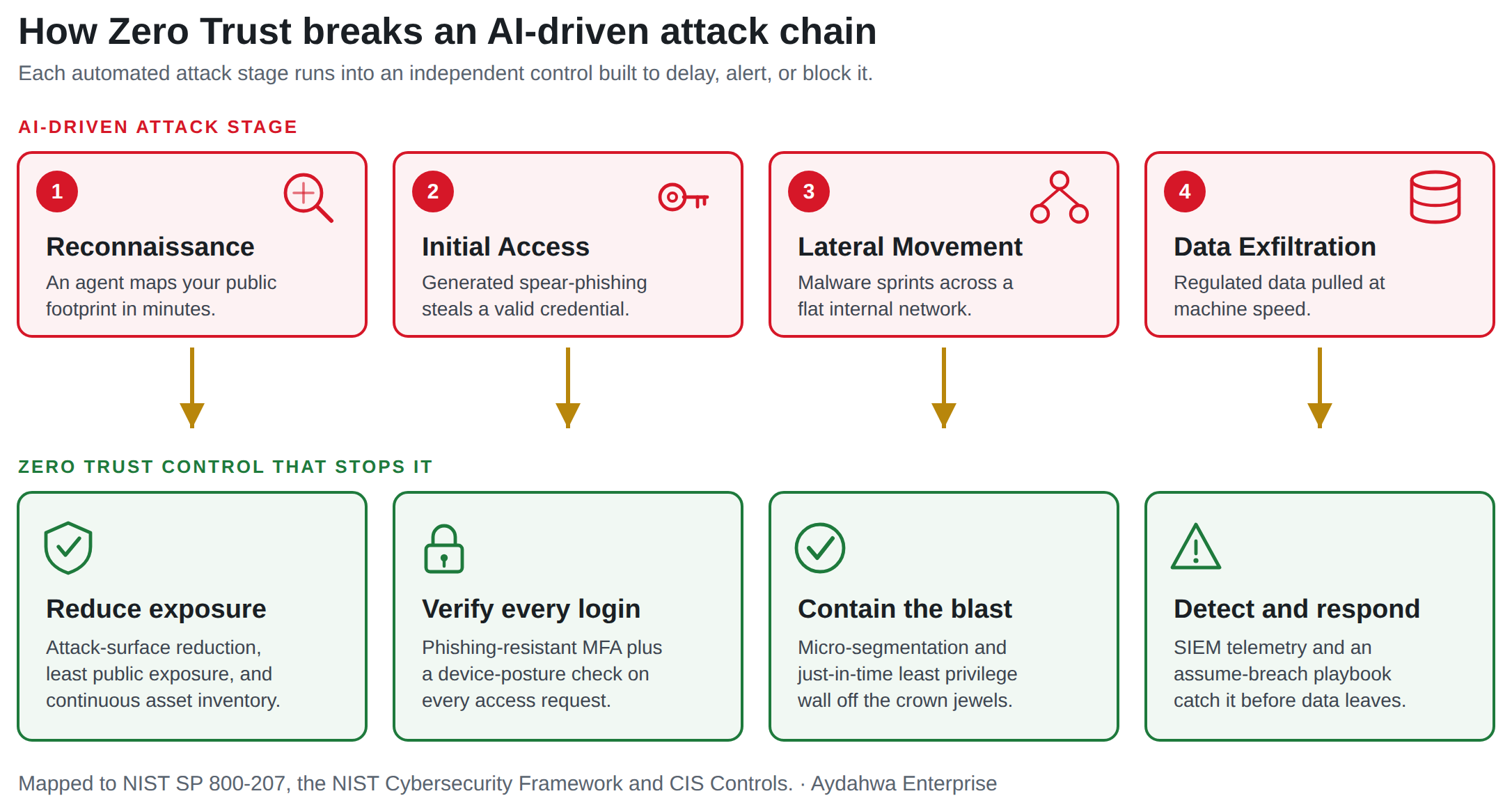 The point of the diagram is not that any single control is a silver bullet. It is that an automated attacker has to defeat several independent controls in sequence, and each one is designed to force a delay, an alert, or an outright block. Speed is the attacker's main advantage. Layered verification is how you take it away.
A rollout sequence that survives contact with reality
Most Zero Trust programs stall because they are attempted as a single enormous project. The ones that succeed are sequenced, and they show value early. This is the order we recommend, drawn from real deployments rather than a reference architecture.
- Fix identity first. Roll out phishing-resistant MFA for every account, kill legacy authentication protocols that bypass it, and get single sign-on in front of your critical applications. This step alone closes the door on the majority of credential-replay attacks.
- Get an inventory you can trust. You cannot protect what you cannot see. Enumerate users, devices, service accounts, and the data that actually matters. Service accounts and machine identities are where we find the worst-hidden standing privilege.
- Enforce device posture. Tie access to device compliance so an unpatched or unmanaged endpoint cannot reach sensitive systems, even with valid credentials.
- Cut standing privilege. Move administrators to just-in-time, time-boxed elevation. A domain admin token sitting idle on a workstation is exactly the prize an automated attacker is hunting for.
- Segment the network. Start with the crown jewels — backups, the virtualization management plane, the CI/CD pipeline, cardholder or regulated data — and wall them off from general user traffic before you worry about segmenting everything.
- Instrument and rehearse. Feed identity, endpoint, and network telemetry into your SIEM, write detections for the behaviors that matter, and run the incident response so the first time your team executes it is not during a real event.
Sequenced this way, every phase leaves the organization measurably safer than the week before, which is what keeps a multi-quarter program funded.
Perimeter thinking versus Zero Trust against an automated adversary
DimensionPerimeter modelZero Trust model
Trust boundary
Network location; inside is trusted
Every request verified regardless of origin
Primary control
Firewall at the edge
Identity, device posture, and policy per request
Effect of a stolen credential
Broad internal access
Limited by MFA, device check, and least privilege
Lateral movement
Fast across a flat network
Blocked or slowed by micro-segmentation
Response to machine-speed attacks
Human triage races the attacker
Automated policy denies before triage is needed
Governing references
Legacy network diagrams
NIST SP 800-207, NIST CSF, CIS Controls, ISO 27001
Where the market is putting its money
If you want a read on where enterprise security is heading, watch where the capital goes. Identity-security vendor Obsidian reached a reported US$1.1bn valuation on the strength of protecting the SaaS and identity layer, and it is not an outlier. The categories attracting serious funding — identity threat detection, SaaS security posture, and AI-security tooling — are precisely the ones Zero Trust depends on. That is not a coincidence. The people betting real money have concluded that identity and least privilege are where the next decade of defense is won, which lines up with what we see in the field. The organizations that get breached badly are rarely the ones that lacked a firewall. They are the ones where one identity, one flat network, or one over-privileged service account turned an incident into a catastrophe.
Mistakes we see repeatedly
Buying a product and calling it Zero Trust is the most common one. Zero Trust is an architecture and an operating discipline; a single "Zero Trust" appliance bolted onto an unchanged network does very little. A close second is treating MFA as finished once it is enabled somewhere, while SMS fallback and legacy authentication protocols quietly leave the real door open. We also see segmentation projects that map every workload in exhaustive detail and never actually enforce a rule, and privileged-access programs that hand out standing admin rights "temporarily" until temporary becomes permanent. The fix for all of these is the same: pick the highest-value control, enforce it for real, prove it works, and move to the next. Progress beats a perfect plan that never ships.
How Aydahwa Enterprise can help
We build Zero Trust programs that fit the resources an organization actually has, not an idealized reference design. That work spans a Zero Trust and identity assessment mapped to NIST SP 800-207 and the NIST CSF, cloud security and segmentation across Azure, AWS, and on-premises virtualization, privileged-access and just-in-time elevation, and SOC and SIEM detection engineering so an automated attacker trips an alert before it reaches anything valuable. Our team holds credentials including ISO 27001, PCI-DSS, SOC 2, CIS Benchmarks, and the Microsoft Cybersecurity Architect Expert certification, and we have delivered in regulated banking, telecom, and critical national infrastructure environments where getting this wrong is not an option.
If you want to know where you stand before committing to a program, start with our free cybersecurity self-assessment and the cybersecurity readiness checklist. To see how the pieces fit together, our cybersecurity services and cloud security and migration pages lay out the approach, and managed IT support covers the day-to-day operations that keep controls enforced after the project ends. When you are ready to talk specifics, get in touch and we will scope a first phase you can actually fund and finish.