The Code That Runs When Nobody Is Watching
Most of what a modern system does never happens inside a web request. The welcome email, the nightly billing run, the image that gets resized and virus-scanned after upload, the webhook that reconciles a payment, the report that lands in an inbox at 6 a.m. — all of it runs out of band, on schedulers and workers that no user ever sees. In our infrastructure and security engagements across the UAE and wider GCC, this is consistently the part of the estate that has the weakest controls and the least documentation. Everyone reviews the login page. Almost nobody reviews the cron job that runs as root every fifteen minutes.
That gap matters because background work tends to hold exactly the things an attacker wants: broad database access, long-lived credentials, the ability to send mail as the company, and just enough privilege to touch production data without a human in the loop. When a background system is designed only for throughput and never for security, it becomes a quiet, standing liability. This article walks through how background processing evolves as a system grows, where the security and reliability failures cluster at each stage, and the controls we put in place to close them.
Why Background Work Exists in the First Place
A request handler has one job: respond quickly. The moment you make a user wait while you resize an image, call a third-party API, and update five tables, you have coupled that person's experience to the slowest thing in the chain. Move the slow work off the request path and the upload returns as soon as the file hits object storage. The resizing, scanning, and CDN push still happen. They just happen elsewhere.
Background work usually gets triggered in one of four ways. A user action kicks it off, such as a signup that queues a welcome email. The clock triggers it, as with nightly reconciliation or monthly invoicing. Another system triggers it through a webhook or a new object landing in a bucket. Or the sheer volume makes batching worthwhile, because ten thousand records are cheaper and safer to process together than one at a time. Each of these patterns is ordinary. Each also quietly expands the attack surface, because now there is code executing on a schedule or a queue with no interactive session tied to it and, too often, no logging that a security team would ever see.
The Three Stages of Background Processing
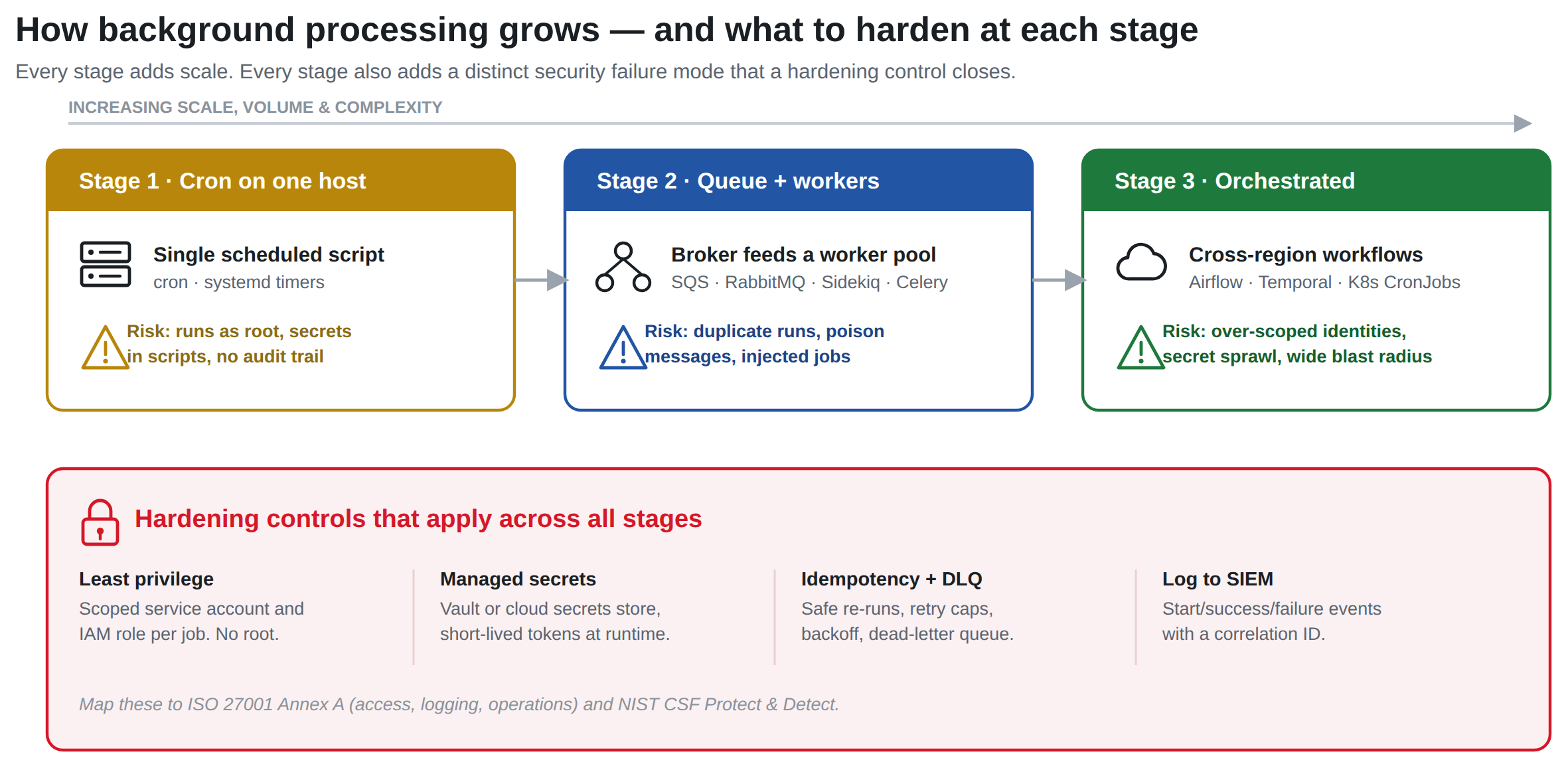
Almost every system we assess has passed through, or is stuck somewhere inside, the same progression. Understanding which stage you are in tells you which risks are live right now.
Stage one: a script on a single machine
It starts with cron. A shell script or a language runtime fires on a schedule, does its work, and exits. On a single server this is genuinely fine for a long time, and there is no shame in it. The reliability problems show up first: if the box is down when the job should fire, the run is simply missed, and nobody finds out until the month-end numbers are wrong. If two runs overlap because one took longer than expected, you get double-processing. There is no retry, no backoff, no record of what ran.
The security problems are worse and less visible. Cron jobs are famous for running as root because it was the fastest way to make them work. Database passwords and API keys end up baked into the script or sitting in a plaintext environment file that the whole server can read. We have opened crontab files during assessments and found production credentials in the comments. Because the job has no user session, standard access logging does not capture it, so a compromised cron entry can run for months without tripping a single alert.
Stage two: a queue and a pool of workers
As load grows, teams move to a job queue. Producers push units of work onto a broker such as Redis, RabbitMQ, or Amazon SQS, and a pool of worker processes pulls jobs off and executes them. Frameworks like Sidekiq, Celery, and BullMQ made this the default pattern for a reason: it decouples the rate of incoming work from the rate of processing, it survives a worker crash, and it scales horizontally by adding more workers.
This is where a specific and dangerous failure mode appears. A worker takes a job, starts processing, and dies before it can acknowledge completion. Most brokers will redeliver that job to another worker so the work is not lost. If the job is not idempotent, that redelivery means the customer gets charged twice, the email goes out twice, or the inventory count drifts. We treat non-idempotent job handlers as a defect, not a preference. Every handler should be safe to run more than once for the same input, usually by keying the operation on a unique identifier and checking whether it has already been done before doing it again.
The queue itself becomes a trust boundary that people forget to defend. If any service on the network can push to the broker without authentication, then anyone who reaches the network can inject work of their own choosing into your workers. A message that says "run this report and email it here" is a data-exfiltration primitive if an attacker can forge it. Broker authentication, TLS between producers, brokers, and consumers, and validation of the job payload before it executes are not optional at this stage.
Stage three: distributed and orchestrated
Past a certain scale, a single queue and a flat pool of workers is not enough. Work needs to run across regions, survive the loss of an entire availability zone, and coordinate multi-step processes that can take hours or days. This is the territory of Kubernetes CronJobs, Apache Airflow, and workflow engines such as Temporal, along with event streams like Apache Kafka for high-volume pipelines. The capability is real, and so is the complexity.
Security at this stage is mostly an identity and blast-radius problem. Every scheduler, worker, and workflow step runs as some identity, and each of those identities accumulates permissions over time because it is easier to grant access than to scope it. We have seen a single Airflow deployment holding credentials to every data store in the business, which turns one compromised orchestrator into a full-estate breach. The discipline that contains this is boring and effective: each job gets its own scoped identity, secrets come from a managed store such as HashiCorp Vault or a cloud secrets manager rather than from environment variables, and workers run with the narrowest cloud IAM role that lets them do their one task.
Comparing the Execution Models
There is no single correct choice here. The right model depends on volume, how much a missed or duplicated run actually costs you, and how much operational maturity the team has. The table below is the shorthand we use when advising clients on where they should be.
| Model | Good fit | Main reliability risk | Main security concern |
|---|---|---|---|
| Cron / systemd timer on one host | Low volume, single server, non-critical tasks | Missed runs, overlapping runs, no retries | Over-privileged execution, secrets in scripts, no audit trail |
| Job queue with worker pool (Sidekiq, Celery, SQS) | Steady application workloads, web apps at scale | Duplicate processing from redelivery, poison messages | Unauthenticated brokers, unvalidated payloads, injected jobs |
| Orchestrated workflows (Airflow, Temporal, K8s CronJobs) | Multi-step, cross-region, long-running pipelines | Partial failures, silent stalls between steps | Over-scoped service identities, secret sprawl, wide blast radius |
| Event streaming (Kafka, Kinesis) | High-throughput, real-time data pipelines | Consumer lag, out-of-order or replayed events | Topic-level access control, unencrypted data in transit and at rest |
The Failure Modes That Actually Bite
Beyond the stage-specific risks, a handful of problems show up regardless of which technology you picked. These are the ones we look for first during a review.
Poison messages. A single malformed job that always throws can wedge a worker into an infinite retry loop, burning resources and drowning your logs while starving legitimate work. Every queue needs a dead-letter queue and a retry limit so that after a set number of failures the job is set aside for inspection instead of retried forever. A dead-letter queue that nobody monitors is its own failure, so it belongs in your alerting.
Retries without backoff. When a downstream dependency is struggling, a flood of immediate retries is the fastest way to keep it down. Exponential backoff with jitter turns a self-inflicted denial of service into a graceful wait. This is a reliability control and a security control at once, because a retry storm is indistinguishable from an attack from the point of view of the service being hammered.
Silent stalls. The worst background failures are the ones that produce no error at all. A worker deadlocks, a queue quietly stops draining, a scheduled job stops firing because a certificate expired, and because there is no exception, no alert fires. The fix is to monitor the work, not just the process. Track queue depth, job age, and successful completions, and alert when a job that should run every hour has not succeeded in three.
Unbounded concurrency. Autoscaling workers against a fixed-size database connection pool is a classic way to take yourself offline. As the queue backs up, more workers spin up, each grabs connections, and the database falls over precisely when you need it most. Concurrency limits and rate limits keep the recovery from becoming the outage.
Hardening Background Jobs: A Practical Checklist
This is the checklist we work through with clients when we review a background processing estate. It maps cleanly onto ISO 27001 Annex A controls around access management, logging, and operations security, and onto the NIST Cybersecurity Framework functions of Protect and Detect.
- Run every job with least privilege. No job runs as root or as a database superuser unless it genuinely requires it. Give each job its own service account and its own scoped cloud IAM role.
- Pull secrets from a managed store at runtime. Move credentials out of scripts, crontabs, and environment files into HashiCorp Vault or a cloud secrets manager, with short-lived tokens where the platform supports them.
- Make every handler idempotent. Key each operation on a unique identifier and check whether it has already completed before repeating it, so redelivery is harmless.
- Authenticate and encrypt the broker. Require authentication to publish or consume, enforce TLS end to end, and validate job payloads against a schema before executing them.
- Set retry limits, backoff, and dead-letter queues. Cap retries, use exponential backoff with jitter, and route exhausted jobs to a monitored dead-letter queue.
- Log jobs where security can see them. Emit start, success, and failure events with a correlation ID into the same SIEM that ingests the rest of your telemetry. A job with no audit trail is an invisible one.
- Monitor the work, not just the host. Alert on queue depth, job age, and missed schedules, not only on CPU and memory.
- Bound concurrency. Set worker and rate limits sized to your real downstream capacity, especially the database connection pool.
- Include background systems in your threat model. Schedulers, workers, and brokers are production infrastructure and deserve the same review as any internet-facing service.
Where Compliance Meets Engineering
For regulated organisations in banking, telecom, and critical national infrastructure — sectors we have worked in directly — background processing is an audit concern as much as an availability one. Auditors increasingly ask how automated jobs are authorised, how their credentials are managed, and whether their activity is logged and reviewable. A background system that runs as root, stores a plaintext password, and produces no audit trail is a finding waiting to be written up against ISO 27001, PCI-DSS, or the local regulatory baseline. The controls above are the same ones that satisfy those frameworks, which is convenient: hardening your job infrastructure and passing your next audit are largely the same piece of work.
The point we make to every client is that background systems age badly on their own. A cron job written in a hurry three years ago is still running, still has its original over-broad permissions, and has long outlived the person who wrote it. Left alone, this class of infrastructure only accumulates risk. It responds well to a deliberate review, and the return on that review is high because so few organisations ever do it.
How Aydahwa Enterprise Can Help
At Aydahwa Enterprise, background and automated workloads are part of every infrastructure and security assessment we run, not an afterthought. Our team brings 25 years of hands-on work across UNIX, Linux, cloud platforms, and DevSecOps, together with certifications and frameworks that matter to auditors — ISO 27001, PCI-DSS, NIST CSF, CIS Benchmarks, and Microsoft Cybersecurity Architect Expert credentials — and direct delivery experience in banking, telecom, and critical infrastructure across the UAE and GCC.
We can review your existing schedulers, queues, and workers for the failure modes described here, redesign a background estate that has outgrown a single cron host, and bring the whole thing in line with your compliance obligations. If you want to see where you stand before committing to an engagement, start with our free cybersecurity self-assessment and the cybersecurity readiness checklist. To go deeper, our cybersecurity services, cloud security and migration, and managed IT support teams cover the design, hardening, and ongoing operation of this infrastructure end to end. When you are ready to talk specifics, get in touch and we will scope a review around what you actually run.