
Aydahwa Enterprise today announced the general availability of its managed Cloud-Mesh VPN platform, a multi-cloud encrypted connectivity service engineered to remain available through the loss of an entire cloud provider, and to protect enterprise traffic with per-session one-time keys.
Why this announcement matters
Enterprise networking has changed faster than the architectures most organisations rely on to secure it. Workloads are now distributed across several public clouds, workforces are hybrid and geographically dispersed, and applications are consumed from anywhere. Traditional hub-and-spoke VPN designs — in which every connection is funnelled through a single concentrator or a single provider's region — were not designed for this pattern. They introduce latency by forcing traffic to detour, and more seriously, they concentrate risk: when the concentrator or its hosting region fails, secure connectivity fails with it.
Today's announcement marks the availability of a managed platform designed around the opposite assumption. The Cloud-Mesh VPN distributes independent Points of Presence (PoPs) across multiple public cloud providers, connects them with redundant mesh trunks, and treats the failure of any single provider as an expected operating condition rather than an incident. For organisations whose secure network is a dependency of daily operations, that distinction is the difference between a degraded hour and a stopped business.
What has been launched
The initial release introduces the following capabilities as a managed service:
- Multi-cloud Points of Presence — independent PoPs deployed across separate public cloud providers and regions.
- Dual mesh backbone — redundant primary and standby trunks interconnecting every PoP.
- One-time-key encryption — per-session ephemeral keys with perfect forward secrecy, issued by dedicated key-management nodes.
- Built-in BCP/DR failover — automated health checking with sub-second session re-establishment to a hot-standby PoP.
- Obfuscated transport — a transport profile that presents as ordinary encrypted web traffic on standard ports.
- Managed deployment and enterprise monitoring — provisioning, telemetry, and tested failover runbooks operated by Aydahwa.
Why now
As organisations increasingly distribute workloads across AWS, Microsoft Azure, Google Cloud, Oracle Cloud and sovereign cloud providers, centralised VPN architectures create both operational and resilience challenges. Data-residency obligations push individual workloads into specific jurisdictions; latency requirements push others closer to users; continuity requirements demand that neither choice creates a single point of failure. Meanwhile, the assumption that internal or transit networks can be implicitly trusted has been retired by zero-trust practice, and the prospect of "harvest-now, decrypt-later" interception has raised the bar for how long encrypted traffic must remain confidential.
The Cloud-Mesh platform was developed to address these emerging deployment models rather than to extend an architecture designed for a single corporate perimeter.
Architecture overview
Rather than routing every session through one central concentrator, the platform builds direct, peer-to-peer encrypted tunnels between nodes. The data plane runs on the Aydahwa VPN engine module, a purpose-built tunnelling implementation developed in-house and tuned for low per-packet overhead, high session density and rapid re-keying — characteristics that legacy IPsec and SSL-VPN stacks were not designed to deliver at this scale. Client sessions attach to the nearest PoP; NAT traversal uses ICE/STUN to discover the optimal direct path, with relay fallback for carrier-grade NAT environments.
Within each PoP, functions are separated into independent VLAN-isolated subnets — edge, tunnel, key management and management — so that a fault or compromise confined to one plane cannot traverse into another.
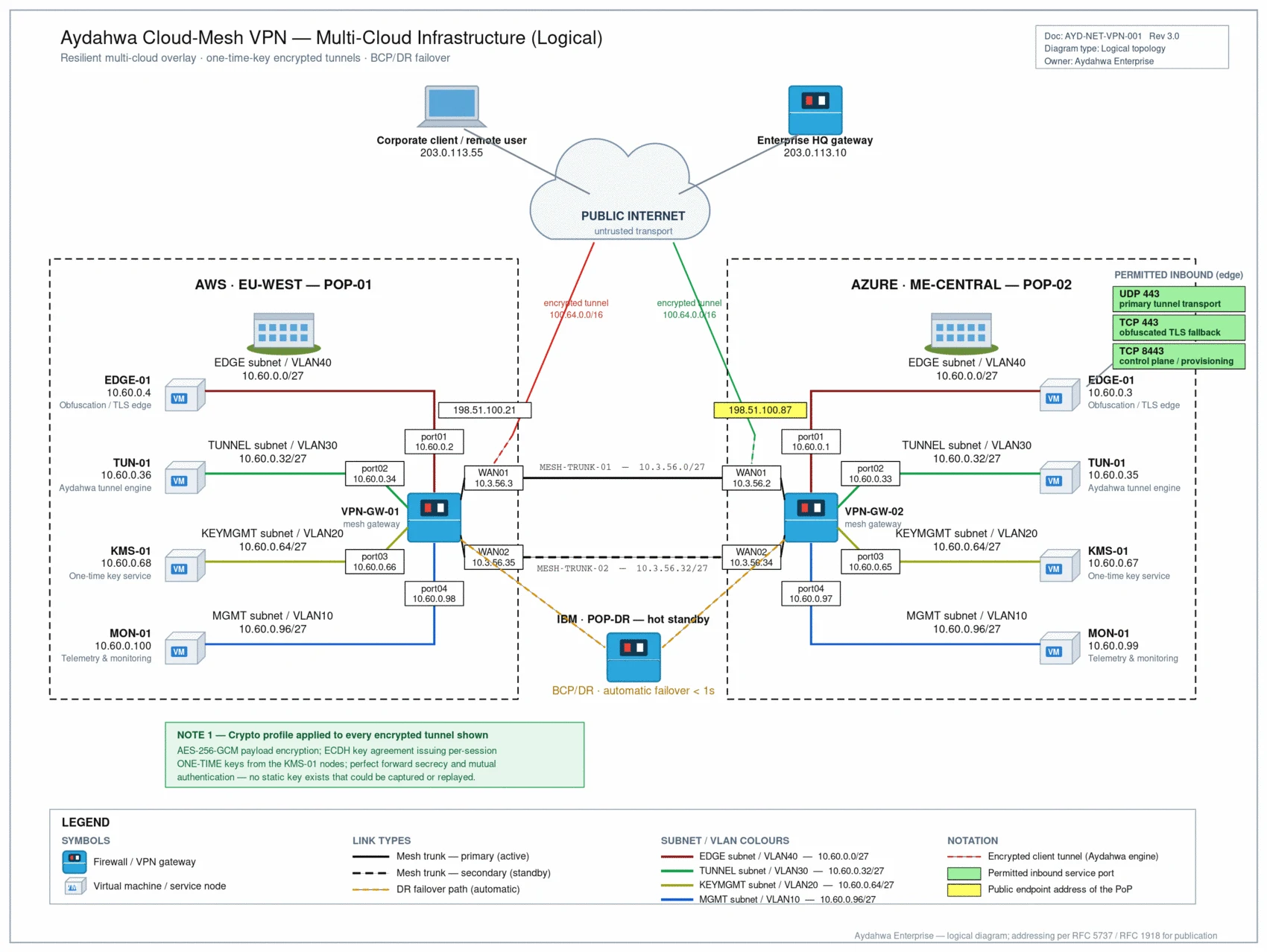
Figure 1 illustrates the production logical topology used by the Aydahwa Cloud-Mesh VPN platform. The architecture distributes independent Points of Presence across multiple public cloud providers, interconnected through redundant mesh trunks with automatic failover, and separates transport, key-management and monitoring functions into isolated networks. Corporate clients and site gateways reach the platform over untrusted public transport via encrypted tunnels terminating at the nearest edge.
Security architecture
The platform is engineered so that no long-lived secret exists that could be captured and later used to decrypt traffic.
- Per-session, one-time keys. Each session performs an authenticated key agreement, derives ephemeral keys, and discards them when the session ends. Keys are issued and protected by dedicated key-management nodes within each PoP and are continuously rotated, providing perfect forward secrecy.
- Authenticated encryption. Payloads are protected with AES-256-GCM. Because session keys are ephemeral, a captured ciphertext stream cannot be decrypted later, even if an endpoint is subsequently compromised.
- Resistance to interception. There is no static pre-shared key to recover, and mutual authentication causes any attempt to insert a device on the path to fail the handshake rather than silently proxy the session.
Resilience architecture
Continuity is a property of the topology rather than a recovery procedure invoked after an outage.
- No single point of failure. PoPs operate active-active across separate providers and regions, joined by primary and standby trunks. The loss of one provider, region or transit path does not remove service.
- Automated failover. Continuous health checking detects degradation and re-establishes affected sessions via a hot-standby PoP in under one second, typically without user-visible interruption.
- Aligned to enterprise objectives. The distribution of control and data planes is designed against the recovery-time and recovery-point objectives regulated organisations are held to, and validated through tested failover runbooks.
Transport protection
Many networks operate deep packet inspection (DPI) systems that examine packet headers and payloads to fingerprint VPN protocols. Conventional VPN implementations are comparatively straightforward to classify because they present fixed handshakes and recognisable header structures.
The platform applies an obfuscation layer based on principles established by Shadowsocks and obfs4. Stream-cipher and polymorphic wrapping remove the fixed handshake patterns that classification engines rely on; the resulting traffic is high-entropy and shaped to resemble ordinary encrypted web browsing; and the service is reachable on standard ports, so intermediate firewalls classify sessions as routine encrypted web traffic.
Responsible use: transport protection exists to preserve confidentiality, ensure reliable connectivity on constrained networks, and provide censorship resilience. Aydahwa provides the service for lawful business use, and customers remain responsible for compliance with applicable law in their jurisdictions.
Who the platform is intended for
The platform has been designed primarily for organisations operating hybrid or multi-cloud environments where secure communication between users, cloud workloads and regional sites must remain available despite infrastructure failures. Typical deployments include distributed enterprises connecting branch sites and remote staff to workloads in more than one cloud, and regulated organisations that must demonstrate both confidentiality of data in transit and continuity of the connectivity layer itself.
Development and rollout
The platform reached general availability following a staged programme:
- Research — evaluation of mesh overlay protocols and multi-cloud transport characteristics.
- Prototype — initial mesh backbone across two providers, validating NAT traversal and path selection.
- Internal validation — failover, key-rotation and transport-classification testing against engineered fault conditions.
- Customer pilots — limited production deployments with enterprise participants.
- Production rollout — expansion of PoP coverage and operational tooling.
- General availability — commercial release as a managed service.
Engineering perspective
"The objective was not simply to build another VPN platform, but to design a networking architecture capable of maintaining secure enterprise connectivity even when an individual cloud provider experiences disruption. Once you accept that any single provider will eventually have a bad day, the topology and the key management have to be designed around that assumption from the beginning — not added afterwards as a recovery plan."
— Eldar Aydayev, Founder and Executive Director, Aydahwa Enterprise
Industry context
The announcement arrives in a market expanding on the strength of the same trends that motivated the platform. Independent market analyses place the global VPN market at roughly USD 83–86 billion in 2026, with compound annual growth in the region of 19–20 per cent projected through the early 2030s, driven by hybrid work, zero-trust adoption and demand for managed connectivity delivered as a subscription rather than as customer-operated appliances.
Managed mesh-VPN services in this segment are generally licensed per seat, with published business tiers among established platforms ranging from approximately USD 6 to USD 18 per user per month. The commercial characteristic of the category is high operating leverage: once a PoP backbone is established, incremental subscribers add proportionally little infrastructure cost, so margin expands with adoption. That structure is why providers in this market compete primarily on resilience, coverage and security assurance rather than on unit price.
Future roadmap
The initial release focuses on managed enterprise deployments. Planned platform enhancements include:
- additional Points of Presence and broader regional coverage;
- expanded cloud provider integration;
- further automation of provisioning and policy management;
- wider enterprise identity integration for authentication and access control;
- continued investment in transport protection, including evaluation of post-quantum key exchange to address long-horizon confidentiality requirements.
Editorial note
The architectural descriptions in this announcement are intentionally presented at a logical level. Certain implementation details, operational procedures and security controls are omitted for security reasons. Network addressing shown in Figure 1 uses documentation ranges reserved by RFC 5737 and RFC 1918 and does not reflect production allocations.
References and further reading
- RFC 8446 — The Transport Layer Security (TLS) Protocol Version 1.3
- RFC 9000 — QUIC: A UDP-Based Multiplexed and Secure Transport
- NIST SP 800-207 — Zero Trust Architecture
- NIST Post-Quantum Cryptography project
- NIST SP 800-34 Rev. 1 — Contingency Planning Guide for Federal Information Systems
- RFC 5737 — IPv4 Address Blocks Reserved for Documentation
Related announcements
- One Private Fabric Across Six Clouds: Connecting AWS, Azure, GCP, OCI, Alibaba and IBM
- Engineering for Zero Failure: Work on Mission-Critical and National Infrastructure
- Payment Data in Motion: Transport-Security Standard for PCI DSS 4.0.1
- When the Customer-to-Wallet Channel Is the Business
- Built Right, Every Time: Policy-Governed Delivery for High-Security Environments