
The Systems Nobody Sees Until They Stop
In December 2025, a cyber attack on Poland's energy sector reached into the industrial control systems that run generation and distribution. That detail matters. Most breaches steal data; this one touched the machinery that keeps power flowing. When an attacker can influence a programmable logic controller or a SCADA workstation, the conversation stops being about compromised records and starts being about physical safety, grid stability, and national security.
Dragos, the firm that tracks industrial threat activity most closely, reported three new threat groups targeting operational technology in its most recent annual review, alongside a steady rise in ransomware crossing from corporate IT into plant environments. We see the same pattern in our own engagements with utility, energy, and industrial operators across the GCC. The attacks are getting more deliberate, and the systems they target were never built to withstand them.
Operational technology, or OT, is the layer of hardware and software that monitors and controls physical processes: turbines, pumps, valves, breakers, conveyor lines, water treatment, building management. For decades it ran on its own islands, physically and logically separate from the office network. Digital transformation quietly dismantled that separation. Remote monitoring, predictive maintenance, cloud historians, and vendor support links all needed connectivity, and connectivity is exactly what an isolated control system was designed to live without. This guide covers what has actually worked for us when securing these environments, the standards worth building on, and the mistakes we see operators make when they treat OT like an extension of their IT program.
Why OT Security Is a Different Discipline
The instinct, when a board finally funds OT security, is to point the existing IT security team at it. That rarely ends well, because the two worlds optimise for opposite outcomes.
IT security is built around the CIA triad, and confidentiality usually comes first. Protect the data, then worry about keeping systems up. In OT the priority order flips almost entirely. Availability and safety come first, integrity second, and confidentiality often last. A control engineer will accept a great deal before accepting a system that stops responding, because a plant that halts unexpectedly can damage equipment, spoil product, or put people in danger. A missed patch is a risk. An unplanned trip on a live turbine is a different category of problem.
Then there is the equipment itself. A modern laptop is replaced every three to four years. A PLC or a distributed control system can run for fifteen or twenty. We routinely find controllers in production that shipped before the vulnerability disclosure process existed in any recognisable form, speaking proprietary protocols such as Modbus, DNP3, PROFINET, and EtherNet/IP that carry no authentication and no encryption by design. You cannot install an endpoint agent on most of them. You often cannot patch them without a maintenance window that the business will not grant, because the window means taking revenue-generating plant offline.
This is the constraint that shapes everything: you are securing systems you cannot easily touch, cannot afford to interrupt, and in many cases cannot fully see. Any approach that ignores that reality gets rejected by the operations team within weeks, and rightly so.
The Threats Facing OT in 2026
Three shifts have changed the risk calculus over the past two years, and operators feel all of them.
Ransomware learned to cross the boundary
Early ransomware that hit industrial firms usually stayed in the enterprise network and disrupted production only as a side effect, by taking down the systems that scheduled and shipped work. That line has blurred. Attackers now understand that pressure on the OT side, or even the credible threat of it, shortens negotiations. When production stops, the ransom clock runs faster than any data-recovery clock.
Nation-state interest moved from espionage to positioning
Energy, water, and transport are strategic targets. The concern is no longer only theft of engineering data but pre-positioning: gaining and holding access to control networks so it can be used later. The Poland incident sits squarely in this category, and it is not an outlier. Regulators in the GCC and beyond have responded with critical-infrastructure protection mandates precisely because the sector-level risk is now treated as a matter of state resilience.
The supply chain became the soft entry point
Third-party maintenance links, remote vendor access, and shared engineering workstations are among the most common footholds we find during assessments. An integrator with a permanent VPN into your control network is, in practical terms, part of your attack surface. Logistics and supply-chain data integrity have drawn enough concern that even players outside security, such as FedEx joining blockchain governance efforts to harden supply-chain trust, are treating provenance as a security problem rather than a logistics one.
Start With the Architecture: Segmentation and the Purdue Model
Before any tool is bought, the single most valuable exercise is understanding how the network is actually laid out, then imposing structure on it. The reference framework the industry still leans on is the Purdue Enterprise Reference Architecture, usually just called the Purdue Model. It organises an industrial environment into levels, from the physical process at the bottom to the enterprise network at the top, with a demilitarised zone in the middle that brokers all traffic between OT and IT.
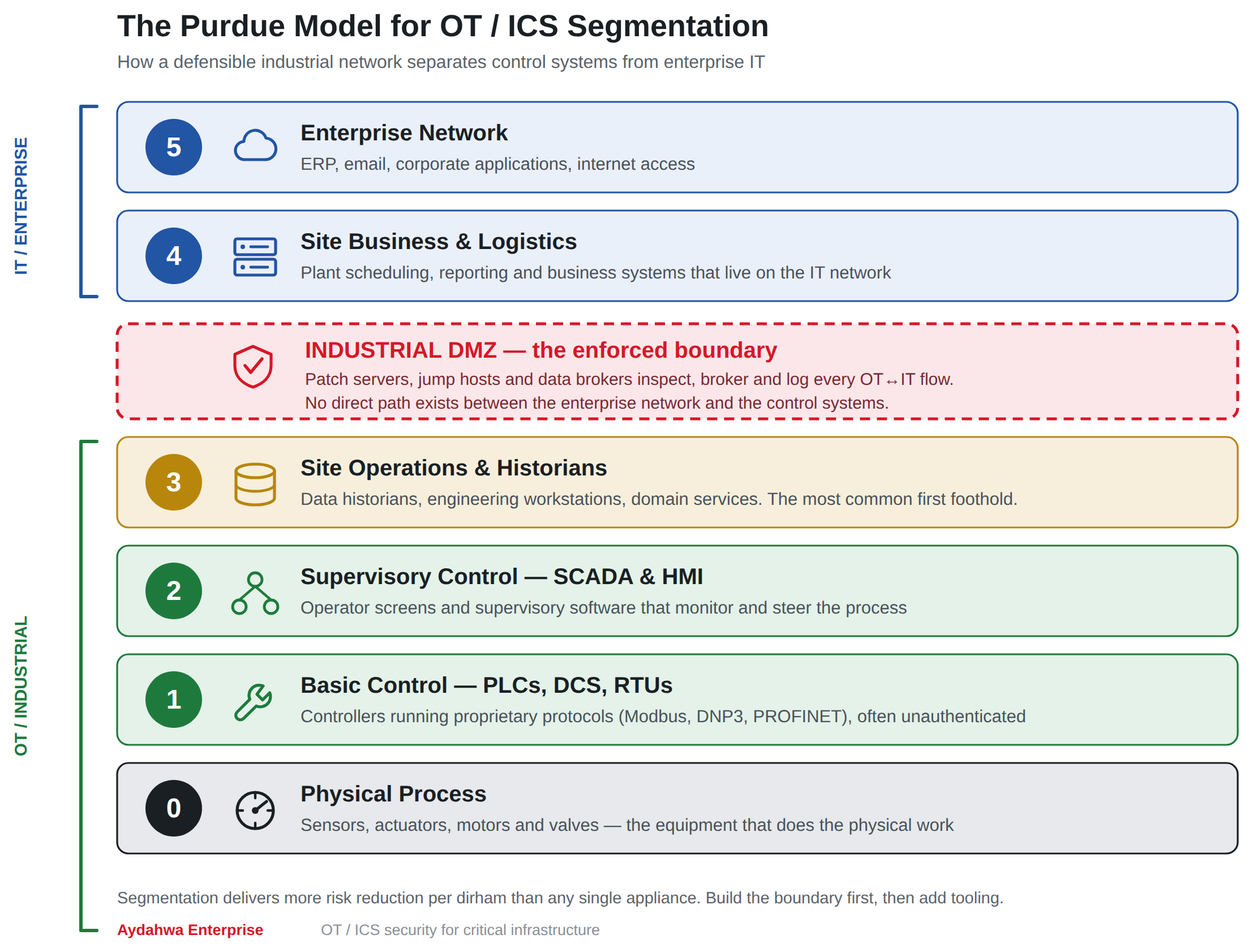 The value of the model is not academic. It gives you a defensible boundary. In a well-segmented environment, nothing in the enterprise network talks directly to a controller. Traffic passes through the industrial DMZ, where it can be inspected, brokered, and logged. A phishing email that compromises an office laptop should not have a clear network path to a PLC three levels down. In too many environments it does, because the OT and IT networks grew together organically and were never deliberately separated.
Segmentation is where we spend most of the early effort on an engagement. It is unglamorous, it takes time, and it delivers more risk reduction per dirham than any single appliance you can install. Micro-segmentation within the OT layers, so that a compromise of one cell does not spread to the whole plant, is the next step once the top-level boundary is solid.
The Standards Worth Building On
Nobody should design an OT security program from a blank page. The frameworks already exist, they are mature, and auditors and regulators recognise them. The ones we build against, and hold our own certifications in where they apply, are these.
IEC 62443 is the international standard written specifically for industrial automation and control systems. It introduces the concepts of zones and conduits, security levels, and a shared responsibility split between the asset owner, the integrator, and the product supplier. If you read one standard for OT, read this one.
NIST SP 800-82, the Guide to Operational Technology Security, is the most practical hands-on companion to 62443. It translates general security control families into the OT context, including how to handle the systems you cannot patch or agent.
The NIST Cybersecurity Framework gives leadership a common language across IT and OT: identify, protect, detect, respond, recover, and now govern. It is how we help a CISO who owns both worlds report risk to a board in one coherent picture rather than two.
ISO 27001 anchors the management-system side, the governance and process discipline that keeps a program alive after the consultants leave, and CIS Controls and Benchmarks give concrete, prioritised hardening steps for the IT-adjacent systems, engineering workstations, and historians that so often sit at the boundary. For operators who also process cardholder or billing data on the enterprise side, PCI-DSS obligations still apply to that segment and should be scoped deliberately, not by accident.
IT Security Versus OT Security: Where the Priorities Diverge
Because so many programs fail by copying IT habits into OT, it helps to see the differences side by side.
DimensionEnterprise ITOperational Technology
Top priority
Confidentiality, then integrity, then availability
Safety and availability, then integrity, then confidentiality
Asset lifespan
3 to 5 years
15 to 25 years
Patching
Frequent, often automated
Rare, tied to maintenance windows, sometimes never
Downtime tolerance
Minutes to hours, usually recoverable
Often unacceptable; can carry safety and physical consequences
Protocols
TCP/IP, HTTPS, authenticated and encrypted
Modbus, DNP3, PROFINET; frequently no authentication or encryption
Monitoring
Active scanning and endpoint agents are normal
Passive monitoring preferred; active scanning can crash fragile devices
Change management
Fast, iterative
Slow, safety-reviewed, engineering-led
The row on monitoring deserves emphasis. An active vulnerability scan that a corporate team runs without a second thought can knock a legacy controller offline, because the device simply cannot handle unexpected traffic. This is why OT monitoring is built on passive network inspection that reads a copy of the traffic and never injects packets of its own. It is also why an IT team running its normal playbook inside a plant is one of the more common ways we see an outage caused by the security program itself.
A Practical Roadmap for Operators Starting Out
When an operator asks where to begin, we give them a sequence rather than a shopping list. The order matters, because each step makes the next one cheaper and safer.
- Build an asset inventory. You cannot protect what you cannot see. Use passive discovery to build a complete picture of every device, protocol, and communication path in the OT network. Most operators are surprised by what turns up, including forgotten remote-access links and devices no one on the current team installed.
- Map and enforce network boundaries. Establish the IT/OT boundary through an industrial DMZ, then work toward segmentation inside the OT layers. Remove any direct path from the enterprise network to control devices.
- Lock down remote access. Replace permanent vendor VPNs with brokered, time-limited, monitored access. Every third-party session should be requested, approved, recorded, and terminated automatically.
- Deploy passive monitoring and detection. Put OT-aware network monitoring in place that understands industrial protocols and can flag anomalies without touching the devices. Feed those alerts into a SOC that knows the difference between a normal engineering change and a genuine threat.
- Harden the boundary systems. Engineering workstations, historians, and jump hosts are the systems you can actually patch and configure. Apply CIS Benchmarks to them, because they are where most intrusions gain their first OT foothold.
- Write an OT-specific incident response plan. Your IT playbook does not cover a scenario where isolating a compromised system might mean tripping a process. Build and rehearse a plan with the operations and engineering teams in the room, not just security.
None of these steps requires ripping out and replacing control equipment, which is the fear that stalls so many programs before they start. They are additive, they respect the constraints of the plant, and they can be phased over budget cycles.
The Mistakes We See Most Often
A few patterns come up again and again, across sectors and across borders.
The first is treating a one-time assessment as a finished project. OT security is a program, not a report. The threat groups Dragos tracks evolve, vendors ship new firmware, and the plant itself changes as equipment is added. A point-in-time audit that gathers dust delivers a false sense of safety.
The second is buying a platform before understanding the architecture. Industrial security platforms are genuinely capable, and the market has matured considerably. But a monitoring tool dropped onto a flat, unsegmented network mostly gives you high-resolution visibility into a problem you have not fixed. Architecture first, then tooling.
The third is excluding the operations team from security decisions. The control engineers know which devices are fragile, which links are load-bearing, and which "temporary" workaround from three years ago is quietly holding production together. A security program designed without them will either be unsafe or be quietly bypassed. The best outcomes we have delivered came from putting security architects and plant engineers at the same table from day one.
How Aydahwa Enterprise Can Help
Securing operational technology sits at the intersection of infrastructure architecture, cybersecurity, and a real understanding of how plants and utilities run. That combination is exactly where we work. Our team brings hands-on experience across critical infrastructure, energy, telecom, and banking, and we build against the standards that matter here: IEC 62443, NIST SP 800-82, the NIST Cybersecurity Framework, ISO 27001, and CIS Controls, backed by certifications including Microsoft Cybersecurity Architect Expert.
We help operators in the UAE and wider GCC assess their current OT exposure, design defensible segmentation, stand up passive monitoring and OT-aware detection, and put governance in place that survives beyond the engagement. If you are early in the journey, our free cybersecurity self-assessment and readiness checklist are a low-commitment way to see where you stand. For a deeper look at our cybersecurity services or how we approach cloud and infrastructure security for connected industrial environments, those pages go into more detail, and our managed services team can carry the monitoring and response load once the architecture is in place.
If you run or advise on critical infrastructure and want a candid read on where your OT risk actually lies, get in touch. We would rather have that conversation before an incident than after one.