Phishing stopped being a spelling test
For twenty years the standard advice for spotting a phishing email held up reasonably well. Look for the broken grammar, the odd sender address, the generic greeting, the urgency that does not quite fit. Train your staff to notice those tells, put a filter in front of the mailbox, and you caught most of it. That advice is now actively dangerous, because the tells are gone. A language model writes cleaner English than most of the people it is impersonating, clones a chief executive's voice from a thirty-second clip, and produces a convincing invoice in the exact format your finance team already trusts.
The security press has spent the last year documenting the shift. Cyber Magazine's briefings through 2026 have tracked the same pattern from several angles: vendors warning that phishing volume is surging as attackers reach for generative tools, security leaders describing AI as the new centre of gravity for both attack and defence, and researchers coining "vibe hacking" for the way a capable model lets someone with modest skills assemble an attack that used to require a team. None of this is speculation about the future. It is the caseload our own engagements have been dealing with, and the businesses getting hurt are not only the large enterprises with a name worth targeting. They are mid-sized firms in the UAE and the wider GCC that assumed they were too small to be interesting.
This piece is about what actually works now. Not awareness posters and an annual quiz, which the current generation of attacks walks straight past, but a layered technical and procedural defence that assumes the human will eventually be fooled and is built to catch the attack anyway.
What changed under the hood
Three capabilities moved from expensive-and-rare to cheap-and-instant, and each one broke a defence that used to work.
The first is fluent, targeted text at volume. Crafting a personalised spear-phishing email once took a human an hour of research and writing per target, which capped how many good lures an attacker could send. A model does the research from scraped LinkedIn and company data and writes the email in seconds, so the economics of "personalise every message" flipped. The generic mass-phishing your gateway was tuned to catch is being replaced by messages that reference a real project, a real colleague, and a real deadline.
The second is synthetic voice and video. Voice cloning that used to need a studio and minutes of clean audio now runs from a short sample pulled off a conference recording or a podcast. We have seen finance staff receive a call that sounds exactly like their director authorising an urgent transfer, followed by a WhatsApp message from a number that looks close enough to the real one. The 2019 and 2024 CEO-fraud cases that made headlines were early, hand-built versions of this. The 2026 version is a commodity.
The third is speed of iteration. An attacker who gets blocked no longer waits a week to retool. They regenerate the lure, swap the sending infrastructure, and try again the same afternoon. Static blocklists and signature-based filters were built for a slower adversary.
Traditional phishing versus the AI-accelerated version
DimensionTraditional phishing (pre-2024)AI-accelerated (2026)
Language quality
Frequent grammar and spelling errors
Native-quality, context-aware prose
Personalisation
Generic, "Dear customer"
Names the real project, colleague, and deadline
Channel
Mostly email
Email, SMS, WhatsApp, cloned voice call, and video
Volume of quality lures
Low — each one took human effort
High — generated per target at near-zero cost
Time to retool after a block
Days to weeks
Minutes to hours
Skill required
Significant technical and social skill
Modest — the model supplies the craft
Read down the right-hand column and the conclusion is uncomfortable but clear. Every defence that depended on the attacker being sloppy, slow, or few in number has lost most of its value. What survives is defence that does not care how good the lure was.
The principle: assume the click, and break the chain anyway
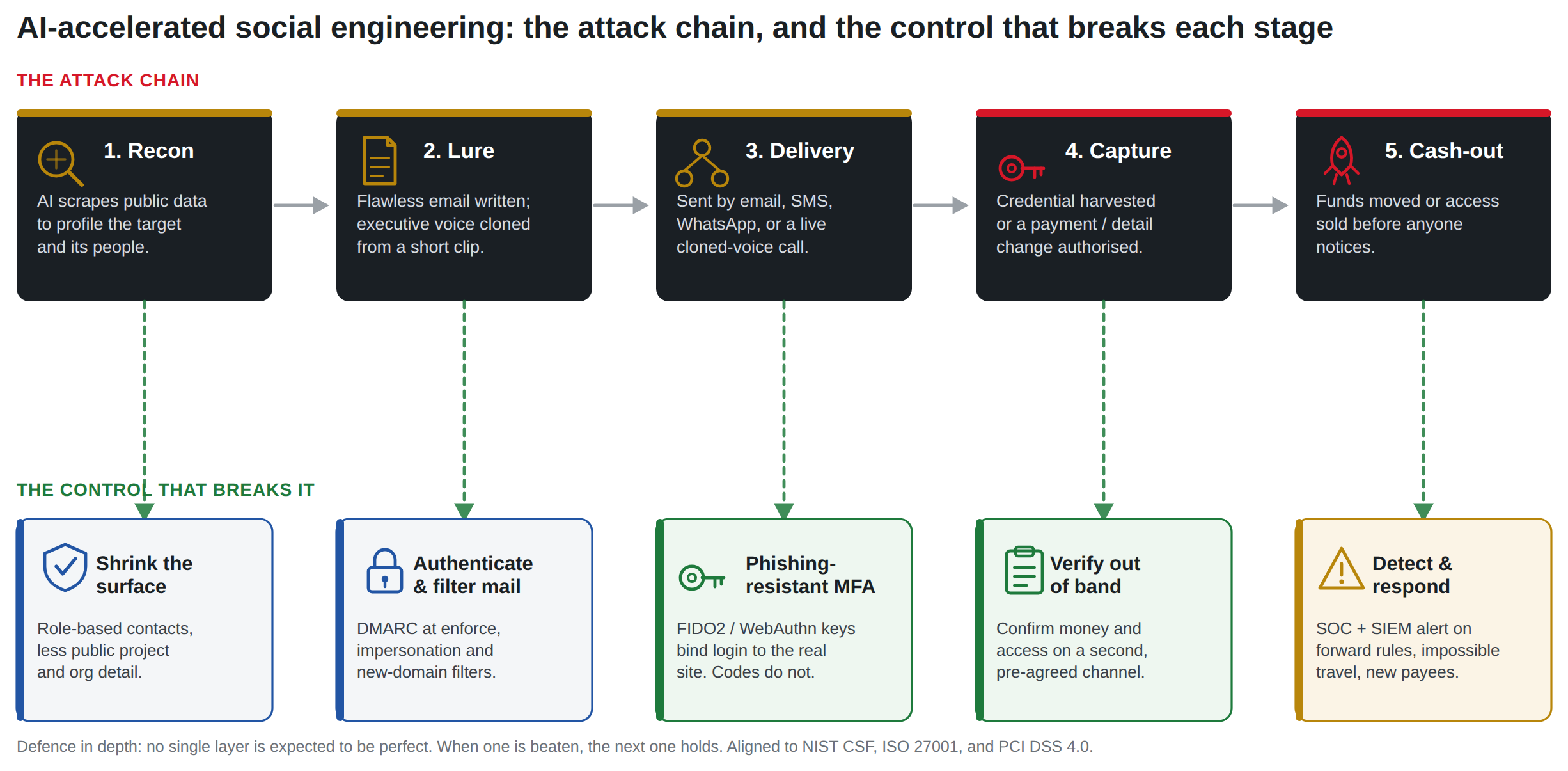
An AI-accelerated attack is still a chain of steps, and a chain fails at its weakest link. The attacker researches the target, crafts a lure across one or more channels, delivers it, harvests a credential or authorises a payment, and then moves the money or the access before anyone notices. A good defence does not try to win at the first step by making every employee an expert lure-spotter. It puts a control on several links so that when one fails, the next one holds.
That is the whole idea behind defence in depth, and it maps cleanly onto the frameworks we build against. NIST CSF 2.0 organises it as Identify, Protect, Detect, Respond, and Recover. ISO 27001 Annex A gives you the control catalogue. For firms handling cardholder data, PCI DSS 4.0 made phishing-resistant controls and anti-phishing mechanisms explicit rather than optional. The point of naming these is not compliance theatre. It is that each one pushes you toward the same architecture: layered controls, not a single wall.
 Layer one: shrink what the attacker can see and send
Reconnaissance feeds the lure. The less an attacker can learn cheaply, the weaker the personalisation. Publish role-based rather than named contact addresses where you can, keep org charts and project detail off public pages, and treat your own domain's mail as an asset worth defending. Implement SPF, DKIM, and DMARC, and move DMARC to an enforcing policy of quarantine or reject rather than leaving it at monitor-only, which is where we still find most UAE SMEs when we first look. A published, enforced DMARC record stops attackers from spoofing your exact domain to your own staff and customers, which is a common move in invoice fraud.
Layer two: filter for intent, not just signatures
The mail gateway still matters, but the selection criteria changed. Signature and reputation filtering catches the known-bad; it does not catch a clean, first-seen message from a freshly registered lookalike domain. Modern secure email gateways and platforms such as Microsoft Defender for Office 365 or Proofpoint add behavioural and intent analysis: they flag a message that impersonates an internal executive, that asks for a payment change, or that arrives from a domain registered yesterday. Turn on impersonation protection and newly-registered-domain policies specifically. These are the features that catch the lure your staff would not.
Layer three: make the stolen password worthless
This is the single highest-value control, and it is where I push hardest in every engagement. Most credential phishing succeeds because the harvested password still works. Phishing-resistant multi-factor authentication breaks that. FIDO2 and WebAuthn security keys, and passkeys built on the same standard, bind the login to the real domain cryptographically, so a user who types their credentials into a convincing fake site simply cannot complete the authentication. The key will not respond to the wrong origin.
One-time codes from an SMS or an authenticator app are better than a password alone, but they are still phishable. A real-time proxy attack asks the user for the code and replays it within the window. If your executives, finance team, and IT administrators are still on push-approval or SMS codes, that is the gap to close first. Pair the hardware keys with conditional access policies that check device health and location, so a login from an unmanaged device in an unexpected country faces additional friction even with valid factors.
Layer four: verify money and access out of band
Technology stops most of the attack. It does not stop the cloned-voice call to a junior accountant on a Thursday afternoon. The control for that is procedural, and it has to be defined before the call comes, not improvised during it. Set a rule that no payment, no change to bank details, and no privileged-access grant happens on the strength of a single inbound channel. A request that arrives by email or voice is confirmed on a different, pre-agreed channel, using a contact detail already on file rather than one supplied in the request itself.
Give staff explicit permission to slow down. Most successful voice-fraud attacks work because a real person felt too junior to question someone who sounded like the boss and too rushed to check. A written policy that says "verify first, always, and you will never be blamed for the delay" removes the social pressure the attacker is counting on. This costs nothing to implement and stops the attacks that no filter can see.
Layer five: detect and respond faster than the cash-out
Assume that despite everything, one attack lands. The question then is whether you notice in minutes or in months. This is the job of a SOC feeding a SIEM: centralise authentication logs, mailbox rule changes, and payment-system events, and alert on the patterns that follow a successful phish. A new inbox rule that auto-forwards and deletes finance mail, an impossible-travel login, a sudden spike in outbound mail from one account, a payment to a never-seen beneficiary. Each is a signal that the earlier layers were beaten and the clock is now running. For most mid-sized firms a co-managed SOC is the realistic route to round-the-clock coverage without hiring a night shift.
A defence checklist you can act on this quarter
- Move DMARC to an enforcing policy (quarantine or reject), with SPF and DKIM aligned, on every domain you own — including the ones you do not actively send from.
- Roll out phishing-resistant MFA (FIDO2 or WebAuthn keys, or passkeys) to executives, finance, and administrators first, then the rest of the organisation.
- Enable impersonation protection and newly-registered-domain filtering on your email platform, not just the default anti-spam.
- Write and circulate an out-of-band verification rule for all payments, bank-detail changes, and privileged-access requests, with named backup contacts.
- Run a real phishing simulation — including a voice or SMS component, not only email — and use the results to target training, not to punish.
- Centralise authentication, mailbox, and payment logs into a SIEM, and define alerts for auto-forward rules, impossible travel, and new-beneficiary payments.
- Rehearse the response once. Who freezes the account, who calls the bank, who owns the communication, and how fast can each happen.
Work top to bottom and you will have closed the highest-value gaps within a quarter without a large capital outlay. Most of these are configuration and policy, not new licences.
Where this is heading
The attacker's tooling will keep improving, and the honest position is that no single control will ever be final. Real-time deepfake video calls are moving from demo to field use, which will put pressure on the out-of-band verification step and push more organisations toward cryptographic proof of identity for high-value actions. The defensive side is arming too. The same AI that writes the lure is being turned on the defence, triaging alerts, correlating weak signals across systems, and cutting the time between a successful phish and its detection. The firms that come through this well will be the ones that treated the layered architecture as the baseline and kept adjusting, rather than the ones still hoping their staff can spot a fake that no longer looks fake.
How Aydahwa Enterprise Can Help
Aydahwa Enterprise has spent since 2018 building and defending infrastructure for organisations across the UAE and the GCC, including regulated environments in banking, telecom, and critical infrastructure where a single successful fraud is not a minor loss. Our work is grounded in the frameworks named throughout this article — NIST CSF, ISO 27001, PCI DSS, and CIS Benchmarks — and in twenty-five years of hands-on infrastructure and security engineering, not slideware.
We can review your current exposure to AI-accelerated phishing and social engineering, harden your email authentication and identity layers, deploy phishing-resistant MFA and conditional access, and stand up the SOC and SIEM monitoring that catches the attacks that slip through. If you want a fast, no-cost starting point, run our cyber security self-assessment or work through the cybersecurity readiness checklist to see where the gaps are. When you are ready to close them, our cybersecurity services, cloud security, and managed IT support teams do the work end to end. Get in touch and we will start with your highest-value gap first.