Authentication is where most breaches begin, and where most audits start
Every system we assess, whether it is a core banking platform under Qatar Central Bank oversight or a startup's first cloud deployment, has an authentication layer. It is the boundary that decides who gets in. When it is designed well, it is invisible to legitimate users and unforgiving to attackers. When it is designed badly, it becomes the single point that turns a stolen password into a full account takeover, a leaked token into a data breach, and a missed control into an audit finding.
The uncomfortable reality is that authentication has grown harder, not simpler. Users expect to sign in once and move across web, mobile, and partner systems without friction. Attackers have industrialised credential stuffing, session hijacking, and token theft, and phishing kits now defeat one-time codes in real time. Meanwhile regulators from PCI-DSS to ISO 27001 keep raising the bar on how identity is verified and logged. A method that was defensible five years ago can be a liability today.
This guide walks through the authentication techniques we actually deploy and defend in production, what each one protects against, where each one fails, and how to choose between them for the environment you operate in. The goal is a set of decisions you can defend to an auditor and, more importantly, to yourself after an incident.
The three forces every authentication design has to balance
Before comparing methods, it helps to name the tension every design lives inside. Security, scalability, and user experience pull against each other, and most weak authentication systems are the result of one of the three quietly winning.
Security means resisting the specific attacks that target identity: credential stuffing using passwords leaked elsewhere, session hijacking through stolen cookies, token theft from a compromised browser or log file, and replay of captured credentials. Scalability means supporting millions of logins without turning the identity service into a bottleneck or a shared secret sprawl. User experience means people can get their work done without abandoning the product or, worse, routing around the control with a sticky note. A design that ignores any one of these does not survive contact with real users.
We have seen banks over-index on security to the point that staff shared credentials to avoid a clumsy token, and we have seen fast-moving SaaS teams ship password-only login because multi-factor "slowed onboarding." Both created the exact risk they were trying to manage. The methods below each sit at a different point in this triangle, and choosing well means knowing which corner you can least afford to give up.
Passwords and why hashing is the part that matters
Passwords are not going away, and treating them as a solved problem is how credential databases end up on breach forums. The password itself is the weak part; how you store and verify it is the part under your control.
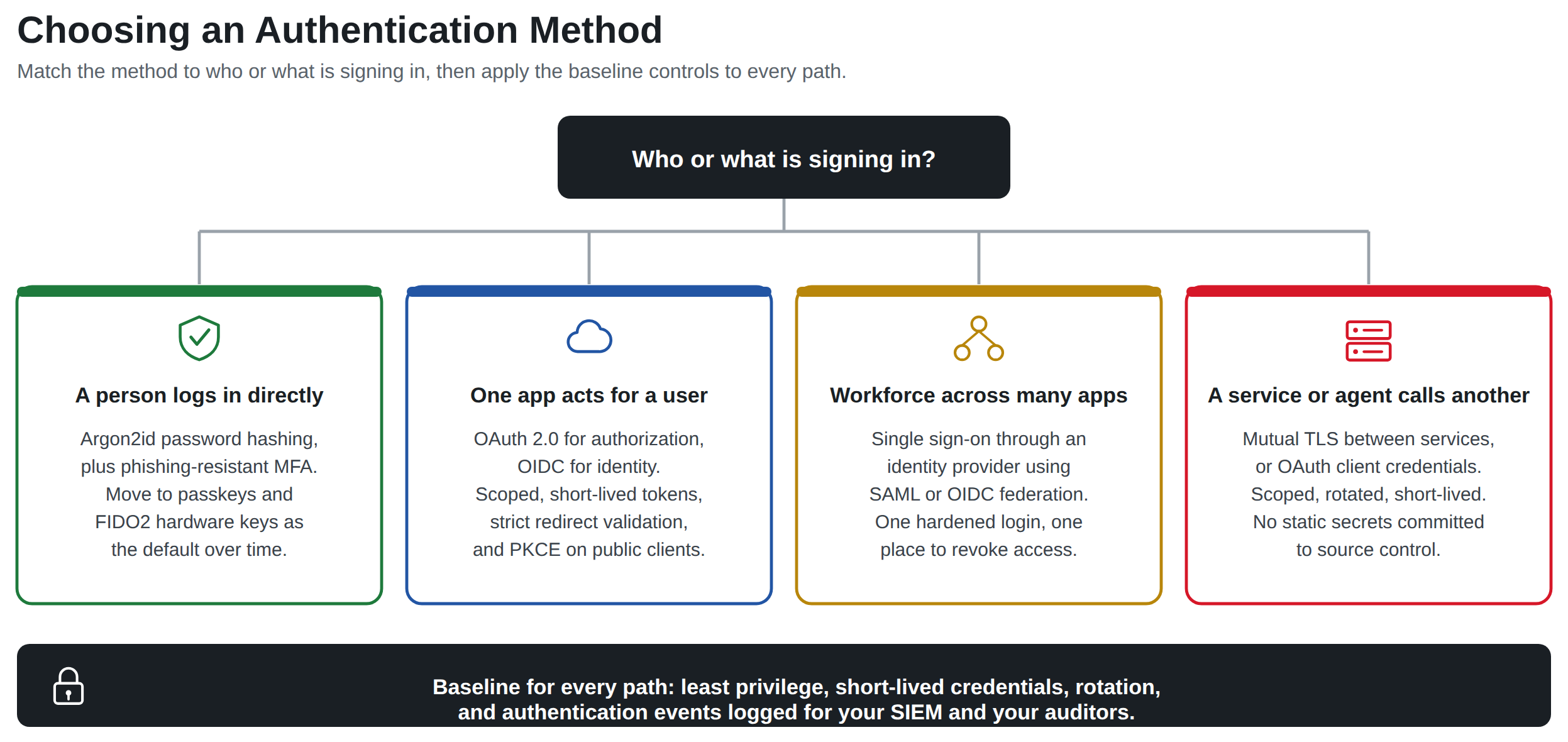
Store passwords only as salted hashes produced by a slow, memory-hard algorithm. Argon2id is the current first choice, with bcrypt and scrypt as acceptable alternatives where Argon2 is not available. A unique salt per credential defeats precomputed rainbow tables, and a deliberately slow hash makes offline cracking expensive even after a database is stolen. Fast general-purpose hashes such as MD5 or plain SHA-256 are not password hashes and should never be used for this purpose. In assessments we still find SHA-1 and unsalted hashes in production systems that passed a checkbox audit years ago and were never revisited.
Around the password, the controls that carry the real weight are rate limiting and lockout to blunt brute force, breach-password screening to reject credentials known to be compromised, and monitoring for credential-stuffing patterns such as thousands of logins from one address against many accounts. A strong hash protects you after a database theft. The surrounding controls protect you during the attack, which is where most damage happens.
Multi-factor authentication, and the gap between factors
Adding a second factor is the highest-return change most organisations can make, and it is now an explicit expectation under frameworks including PCI-DSS and NIST guidance. What matters is which second factor you choose, because they are not equivalent.
SMS one-time codes are better than nothing and worse than they look. They are vulnerable to SIM swapping, interception, and real-time phishing, where a fake login page relays the code to the attacker within its validity window. Authenticator-app codes based on TOTP remove the carrier from the picture but remain phishable in the same relay attack, because the user can be tricked into typing the code into the attacker's page. Push-based approvals reduce typing but introduce "MFA fatigue," where a user bombarded with prompts eventually taps approve. Hardware security keys and passkeys built on FIDO2 and WebAuthn close the phishing gap entirely, because the cryptographic response is bound to the real site's origin and cannot be replayed against a fake one.
The practical guidance we give is to treat phishing-resistant factors as the target state for anything that matters, and to reserve SMS for account recovery of last resort rather than a primary second factor. For a workforce, that usually means passkeys or hardware keys. For consumers, it means offering passkeys and making them the default path while keeping a fallback that is itself hardened.
 Passwordless and passkeys: what actually changes
Passkeys deserve their own treatment because they change the economics of the most common attack. A passkey is a public-private key pair created for a specific site. The private key never leaves the user's device or hardware key, and each login is a challenge-response signed against the site's real origin. There is no shared secret to steal from your database, nothing to phish, and nothing to replay.
For the organisation, the payoff is concrete. The credential-stuffing risk drops to near zero because there is no reusable password. The phishing risk drops because the browser and authenticator enforce origin binding. The support burden of password resets falls over time. The tradeoffs are real and worth planning for: account recovery has to be designed carefully so that losing a device does not lock a user out or, worse, become the new weak link an attacker targets. Cross-device and cross-platform behaviour still varies, and enterprise deployments need a clear policy on synced versus device-bound keys depending on assurance requirements.
We generally recommend introducing passkeys alongside existing methods first, measuring adoption, then moving them to the default. A hard cutover tends to generate a wave of recovery requests that itself becomes an attack surface.
Delegated and federated access: OAuth 2.0, OIDC, and SAML
Once you move beyond a single application, the question shifts from "how does this user prove who they are" to "how do systems share identity safely." Three protocols dominate, and they solve related but distinct problems. Confusing them is a common source of both security holes and wasted engineering effort.
OAuth 2.0 is an authorization framework. It lets a user grant one application limited access to their resources in another without sharing a password, using scoped, expiring access tokens. It answers "what is this app allowed to do," not "who is this user." OpenID Connect is a thin identity layer on top of OAuth 2.0 that adds an ID token, so it answers the authentication question properly. When a team says they "use OAuth for login," what they usually want, and should be using, is OIDC. SAML is the older XML-based standard that still runs most enterprise single sign-on, particularly where established identity providers and B2B integrations are involved.
The failure modes here are specific and worth naming. Missing or lax redirect-URI validation lets an attacker capture authorization codes. Skipping PKCE on public clients such as mobile and single-page apps leaves the flow open to code interception. Failing to validate token signatures, the issuer, and the audience turns a token check into a formality an attacker can forge past. Overly broad scopes hand third parties far more access than the task requires. Each of these is routine to get right and routinely gotten wrong.
Sessions, tokens, and the JWT decisions people regret
After a user authenticates, something has to remember that fact on later requests. The two dominant patterns are server-side sessions and stateless tokens, most often JSON Web Tokens, and the choice has real operational consequences.
Server-side sessions keep a session identifier in a cookie and the actual state on the server. Revocation is easy because you delete the record, and the cookie carries no sensitive data. The cost is that the server, or a shared store such as Redis, has to hold session state, which is a scaling and availability consideration but rarely a real obstacle. Stateless JWTs carry claims signed by the server, so any node can validate a request without a lookup, which scales cleanly across services. The catch is revocation: a signed token is valid until it expires, so a stolen token stays useful unless you add a denylist or keep lifetimes short, which pulls you back toward keeping state anyway.
The recurring mistakes we clean up are long-lived access tokens with no refresh strategy, storing tokens in browser local storage where any cross-site scripting flaw can read them, accepting the "none" signing algorithm, and putting sensitive data in a JWT payload that is signed but not encrypted and therefore fully readable. A workable default for most web applications is short-lived access tokens paired with rotating refresh tokens, cookies marked HttpOnly, Secure, and SameSite, and server-side sessions wherever prompt revocation is a hard requirement, which in regulated environments it usually is.
Machine-to-machine authentication
Not every caller is a person. Services, jobs, and increasingly AI agents authenticate to each other, and the same rigour applies even though no human is present. API keys are simple and appropriate for low-risk internal use, provided they are scoped, rotated, and never committed to source control, where secret scanners and attackers both look first. Mutual TLS raises the bar by having both sides present certificates, which is well suited to service-to-service traffic inside a zero trust architecture. OAuth 2.0 client-credentials grants give services scoped, expiring tokens in the same way user flows do, with the advantage of central issuance and revocation.
In one regulated blockchain engagement we isolated the transaction-signing infrastructure behind its own network segmentation and strict mutual authentication, so that even a compromise elsewhere in the platform could not reach the systems that move value. The principle generalises: machine identities deserve least privilege, short-lived credentials, and audit logging exactly as human identities do, and in most estates they now outnumber the humans.
Comparing the methods at a glance
MethodPrimary useProtects againstMain weaknessBest fit
Password + Argon2id hashing
Direct user login
Database theft, rainbow tables
Reuse, phishing, stuffing
Baseline, never alone
SMS / TOTP MFA
Second factor
Password-only compromise
Real-time phishing, SIM swap
Fallback, not primary
Passkeys / FIDO2
Passwordless login, strong MFA
Phishing, stuffing, replay
Recovery design complexity
Workforce and high-value accounts
OAuth 2.0 + OIDC
Delegated access and SSO
Password sharing across apps
Misconfigured redirects, scopes
Third-party and consumer SSO
SAML
Enterprise SSO
Credential sprawl across apps
XML complexity, older tooling
B2B and workforce federation
Mutual TLS
Service-to-service
Impersonation between services
Certificate lifecycle overhead
Zero trust internal traffic
How we choose in practice
There is no single correct authentication design, only the right design for a given risk profile, user base, and regulatory context. The decisions below are the ones we work through with clients before writing a line of integration code.
- Start from the threat model and the data. A payments platform under PCI-DSS and a marketing microsite do not warrant the same controls. Match assurance to what a compromise would actually cost.
- Make phishing-resistant authentication the target for anything that matters. Passkeys or hardware keys for workforce and high-value accounts, with hardened fallbacks rather than SMS as a primary factor.
- Use OIDC for user authentication and OAuth 2.0 for delegated authorization, and keep the two ideas separate in your design and your logs.
- Default to short-lived tokens with rotation and secure, HttpOnly cookies, and keep server-side sessions wherever you need to revoke access immediately.
- Treat machine identities with the same discipline as human ones: scoped, short-lived credentials, rotation, and audit trails.
- Log every authentication event in a form your SIEM and your auditors can both use. Failed logins, factor changes, token issuance, and privilege changes are the events that reconstruct an incident.
Getting these right is rarely about buying a product. It is about the configuration details, the recovery flows, and the monitoring around them, which is exactly where most implementations quietly fall short.
How Aydahwa Enterprise can help
We have designed and hardened authentication for environments where getting it wrong is not an option, from a 50-plus server banking estate under Qatar Central Bank, PCI-DSS, ISO 27001, and CIS benchmarks, to nationwide telecom platforms and regulated cloud workloads across AWS, Azure, and GCP. That work spans zero trust access with 802.1x, RADIUS, and LDAP, privileged access management, custom web-application and API protection, and identity federation at scale.
If you are reviewing your own authentication posture, our free cybersecurity self-assessment and readiness checklist are a fast way to find the gaps. For a deeper engagement, our cybersecurity services cover identity and access architecture, our cloud services team handles authentication for cloud and hybrid workloads, and our managed IT support keeps these controls current as threats and standards move. When you are ready to talk specifics, get in touch and we will start from your actual risk, not a template.