Ransomware stopped being a break-in and became a business model
The groups running ransomware today operate like companies. They have affiliates, revenue splits, support desks for victims who can't figure out how to buy cryptocurrency, and increasingly, automation that does the tedious parts of an intrusion faster than any human operator could. That last shift is the one that matters for anyone responsible for keeping a business running. When the work of finding a foothold, escalating privileges, locating the backups, and pushing the encryptor can be scripted and accelerated with machine assistance, the window a defender has to notice and react shrinks from days to hours, sometimes to minutes.
Cyber Magazine's recent roundup of ransomware defence platforms framed the market as a race toward "AI-native" tooling built to counter machine-speed extortion. The framing is fair, and the vendors are real. But a platform purchase is the last decision you should make, not the first. In our engagements across banking, telecom, and critical national infrastructure in the UAE and wider GCC, the organisations that recover cleanly from ransomware are rarely the ones with the most expensive product. They are the ones who assumed an attacker would eventually get in, and built for that day before it arrived.
What machine-speed actually changes for a defender
It helps to be precise about what is new and what is not. The initial access methods have barely changed: phishing, exposed remote access, unpatched edge devices, and stolen credentials still account for the overwhelming majority of ransomware entries. What has changed is the tempo of everything that happens after that first foothold.
An operator working by hand might take a day or two to map an Active Directory environment, identify the domain admins, find the file servers and the backup infrastructure, and stage the encryptor. Automation compresses that. Reconnaissance that reads a directory, spots the highest-value accounts, and picks a lateral-movement path can run in the time it takes a SOC analyst to finish reviewing the morning's alert queue. The attacker also now routinely exfiltrates data before encrypting anything, so the threat is double: your files are locked, and a copy is already gone, ready to be leaked if you refuse to pay.
The practical consequence is that detection has to move from "review and investigate" toward "detect and contain automatically". A control that requires a human to read an alert, decide it's real, and then act is a control that loses the race. This is where the AI-native detection tooling earns its place, not as a silver bullet, but as a way to shrink the gap between a suspicious signal and an automated response such as isolating a host or disabling an account.
Build for the day the attacker gets in
Prevention still matters, and we spend real effort on it. But a defence strategy that depends entirely on keeping everyone out has a single point of failure: the first mistake. A resilient design assumes the perimeter will be breached and asks a harder question. If an attacker is already inside with a valid credential, how far can they get, how quickly will you see them, and how fast can you restore?
Detection and containment come first
Endpoint detection and response (EDR) on every server and workstation is the baseline, feeding a SIEM that correlates signals across the estate. The value is in the correlation. A single failed login means nothing. A failed login, followed by a successful one from an unusual location, followed by a new service being installed and a burst of file access across a share, is a ransomware playbook in progress. Your monitoring has to see that as one story, not four unrelated events. For organisations without a 24-hour security team, a managed SOC closes the overnight and weekend gaps, which is precisely when most encryption events are launched.
Identity is the highway ransomware travels
Most ransomware does not spread through some exotic exploit. It spreads through credentials and the permissions attached to them. Three controls do more than almost anything else to slow an intruder: multi-factor authentication on every account that can reach anything sensitive, aggressive reduction of standing administrative rights, and network segmentation so that a compromised workstation cannot reach a domain controller or a backup server directly. Applying the CIS Benchmarks to your identity platform and hardening privileged access removes the easy lateral paths that automation depends on.
Backups you can actually restore from
Every organisation says it has backups. Far fewer have backups an attacker cannot reach, and fewer still have tested that they restore. Modern ransomware operators go looking for backup infrastructure specifically, because a victim with clean, recoverable backups has no reason to pay. The design principle that survives contact with a real attack is the 3-2-1-1-0 rule, and it is worth building the whole backup strategy around it.
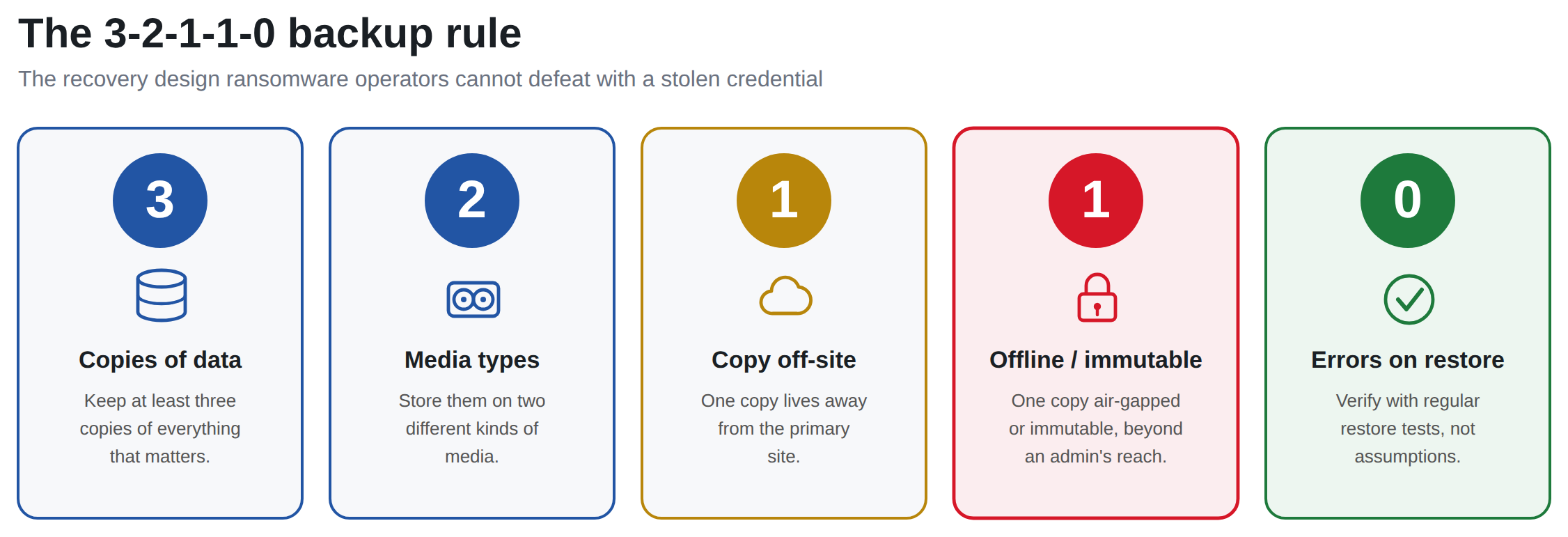 The two elements attackers hate most are the immutable, air-gapped copy and the tested restore. An immutable backup cannot be altered or deleted for a defined retention window, even by an administrator account, so a stolen credential cannot quietly wipe your recovery point. The tested restore is what turns a backup from a checkbox into a capability. A backup you have never restored is a hypothesis, not a safety net.
The recovery clean-room
Restoring after ransomware is not a matter of copying yesterday's data back over today's mess. If you restore into the same environment the attacker compromised, you risk restoring the malware alongside the data, or handing the attacker a still-valid foothold to encrypt you a second time. The recovery has to happen through an isolated, controlled path.
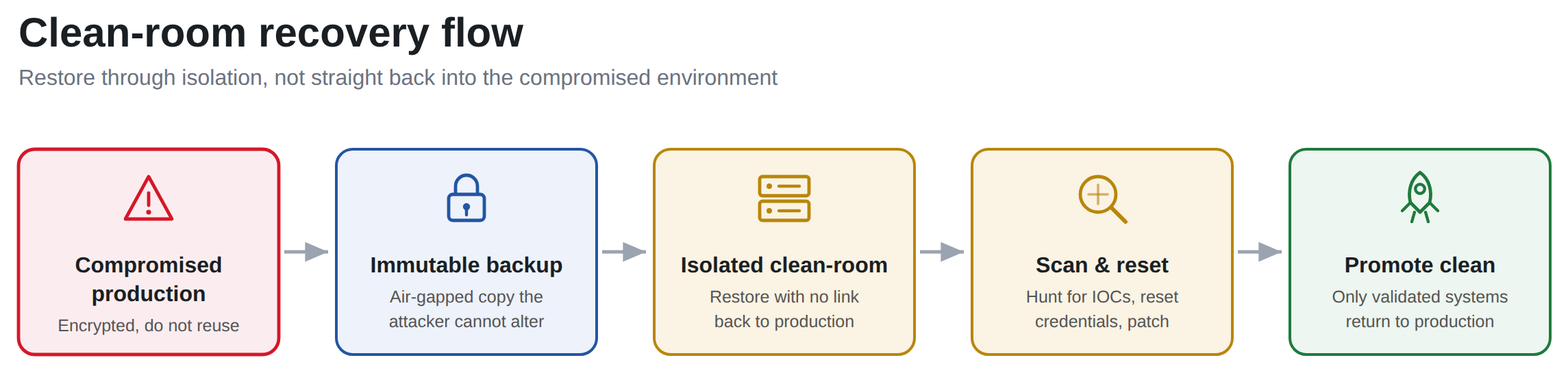 The clean-room approach restores from the immutable copy into an isolated environment with no connection back to production. There, systems are scanned for indicators of compromise, credentials are reset, patches are applied, and only validated, clean workloads are promoted back into production. This is slower than a naive restore, and that is the point. The extra hours buy certainty that you are not rebuilding on top of the same compromise. We rehearse this flow with clients before an incident, because the first time you attempt a clean-room recovery should not be during the worst week of the year.
Paying is not a recovery plan
When an organisation has no clean way back, the ransom starts to look like the fast option. It rarely is. Decryptors supplied by criminal groups are often slow and buggy, and they only address the encryption half of a double-extortion attack; the stolen copy of your data is still out there whether you pay or not. There are also sanctions and legal exposures attached to paying certain groups, which for a regulated UAE business is a serious complication rather than a footnote. The regulatory picture cuts the other way too. Data-protection obligations across the GCC now carry real penalties for breaches and for the downtime that follows one, so a slow, uncertain recovery is expensive even before you count the lost revenue.
Every hour of the design work described above is cheaper than a single day of an unplanned outage. In the incidents we have supported, the organisations that never seriously considered paying were the ones who had rehearsed their recovery and trusted it. That confidence is not a personality trait. It is the direct output of tested immutable backups and a recovery process someone has actually run.
Mapping the work to a framework you will be audited against
The controls above are not a random collection. They map cleanly onto the frameworks that GCC regulators, banks, and enterprise customers increasingly expect, and expressing the work in those terms makes both the audit and the board conversation easier.
CapabilityWhat it delivers against ransomwareFramework anchor
Asset and identity inventory
You cannot protect or segment what you have not mapped
NIST CSF Identify; ISO 27001 A.5, A.8
MFA, least privilege, segmentation
Removes the lateral-movement paths automation relies on
NIST CSF Protect; CIS Controls 5, 6
EDR, SIEM, managed SOC
Detects and contains an active intrusion at speed
NIST CSF Detect; ISO 27001 A.8.15, A.8.16
Immutable, tested backups
Removes the attacker's leverage; enables recovery without paying
NIST CSF Recover; ISO 27001 A.8.13
Incident response and clean-room recovery
Restores operations without reinfection
NIST CSF Respond and Recover; ISO 27001 A.5.24-A.5.27
For businesses handling cardholder data, the same backup, access-control, and logging requirements are echoed in PCI-DSS, and for those pursuing SOC 2, the availability and confidentiality criteria lean on exactly this recovery capability. The point is that a ransomware programme done properly is not extra work sitting outside your compliance obligations. It is most of the compliance work, organised around a threat you can explain to anyone.
A readiness checklist
If you want a concrete place to start, work through these in order. Each one is something we check in a readiness assessment, and each one has stopped a real incident from becoming a catastrophe.
- Confirm MFA is enforced on all remote access, email, and privileged accounts, with no exceptions carved out for convenience.
- Inventory every account with administrative rights and remove the ones that do not need to be standing.
- Verify that at least one backup copy is immutable or air-gapped and cannot be deleted by a normal administrator credential.
- Perform an actual restore test from that copy and time how long a full recovery takes.
- Segment the network so that user workstations cannot directly reach domain controllers or backup systems.
- Ensure EDR is deployed everywhere and its alerts reach someone, or something, that responds around the clock.
- Write and rehearse an incident response plan that names who decides, who communicates, and how a clean-room recovery is executed.
- Map your controls to NIST CSF or ISO 27001 so gaps are visible before an auditor or an attacker finds them.
How Aydahwa Enterprise can help
Aydahwa Enterprise builds and operates ransomware-resilient infrastructure for organisations across the UAE and GCC, drawing on 25 years of hands-on work in banking, telecom, and critical national infrastructure. Our team holds credentials including ISO 27001, PCI-DSS, and the Microsoft Cybersecurity Architect Expert certification, and we design to NIST CSF and CIS Benchmarks rather than to a vendor's marketing.
If you are not sure where your gaps are, our free cyber security self-assessment and cybersecurity readiness checklist are a fast way to get a first read. When you are ready to go deeper, our cybersecurity services cover SOC and SIEM monitoring, identity hardening, and incident response, while our cloud services team designs immutable backup and clean-room recovery for cloud and hybrid estates. Day-to-day, our managed IT support keeps the controls patched, monitored, and tested rather than left to drift. To talk through your specific environment, get in touch and we will start with your actual risk, not a product demo.