The real question isn't whether to use AI. It's where your data goes when you do.
A 70-billion-parameter model needs roughly 140 GB just to hold its weights. A strong workstation GPU gives you 24 GB, a data-centre card maybe 48 or 80. Models have grown about a hundredfold in a few years while the memory on a single card has barely doubled. That gap is why almost everyone reaching for AI today does the obvious thing: they send their prompts to a hosted API and let someone else's cluster do the work.
For a marketing team drafting copy, that trade is fine. For a bank reconciling accounts, a telecom operator analysing call records, or an operator of critical national infrastructure reviewing incident logs, it is a different conversation. The moment a prompt leaves your network, it carries whatever you put in it. Customer records, cardholder data, network diagrams, source code, internal tickets. It crosses into another company's storage, another country's jurisdiction, and a retention policy you did not write and cannot audit.
In our engagements we keep meeting the same wall. Leadership wants the productivity that AI clearly delivers. The compliance officer wants to know exactly where the data sits and who can subpoena it. Both are right. The way to satisfy both is to run the model on hardware you control, and the reason that has become practical is a set of compression techniques that shrink a capable model down to something an owned GPU can actually hold.
What you are really deciding when you pick an AI vendor
Sending data to a third-party model is a data-transfer decision dressed up as a productivity decision. Treat it as the former and the questions get sharper.
Under PCI-DSS, cardholder data has strict handling and storage boundaries, and "we pasted it into a chatbot" is not a control you can show an assessor. ISO 27001 expects you to know where information assets live and to manage suppliers who touch them; an AI API is a supplier processing your most sensitive text. In the UAE, the Personal Data Protection Law and the sector rules that banking and telecom operators already work under put real weight on cross-border transfer and data residency. If your prompts land on servers in another region, you have created a transfer you now have to justify.
Then there is the quieter risk. Hosted providers log requests for abuse monitoring and, in many cases, for evaluation. Enterprise tiers offer contractual carve-outs, and the good ones honour them, but a contractual promise is a different class of assurance than a network boundary. When a regulator or a court asks where a specific customer's data went on a specific day, "it stayed inside our perimeter" is an answer you can prove. "Our vendor says they deleted it" is an answer you have to hope for.
None of this means AI is off the table. It means the deployment model is a security control in its own right, and it deserves the same scrutiny you would give a firewall change.
Why running your own model stopped being a fantasy
Two years ago, self-hosting a genuinely useful model meant buying a rack of accelerators most organisations could not justify. That has changed, and not because the hardware got cheap. It changed because the models got smaller without getting noticeably dumber.
The intelligence of a language model lives in its weights, a very large pile of numbers arranged into matrices and stacked across dozens of layers. Two facts about those weights make compression possible. First, most of them barely matter; a large majority sit close to zero and contribute almost nothing to the output. Second, you judge a model by how it behaves, not by the exact value of any single weight. Nudge the numbers a little and the behaviour holds, the same way a photograph is still recognisable after you shave a bit of detail off every pixel.
Three techniques exploit those facts. You can store each weight in less detail, delete the weights that carry no load, or train a small model to imitate a big one. They stack, which is the important part. A lab can distil a model, a research team can prune it, and you can quantize it on the way into your own server. Stacked together, they are what let a model that once demanded a cluster run on a single card in your own rack.
Quantization: fewer bits per weight
During training, weights are held in high precision, usually 32-bit floating point, because training makes millions of tiny adjustments that need the headroom. Once training is done, that precision is mostly wasted. Whether a weight is stored as 0.02934517 or simply 0.029 makes almost no difference to the answer.
Quantization takes advantage of that. It groups nearby weights into small blocks, finds the range each block spans, and maps every value onto a much coarser scale, often an 8-bit or 4-bit integer, keeping one scale factor per block so the numbers can be reconstructed closely enough at run time. The model keeps the same weights, matrices and layers. It just describes each number more crudely and uses a fraction of the memory. Dropping from 32-bit to 8-bit is nearly free in quality. Push to 4-bit and below and you start to see it, especially on nuanced or highly factual work, so this is a dial you tune per use case rather than a switch you flip.
Pruning: cut the weights that do nothing
Pruning deletes weights outright. The naive version sorts weights by how far they sit from zero and removes the smallest, which on a 70-billion model can mean cutting well over ten billion of them. The better version runs sample text through the model first and scores each weight by how much traffic actually flows through it, because a small weight on a busy pathway matters more than a larger one on a dead end.
How you remove them matters too. Zeroing weights in place does the least damage but leaves a matrix full of holes the GPU still has to process. Removing whole structural pieces, an entire neuron, attention head or layer, genuinely shrinks the model but is a blunter cut that can take useful connections with it. Pruning is rarely a full answer on its own, which is why it is usually paired with the other two.
Distillation: a small model that copies a large one
Distillation leaves the original untouched and trains a new, smaller "student" model to reproduce the behaviour of the large "teacher". The trick is what the student learns from. Ordinary training only shows the correct next word. Distillation shows the teacher's full set of probabilities, so the student learns not just that "mat" was the answer but that "floor" and "couch" were reasonable and "purple" was not. That richer signal is why a well-distilled small model can hold a surprising amount of its teacher's judgement, though it will still stumble on genuinely novel problems the teacher was never asked.
How the three techniques compare
TechniqueWhat it doesStorage winMain quality riskBest used for
Quantization
Stores each weight in fewer bits (e.g. 16-bit to 4-bit)
High, 2x to 8x smaller
Loss of nuance and specific facts at 4-bit and below
Fitting an existing model onto owned hardware quickly
Pruning
Removes low-value weights or whole structural pieces
Moderate, depends on how aggressive
Weaker multi-step reasoning if you cut too deep
Trimming a model in combination with quantization
Distillation
Trains a small model to imitate a large one
Very high, e.g. 7B replacing 70B
Weaker on novel problems outside the teacher's coverage
A permanent, lightweight model for a defined task
In practice you rarely pick one. A common path is to start with a distilled open-weight model in the size class your task needs, then quantize it to land inside your GPU's memory budget, and evaluate against your own data before it goes anywhere near production.
Keeping the data inside the boundary
The security argument is simpler than the engineering. If the model runs on infrastructure you own, the sensitive data and the inference that acts on it never cross your perimeter. There is no third-party retention to reason about, no cross-border transfer to justify, and no vendor log to subpoena. The diagram below is the whole thesis on one page.
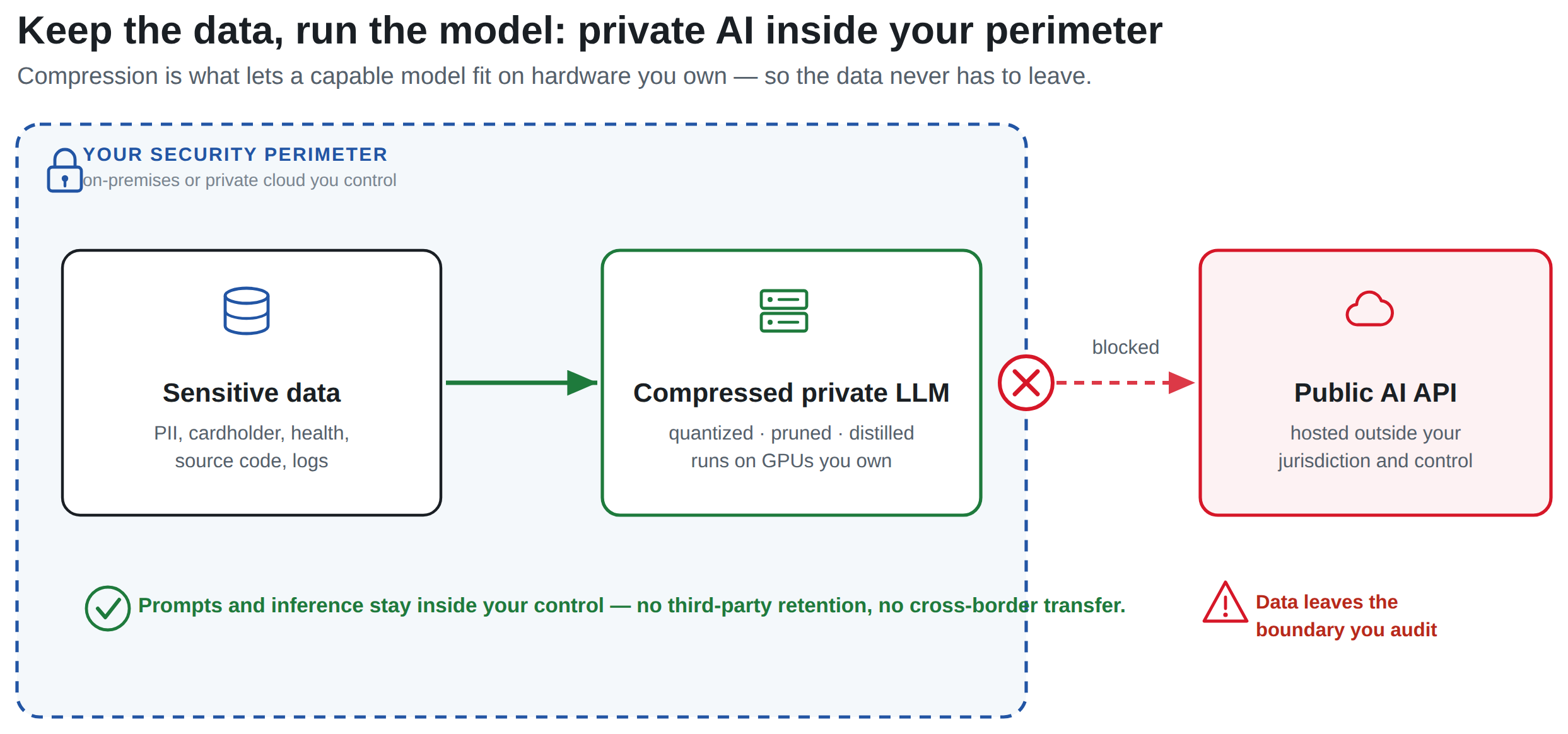 Getting there is an infrastructure and DevSecOps exercise, and it is one our team runs often. The open-weight tooling now makes the moving parts approachable: runtimes such as vLLM, Ollama and llama.cpp for serving, quantization formats and tools like GPTQ, AWQ, bitsandbytes and GGUF, and a broad library of open models on Hugging Face you can pull, inspect and pin to a known version. Hardware ranges from a single professional GPU for a departmental workload up to a modest multi-card server for something shared across teams.
What a defensible private-AI deployment looks like
Self-hosting removes the third-party exposure, but it hands you the responsibility for everything inside the boundary. A private model is still software running on servers, and it inherits the same controls you already apply to any sensitive system. The pieces we insist on:
- Model supply chain. Treat model weights like any other dependency. Pull from a known source, record the exact version and checksum, and understand its licence before it touches production. An open-weight model you cannot account for is an unmanaged dependency.
- Network isolation. Place the inference servers in a segmented zone with no outbound internet path. For the most sensitive environments in banking and critical infrastructure, that means a genuine air gap, which is only possible because the model no longer needs to phone home.
- Access control and identity. Put the model behind your existing identity provider, scope who can query it, and apply least privilege to the data it is allowed to reach. A private model wired to every share on the network is a data-exposure problem waiting to happen.
- Logging and monitoring. Capture prompts and responses to your own SIEM so you can investigate misuse, tune the system, and answer an auditor. Because the logs are yours, this improves your posture instead of widening your exposure.
- Data governance. Decide which data classes the model may see and enforce it at the retrieval layer, not on trust. Map the deployment to your existing controls under ISO 27001, PCI-DSS, NIST CSF and the CIS Benchmarks rather than treating AI as a special case that sits outside them.
- Evaluation against your own data. A compressed model can lose exactly the nuance your work depends on. Test it on representative internal tasks and set a quality bar before rollout, then re-test whenever you change the quantization level or swap the base model.
A readiness checklist before you self-host
- Have you classified the data the model will handle, and confirmed which classes cannot leave your perimeter under PCI-DSS, ISO 27001 or UAE data-protection rules?
- Do you know the smallest model size that clears your quality bar for the task, so you are not paying for capability you do not use?
- Is there a GPU budget and a serving runtime chosen, with a quantization target that fits the hardware?
- Are the inference servers segmented from the internet, and is an air gap required for your most sensitive workloads?
- Is the model version pinned, checksummed and licence-cleared, with a plan for updates?
- Do prompts and responses flow into your SIEM, and is access scoped through your identity provider?
- Have you defined the evaluation set and the pass mark before anything reaches users?
How Aydahwa Enterprise can help
Running AI on your own infrastructure sits exactly where our work lives: at the meeting point of infrastructure architecture, cloud, and security. We have spent years designing and hardening systems for regulated sectors, including banking, telecom and critical national infrastructure, against frameworks like ISO 27001, PCI-DSS, SOC 2, the NIST Cybersecurity Framework and the CIS Benchmarks, with Microsoft Cybersecurity Architect Expert depth on the team.
For a private-AI programme, that means we can help you decide which workloads justify self-hosting, size the model and the hardware to your quality and budget targets, and stand up the deployment inside a segmented, auditable architecture that maps to the controls you already report against. If you are weighing this move, our cybersecurity services and cloud and infrastructure services cover the design and the build, and our managed IT support keeps it running. You can gauge where you stand today with our free cyber security self-assessment and the cybersecurity readiness checklist, and when you are ready to scope the work, get in touch and we will map it to your environment.