The blind spot that appears after a cloud migration
A pattern shows up again and again in our engagements across the UAE and wider GCC. A company finishes migrating to AWS, Azure, or a private OpenStack cloud, stands up a cloud security posture tool, watches the dashboard turn green, and assumes the workloads themselves are protected. They are not. Posture tooling checks how the cloud is configured. It says almost nothing about what is actually running inside the virtual machines, containers, and functions that carry the business.
The market is quietly confirming how large that gap has become. IDC reported that China's public cloud workload security market grew 17.1% year on year in 2024 to 1.16 billion RMB, and its headline finding was blunt: CNAPP is becoming the standard for cloud security. Different region, same underlying force. Organisations that moved fast to the cloud are now discovering that configuration checks and workload protection are two separate disciplines, and that they only bought the first one.
This article walks through the three capabilities that actually secure a cloud workload, how they combine into a Cloud-Native Application Protection Platform (CNAPP), and how to roll the whole thing out without burying a small security team. The framing is deliberately vendor-neutral. The point is to understand the controls, not to sell a logo.
CSPM, CWPP, and CIEM: what each one actually does
Three acronyms cover most of cloud-native security, and they are routinely confused with one another. Each answers a different question.
Cloud Security Posture Management (CSPM) looks at the configuration of your cloud account. Is that S3 bucket public? Is the security group open to 0.0.0.0/0 on port 22? Is logging turned off on a database? CSPM is a control-plane discipline. It reads the cloud provider's API and compares what it finds against a benchmark such as the CIS Foundations for AWS or Azure.
Cloud Workload Protection Platform (CWPP) looks inside the workload itself. It inventories the packages on a host, flags a vulnerable OpenSSL version, spots a process spawning a reverse shell at runtime, and catches malware written to disk. CWPP is a data-plane discipline. It cares about what is executing, not how the account is set up.
Cloud Infrastructure Entitlement Management (CIEM) looks at who and what can do what. It maps the tangle of IAM roles, policies, and trust relationships, then surfaces the over-privileged identities that turn a small foothold into a full compromise. In most breaches we review, excessive entitlement is what let a minor issue escalate.
The distinction matters because these tools rarely overlap. A perfect CSPM score with no workload protection is common, and it is exactly the state that gets an organisation breached through an unpatched application running on a correctly configured server.
CapabilityWhat it securesThe question it answersTypical checks
CSPM
Cloud configuration (control plane)
Is the environment set up safely?
Public storage, open ports, disabled logging, weak encryption settings
CWPP
The running workload (data plane)
Is something malicious happening inside the host, container, or function?
Vulnerable packages, runtime process anomalies, file integrity, malware
CIEM
Identities and entitlements
Who can do what, and who has far too much access?
Over-privileged roles, unused permissions, risky trust relationships
Why posture management alone leaves you exposed
Picture a payment-processing service running on a hardened VM. The account passes every CIS benchmark. The network is segmented, logging is on, encryption is enabled. Then a developer ships a build with a known-vulnerable Java library, an attacker exploits it, and a crypto-miner lands on the host. CSPM sees none of this, because nothing about the cloud configuration changed. The door was locked; the intruder came through the application.
This is the practical reason the industry is consolidating on CNAPP. Posture, workload, and entitlement data are far more useful together than apart. A single vulnerable package is a finding. A vulnerable package on an internet-facing host, running as an over-privileged role, with no runtime monitoring, is an incident waiting to happen. You can only see that chain when the three data sets sit in one place.
For teams working toward ISO 27001 or PCI-DSS, the gap is also a compliance problem. PCI-DSS 4.0 expects you to detect and respond to anomalies on systems in the cardholder data environment, not just prove the environment was configured correctly at audit time. A green posture dashboard does not satisfy that requirement on its own.
Agent-based or agentless? The trade-off that matters
Once you accept that workloads need protection, the first real decision is how to collect the data. There are two models, and the honest answer is that most mature environments end up running both.
Agent-based protection installs software on each host or into each container image. It gives you deep, continuous visibility: live process telemetry, runtime behaviour, file integrity monitoring, and the ability to block an action as it happens. The cost is operational. Agents have to be deployed, updated, and kept compatible with kernels and runtimes, and a badly behaved agent can affect performance. On locked-down or legacy systems, getting an agent approved and installed is sometimes the hardest part of the whole project.
Agentless protection scans workloads through the cloud provider's API, typically by taking a snapshot of a disk and analysing it out of band. Deployment is fast and there is no runtime footprint, which is why IDC specifically called out agentless and sidecar models as a fast-growing area. The limitation is timing. A snapshot is a point-in-time view. It will find the vulnerable package, but it will not catch the reverse shell that opens and closes between scans.
The practical pattern we recommend: use agentless scanning to get broad coverage across the entire estate quickly, including the workloads nobody remembered to onboard, then deploy agents on the systems that carry real risk, such as anything internet-facing or inside a regulated data boundary. Coverage first, depth where it counts.
Where each model fits
- Agentless first for rapid, estate-wide vulnerability and configuration visibility, especially during an assessment or the early phase of a programme.
- Agents for runtime detection and response on high-value or exposed workloads, and anywhere a standard requires continuous monitoring.
- Both together as the steady state for most organisations that have more than a handful of production systems.
Containers and serverless change the runtime problem
The moment an organisation adopts Kubernetes or serverless functions, the old model of "protect the server" stops making sense. Containers are immutable and short-lived. A pod might exist for ninety seconds. You cannot patch it in place, and installing a traditional agent inside every container is awkward.
This is where the security shift-left idea earns its keep, and it is a genuine practice rather than a slogan. Because a container is built from an image, the most effective place to catch a vulnerable dependency is in the CI/CD pipeline, before the image is ever deployed. Scan the image at build time, block the build if a critical vulnerability is present, and sign the image so only approved builds run. At runtime, a sidecar or a node-level agent watches for behaviour that should never happen, such as a container writing to a directory it has no business touching or reaching out to an unexpected network destination.
In our own infrastructure and DevSecOps work we lean heavily on this pattern: image scanning wired into the pipeline, admission control that refuses unsigned or unscanned images, and Infrastructure-as-Code checks against CIS Benchmarks in Terraform before anything reaches production. Catching a misconfiguration in a pull request costs minutes. Catching it after an incident costs a great deal more.
How CNAPP pulls it together
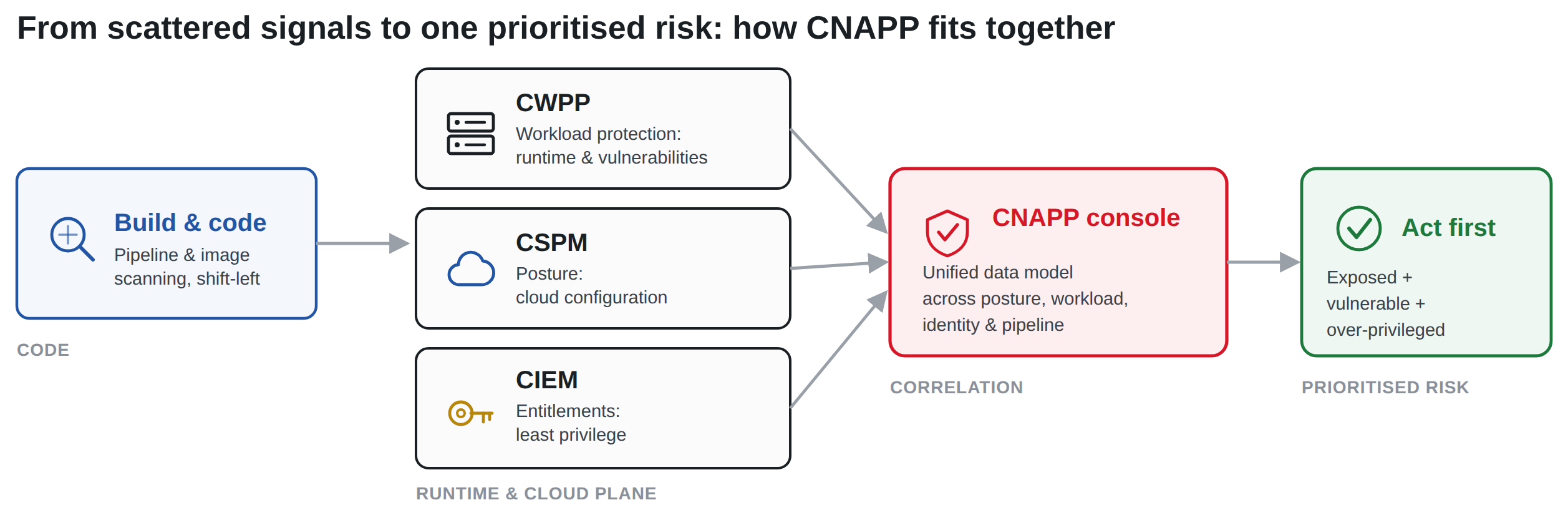
CNAPP is not a new invention so much as an integration. It takes CWPP, CSPM, and CIEM, adds pipeline and image scanning, and presents them through one console with a shared data model. The value is correlation. Instead of three tools each raising its own alerts, one platform can say: this specific workload has a critical vulnerability, is exposed to the internet, runs under an over-privileged role, and showed anomalous process activity twenty minutes ago. That is a prioritised, actionable finding rather than a pile of disconnected noise.
 The IDC analysis pointed at the same direction of travel: generative AI now sits inside these platforms to reduce alert noise, generate remediation suggestions, and drive automated response through playbooks. That is worth taking seriously, but with a practitioner's caution. AI-assisted triage is genuinely useful for cutting the volume a small team has to read. It is not a replacement for understanding your own environment, and an automated remediation that no one reviewed can take down production just as effectively as an attacker can.
Rolling this out without drowning your team
The failure mode we see most often is a team that buys a capable platform, enables every check, and is instantly buried under thousands of findings they cannot triage. A workload security programme has to be sequenced. The order below has worked repeatedly for mid-sized organisations that do not have a large dedicated security function.
- Build an accurate inventory first. Run agentless scanning across every cloud account before anything else. You cannot protect workloads you do not know exist, and the shadow accounts are usually where the worst problems hide.
- Fix the exploitable, exposed, and privileged before the merely present. Rank findings by exploitability, internet exposure, and entitlement, not by raw CVSS score. A medium vulnerability on a public host under an admin role outranks a critical one on an isolated internal system.
- Wire scanning into the pipeline. Stop new vulnerable images from shipping. This is the control that bends the curve, because it reduces the inflow instead of only cleaning up the backlog.
- Deploy runtime agents on the workloads that matter. Internet-facing systems, anything in a regulated data boundary, and your most critical services get continuous runtime detection.
- Tune, then automate. Suppress the confirmed false positives, agree on what an alert actually means, and only then hand response playbooks to automation. Automating a noisy signal just makes the noise faster.
- Map every control to the standard you report against. Each capability should trace to a requirement in ISO 27001, PCI-DSS, or your NIST CSF profile, so the programme produces audit evidence as a by-product rather than a scramble before assessment.
Mapping controls to the standards you will be audited against
For regulated organisations in the region, workload security is not only a technical exercise. It has to produce evidence. The mapping below is how we typically connect cloud-native controls to the frameworks clients are assessed against.
ControlISO 27001:2022PCI-DSS 4.0NIST CSF 2.0CIS
Configuration posture (CSPM)
A.8.9 Configuration management
Req. 2 secure configurations
PR.PS / Protect
CIS Benchmarks, Control 4
Vulnerability management (CWPP)
A.8.8 Technical vulnerabilities
Req. 6 & 11
ID.RA / DE.CM
Control 7
Runtime detection (CWPP)
A.8.16 Monitoring activities
Req. 10 & 11.5
DE.CM / RS
Control 8
Entitlement management (CIEM)
A.8.2 / A.5.15 Access control
Req. 7 least privilege
PR.AA
Controls 5 & 6
When the mapping is built in from the start, an auditor's request for evidence becomes an export from the platform rather than a fire drill. That is the difference between a security programme that also serves compliance and two separate teams doing overlapping work twice.
How Aydahwa Enterprise Can Help
Aydahwa Enterprise builds and secures cloud infrastructure for organisations across the UAE and GCC, with hands-on experience in banking, telecom, and critical infrastructure environments where the workloads genuinely matter. Our work spans architecture, migration, and the security controls that have to hold up under an ISO 27001, PCI-DSS, or NIST CSF assessment, delivered by a team that has run these platforms in production rather than only specified them on paper.
If you have migrated to the cloud and are not certain what is actually running inside your workloads, a good place to start is our free cybersecurity self-assessment and the cybersecurity readiness checklist, which will tell you quickly where the gaps sit. From there, our cloud security and migration services and broader cybersecurity practice cover the full path from an agentless assessment of your estate to CNAPP rollout, pipeline integration, and ongoing managed protection. To scope a workload security review for your environment, get in touch and we will map the controls to the standards you report against.