
The data you can't see is the data you can't protect
Walk into most cloud estates that have grown organically over five or six years and ask a simple question: where is your sensitive data right now? Not where it is supposed to be, where it actually is. In our engagements across the UAE and wider GCC, the honest answer is usually a shrug and a spreadsheet that stopped being accurate two reorganisations ago. Customer records sit in a forgotten S3 bucket a developer spun up for a proof of concept. A full copy of the production database, cardholder fields and all, lives in a staging environment nobody has patched since it was built. An analyst has exported a report full of Emirates ID numbers to a shared drive so a partner could look at it.
None of that shows up on an architecture diagram. It shows up in a breach report. Roughly 94% of enterprises now run cloud services, and more than half of enterprise and SMB workloads sit in public clouds, so the volume of data scattered across managed databases, object storage, SaaS platforms and half-decommissioned test environments has outrun the manual methods most teams still use to track it. You cannot write an access policy for a data store you have forgotten exists, and you cannot prove compliance for records you cannot find.
This is the gap that Data Security Posture Management, or DSPM, was built to close. It is worth understanding what the category does, where it fits, and how to get value from it without buying another tool that ends up as shelfware.
Why a whole product category grew up around finding data
For years, data security meant buying separate products and hoping they added up to something: a database activity monitor here, a data loss prevention agent there, an encryption gateway, a rights management add-on. Each covered one slice. None of them agreed on what counted as sensitive, and none of them could tell you the whole story for a single customer record as it moved from the application database into a data warehouse, out to a BI dashboard, and into a backup.
The market has been consolidating those slices into a single view. Gartner published its first Market Guide for Data Security Posture Management in 2024 and refreshed it in 2025, which is usually the signal that a category has moved from novelty to something buyers are actively shortlisting. Frost & Sullivan put the DSPM market at around 415 million US dollars in 2024 and projected it to grow at roughly 37% a year through the end of the decade. The same shift is visible outside the usual North American numbers. IDC reported that China's data security management platform market reached 791 million yuan in 2024, up 14.8% year on year, and named unified data security management, rather than a pile of point tools, as the defining trend. Cyber Magazine's recent roundup of cloud compliance platforms made the same underlying point from the compliance side: manual audits cannot keep pace with the speed at which virtual resources are created and destroyed in a multi-cloud environment.
Strip away the vendor language and the idea is old-fashioned. Find the data. Know how sensitive it is. Know who can reach it. Know whether that matches the rules you are bound by. Fix the gaps, and keep checking, because the estate changes every day.
Discovery and classification come first
Every credible data security programme starts in the same place, and it is not a product purchase. It is discovery. Before anything else, you need an accurate, continuously updated inventory of where data lives across your accounts and subscriptions: managed relational databases, NoSQL stores, data lakes, object storage, file shares, and the SaaS tools your business runs on. In a multi-cloud setup that spans AWS, Azure and Google Cloud, this inventory has to reach across all three, because attackers and auditors both go looking in the account you forgot about.
Classification is the step that gives discovery meaning. A bucket full of marketing images and a bucket full of passport scans are not the same risk, and treating them the same way wastes money on one and under-protects the other. Classification tags data by what it is and what governs it: cardholder data under PCI DSS, personal data under the UAE's data protection law, health information, trade secrets, ordinary internal documents. Modern DSPM tools do a reasonable first pass automatically, sampling content and matching patterns, but the output is a starting point, not gospel. The teams that get real value pair automated classification with named data owners in each business unit who can confirm or correct what the scanner found. A scanner can tell you a column looks like a national ID number. Only a person can tell you it is the one the whole loyalty programme depends on.
Mapping data to the rules that govern it
Classification is only useful if it connects to obligations. This is where a lot of technically sound projects lose the thread, because the person running the scanner is rarely the person who has read the regulations.
The frameworks most of our clients answer to are well established. ISO/IEC 27001 expects information to be classified and handled according to its value and sensitivity, with clear rules for labelling and for secure deletion. PCI DSS is uncompromising about where cardholder data may live and demands that you shrink that footprint wherever you can. The NIST Cybersecurity Framework organises the whole effort under Identify, Protect, Detect, Respond and Recover, and DSPM feeds the Identify function directly. The CIS Critical Security Controls put data protection at Control 3, and its very first sub-control is to establish and maintain a data management process, which is exactly the inventory problem described above.
In the UAE the picture has more layers, and they do not overlap neatly. Federal Decree-Law No. 45 of 2021, the Personal Data Protection Law, governs personal data on the mainland with principles you will recognise from GDPR: lawfulness, purpose limitation, data minimisation, accountability, plus data subject rights, impact assessments and breach notification. The DIFC applies its own regime under Data Protection Law No. 5 of 2020, and the ADGM has its Data Protection Regulations 2021. Dubai's DESC Information Security Regulation and the national information assurance standards add sector requirements on top. An organisation with a mainland trading arm, a DIFC entity and a workload in ADGM has to satisfy three data protection regimes at once, and a classification scheme that ignores that reality will generate confident, wrong answers. Getting the mapping right up front is what turns a data inventory into a compliance asset instead of a liability.
The DSPM workflow, end to end
It helps to see the process as a loop rather than a checklist, because the estate never stops changing. Each stage feeds the next, and monitoring feeds back into discovery when something new appears.
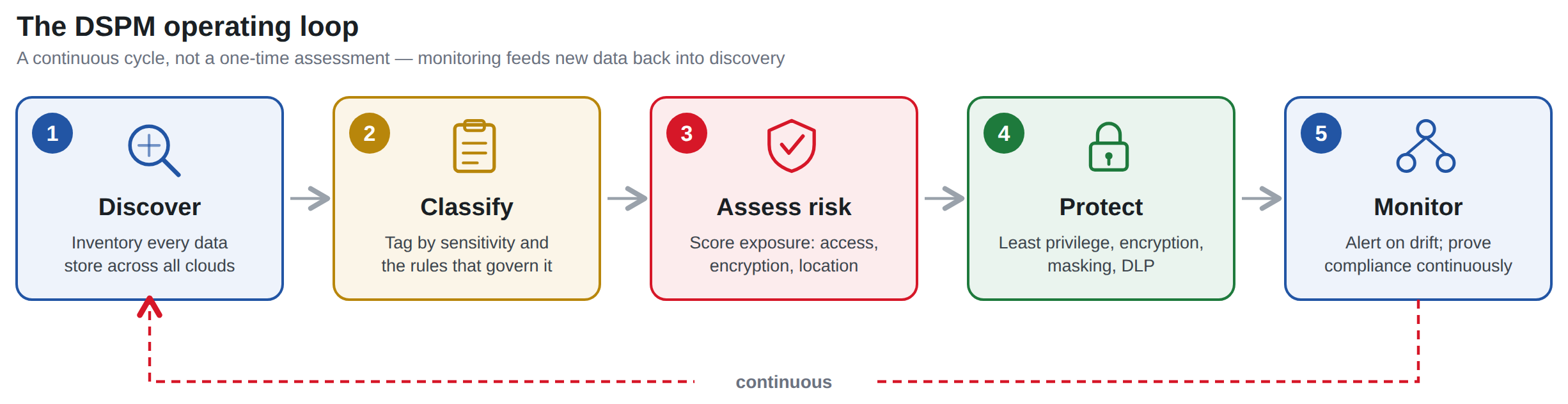 The discipline is in the last stage. A one-time assessment produces a report that is out of date the moment a developer creates a new database. Continuous operation is what keeps the inventory honest, and it is the difference between a posture you can defend to an auditor and a slide deck from last quarter.
Protection follows classification, not the other way round
Once you know what you hold and how sensitive it is, the protective controls stop being guesswork. Access governance comes first, because over-permissioned access is the single most common finding we see. Service accounts with standing read access to production data, staff who kept sensitive permissions after changing roles, third parties granted broad access for a project that ended a year ago: each one is a breach waiting for an excuse. Least privilege is unglamorous and it is where the real risk reduction happens.
Encryption is the next layer, at rest and in transit, with a genuine key management practice behind it rather than default keys nobody rotates. For data that does not need to be real everywhere it is used, masking and tokenisation are underused tools. There is rarely a good reason for a test environment to contain live cardholder numbers or real Emirates ID data, and replacing them with realistic but fake values removes an entire class of exposure at almost no cost to the developers who use it. Data loss prevention then watches the movement of sensitive data across email, endpoints and cloud channels, and it works far better when it is driven by the same classification labels as everything else instead of maintaining its own separate, conflicting idea of what matters.
From the annual audit to continuous evidence
The older model of compliance was a periodic event. An auditor arrived once a year, you scrambled for two weeks to assemble evidence, and everyone relaxed once the certificate was renewed. That model is quietly failing, because the cloud does not hold still between audits and the gap between two annual reviews is long enough to hide a serious incident.
The direction of travel, and the IDC analysts tracking these platforms said the same thing, is toward continuous compliance. Instead of proving a control worked last March, you monitor it constantly and get alerted the moment reality drifts from policy: a bucket made public, a database provisioned without encryption, a new copy of sensitive data appearing outside its approved zone. Risk scoring sits on top, so that instead of a flat list of 4,000 findings you get a ranked view of the handful that actually matter this week. For a lean security team, and most GCC mid-market teams are lean, that prioritisation is the difference between fixing the right things and drowning.
Stitched point tools versus a unified approach
The practical question most teams face is whether to keep assembling individual tools or move to a consolidated platform. Both can work. The trade-offs look like this:
DimensionSeparate point toolsUnified DSPM approach
Data inventory
Each tool sees its own slice; no single source of truth
One continuously updated inventory across clouds
Classification consistency
Every tool defines sensitivity differently
One classification model drives all controls
Compliance mapping
Manual correlation across consoles
Findings mapped to frameworks and regulations directly
Operational cost
Multiple licences, integrations and skill sets
Consolidated, but a real migration effort to get there
Best fit
Mature teams with existing investment and integration capacity
Teams wanting one view without stitching it together themselves
There is no universally correct answer. A bank with a mature security function and years of investment in specialised tools may rationally keep them and add a thin correlation layer. A growing firm with a three-person security team almost always gets further, faster, with a consolidated approach, because the integration work it would otherwise carry is the work it has no people to do.
Where teams get this wrong
A few failure patterns come up again and again, and all of them are avoidable:
- Buying the tool before naming data owners. The scanner finds the data; only the business can confirm what it is and who is accountable for it. Skip that step and you get a precise inventory nobody trusts.
- Trying to classify everything to the highest standard at once. Start with the data that would hurt most if it leaked, prove the process there, then widen the scope.
- Treating DSPM as a project with an end date. The value is in continuous operation. A posture assessment that runs once is a snapshot of a moving target.
- Ignoring non-production copies. Backups, test databases and analytics extracts often hold the same sensitive data as production with a fraction of the controls, and they are where a surprising number of breaches actually begin.
- Producing findings with no remediation path. A list of 4,000 risks that no one is assigned to fix is not a security programme, it is a liability you have now written down.
How Aydahwa Enterprise Can Help
At Aydahwa Enterprise we build data security programmes the way they actually hold up in an audit and in an incident, not the way they look on a vendor slide. Our work starts with the unglamorous part, an honest inventory of where your sensitive data lives across AWS, Azure and Google Cloud, classified against the standards that bind you, whether that is ISO 27001, PCI DSS, the UAE Personal Data Protection Law, or the DIFC and ADGM regimes if you operate across those zones.
From there we help you close the gaps that matter: tightening over-permissioned access, getting encryption and key management onto a sound footing, removing live data from environments that have no business holding it, and standing up continuous monitoring so compliance becomes something you can demonstrate on any given day rather than scramble for once a year. Our team brings hands-on experience across banking, telecom and critical national infrastructure, sectors where getting data security wrong is not an option.
If you want to know where you stand before committing to anything, start with our free cyber security self-assessment or work through the cybersecurity readiness checklist. To go deeper, our cybersecurity services and cloud security and migration practices cover data discovery, classification and compliance end to end, backed by managed IT support for the day-to-day. When you are ready to map your own data estate, get in touch and we will take it from there.