
The breach that starts in someone else's network
Look closely at the incidents that dominated security headlines through 2026 and a pattern repeats. The attackers rarely kicked down the front door of the large enterprise. They walked in through a supplier: a managed service provider with standing access, a widely used open-source scanner in the build pipeline, a payroll or logistics vendor holding a copy of sensitive data. The Trivy supply-chain compromise and the string of breaches traced back to third-party providers were not sophisticated feats against hardened targets. They were the predictable result of trust extended without verification.
We see the same story in our own engagements across banking, telecom, and critical national infrastructure in the GCC. An organisation spends heavily to secure its own estate, then hands a network drop, an API key, or a data export to a vendor whose security posture nobody has ever examined. The vendor becomes the weakest wall in a building everyone assumed was solid. Third-party risk management, or TPRM, is the discipline that closes that gap, and it has moved from a procurement formality to a genuine board-level concern.
Why third-party risk became a board-level exposure
Two forces pushed vendor risk up the priority list. The first is attacker economics. Compromising one managed provider can yield access to dozens of its downstream clients, so the return on a single intrusion is enormous. Adversaries have industrialised this: they map the supplier graph, find the softest node, and pivot. The enterprise that invested in zero trust internally still gets breached because a supplier with VPN access did not.
The second force is regulation catching up with reality. Boards are now accountable for the security of data even after it leaves their perimeter. In the UAE, the Personal Data Protection Law places clear obligations on controllers to bind their processors through contract and to remain answerable for how those processors handle personal data. Sector rules from the National Electronic Security Authority framework, along with central-bank and critical-infrastructure guidance, expect documented oversight of the supply chain, not a filing cabinet of signed forms. When a supplier fails, "we outsourced that" is no longer a defensible answer to a regulator or a customer.
The practical consequence is that vendor risk can no longer live only in procurement. It needs an owner in security, a defined process, and evidence that the process runs. That is what separates a program from a paperwork exercise.
What the standards actually ask of you
The good news is that you do not have to invent a framework. Several mature standards already describe what competent third-party governance looks like, and they overlap far more than they conflict. The job is to map them once and run a single program that satisfies all of them.
StandardWhat it requires for third parties
ISO/IEC 27001:2022 (Annex A 5.19–5.23)
Information security in supplier relationships, security terms in agreements, managing risk across the ICT supply chain, monitoring supplier service delivery, and explicit controls for cloud service use.
NIST CSF 2.0 (Govern function, GV.SC)
A dedicated Cybersecurity Supply Chain Risk Management category: establish, agree, and manage supply-chain risk as a governance outcome, not a one-off assessment.
NIST SP 800-161r1
Detailed C-SCRM practices for identifying, assessing, and mitigating risk from suppliers, products, and services throughout their lifecycle.
PCI-DSS v4.0 (Requirement 12.8)
Maintain a list of third-party service providers, a documented responsibility matrix, due diligence before engagement, and monitoring of each provider's PCI compliance status.
CIS Controls v8 (Control 15)
Inventory service providers, classify them, assess them against a standard, and decommission access when the relationship ends.
UAE PDPL
Written processing agreements with processors, controls on cross-border transfer, and controller accountability for processor conduct.
Read across that table and the same skeleton appears each time: know who your vendors are, decide how much each one matters, check them before and during the relationship, write the obligations into the contract, and cut access cleanly at the end. Everything below is a way to make that skeleton operational.
The vendor risk lifecycle, made to run
A program that works treats every supplier as passing through the same stages, with the depth of scrutiny set by how much damage that supplier could cause. The diagram below shows the lifecycle we implement for regulated clients.
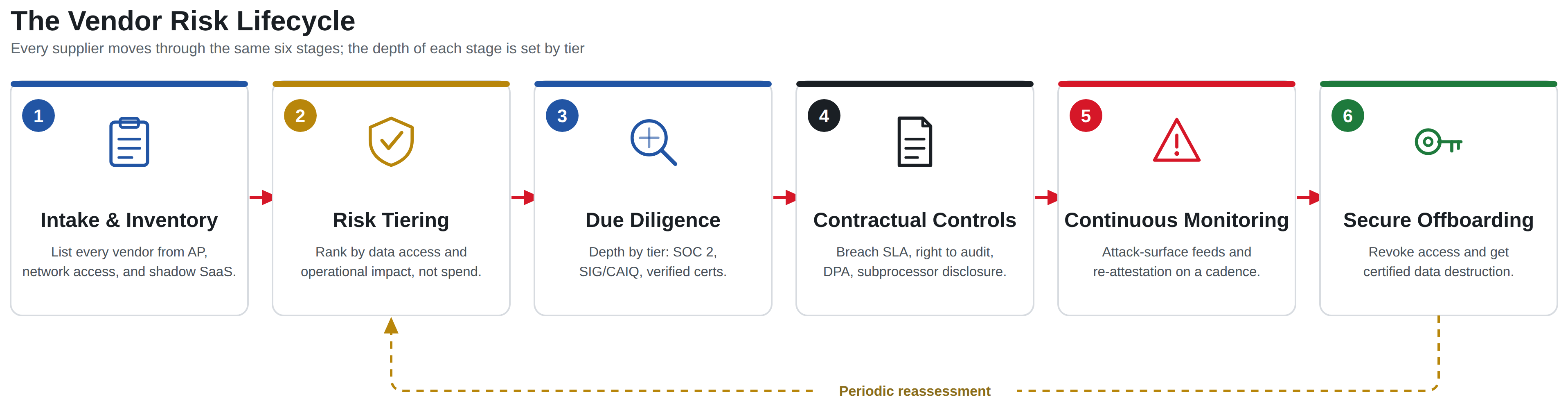 None of these stages is optional, but the effort inside each one scales with tier. A cloud provider holding your production data and a stationery supplier do not deserve the same questionnaire.
Tier vendors by the damage they could do
The most common mistake we correct is tiering vendors by spend. Spend tells you what a relationship costs, not what it can destroy. Tier instead by exposure: what data does the vendor hold, what access does it have into your network, and how badly would your operations degrade if it disappeared or was compromised. A small analytics start-up with an API token that reads your customer table is a higher risk than a large facilities contractor who never touches a system. We usually settle on three or four tiers, with the top tier reserved for vendors whose failure would trigger a reportable incident or halt a core service.
Make due diligence proportional and evidence-based
For low tiers, a short self-attestation and a check of basic hygiene is enough. For critical vendors, ask for evidence and read it properly. A SOC 2 Type II report is worth more than any questionnaire because it covers a period of operation, not a single day. Read the exceptions in it; that is where the truth lives. Standardised questionnaires such as the Shared Assessments SIG or the Cloud Security Alliance CAIQ give you comparable answers across vendors, and for cloud suppliers the CSA STAR registry can save a round of back-and-forth. Where a vendor claims a certification, verify it against the issuing body rather than accepting a PDF. For anything touching cardholder data, confirm the provider's own PCI status and get the responsibility matrix in writing.
Put the controls in the contract
Security promises made in a sales call evaporate the day something goes wrong. The contract is where they become enforceable. At minimum, critical-vendor agreements should carry a breach-notification window measured in hours rather than "without undue delay," a right to audit or to receive independent audit evidence, a data processing agreement aligned to PDPL, mandatory disclosure of subprocessors, and flow-down clauses so your requirements bind the vendor's own suppliers. We also insist on defined offboarding obligations: certified data destruction and access revocation on termination. Negotiating these after an incident is impossible, so they belong in the paper before the relationship starts.
Monitor continuously, because a point-in-time review ages badly
A vendor assessed as sound in January can be breached, acquired, or left to decay by June. Point-in-time due diligence is necessary but not sufficient. For top-tier vendors, maintain ongoing signals: external attack-surface and security-rating feeds, breach and news monitoring, and periodic re-attestation on a cadence tied to tier. Treat security ratings as a smoke detector, not a verdict; they flag externally visible hygiene but say nothing about internal controls, so pair them with real evidence. The goal is to notice a supplier's posture slipping before an attacker does.
Your software supply chain is a vendor too
Third-party risk is not only companies with contracts. Every open-source dependency, base image, and build tool in your pipeline is a supplier you never signed with, and the Trivy-style incidents of the past year show how directly that pipeline can be turned against you. The controls here are technical rather than contractual, but they answer the same question: do you know what you are trusting, and can you prove it has not been tampered with?
The concrete practices are well established. Generate a software bill of materials for what you ship, so that when the next widely used package is found to be malicious you can answer "are we affected" in minutes rather than days. Pin dependencies to known-good versions and hashes rather than floating tags. Adopt the SLSA framework's provenance levels for your builds, sign artefacts with something like Sigstore, and verify those signatures at deploy time. Keep the build environment as locked down as production, because a compromised CI runner is a compromised release. These measures turn a blind spot into an inventory you can reason about.
Where AI shifts the ground under vendor risk
AI enters this picture from both sides. On the offensive side, attackers use it to probe supplier graphs and generate convincing pretexts at scale, which shortens the time between a vendor weakness appearing and its being exploited. That raises the value of continuous monitoring over annual reviews.
On the defensive side, the vendor-risk tooling market is absorbing machine learning to make oversight tractable. Predictive procurement platforms now score suppliers for risk before a purchase order is raised, an approach seen in moves like Nissan's partnership with Arkestro to gain visibility into third-party suppliers and steer away from risky vendors. Large operators such as Deutsche Telekom have placed AI at the centre of their group security strategy for exactly this reason: the supplier estate is too large to review by hand. Used well, these tools triage the queue so your analysts spend time on the vendors that matter.
AI also creates a new class of supplier. When you embed a model provider, an AI API, or an agent framework into a workflow, you have taken on a vendor that can receive your data and act on your systems. That provider has its own subprocessors, its own training and retention practices, and its own failure modes. It belongs in the vendor inventory and the tiering exercise like any other critical supplier, with contractual terms covering data use and a clear understanding of what the model does with what you send it. The fourth-party question, who your vendor's vendors are, becomes sharper when one of them is a foundation-model company.
A practical starting checklist
If your program is immature, momentum matters more than perfection. This sequence gets a defensible baseline in place without boiling the ocean.
- Build the inventory first. You cannot manage vendors you have not listed. Pull from accounts payable, from network access logs, and from the SaaS applications your teams have signed up for without telling anyone.
- Tier the inventory by data access and operational impact. Accept that the top tier will be small; that is where your effort concentrates.
- Assign an owner in security for the program and a named business owner for each critical vendor. Unowned risk is unmanaged risk.
- Run evidence-based due diligence on the top tier now, and standardise a lighter questionnaire for everyone else.
- Fix the contract template so new critical vendors inherit breach-notification, audit, DPA, subprocessor, and offboarding clauses by default.
- Stand up continuous monitoring for the top tier and set a re-assessment cadence for the rest.
- Define and rehearse offboarding, so access and data actually leave when a vendor does.
- Extend the same thinking to your software supply chain with an SBOM and signed builds.
The mistakes we keep fixing
Across assessments, the failures cluster into a short list. Tiering by spend instead of exposure, so the dangerous small vendor slips through. Treating the questionnaire as the goal rather than reading the evidence behind it. Assessing at onboarding and never again. Leaving vendor access accounts active for years after the contract ended, because nobody owns offboarding. And forgetting the fourth party entirely, so a critical supplier's own subcontractor becomes an unmonitored path into your data. Each of these is cheap to fix once you name it, and expensive to ignore.
How Aydahwa Enterprise can help
We build and operate third-party risk programs for organisations that carry real regulatory weight: banks, telecoms, and critical-infrastructure operators across the UAE and wider GCC. Our team holds the certifications that back this work, including ISO 27001 lead credentials, PCI-DSS and SOC 2 experience, and Microsoft Cybersecurity Architect expertise, and we have run vendor due diligence on suppliers to national infrastructure programs where getting it wrong was not an option.
A typical engagement starts with building the vendor inventory and a defensible tiering model, then designing the assessment, contractual, and monitoring workflow so your own team can run it after we leave. Where you want the software supply chain covered too, we extend the program into your pipeline with SBOM generation and build-integrity controls. You can explore our cybersecurity services, our cloud security and migration practice, and our managed IT support to see where this fits.
If you would rather gauge where you stand before committing, our free cyber security self-assessment and cybersecurity readiness checklist are a fast way to surface the gaps, and you can contact us to talk through a vendor-risk program scoped to your regulatory obligations. The supplier you have not assessed is the one an attacker is counting on. It is worth finding it first.