
Machine identities now outnumber people, and most access programs haven't caught up
Walk into almost any enterprise environment today and count the things that authenticate. Employees and contractors are a small fraction of it. The rest are service accounts, API keys, CI/CD pipeline tokens, Kubernetes workloads, cloud IAM roles, database logins, and now a growing population of AI agents that call tools and other services on their own. In our engagements across banking, telecom, and critical national infrastructure, the ratio of non-human to human identities is routinely 10:1 or higher, and the non-human side is the part nobody fully owns.
Cyber Magazine put the shift plainly in its April 2026 roundup of identity platforms: the rise of AI, cloud, APIs, and connected devices means machine identities now far outnumber human users, creating a large and frequently overlooked attack surface. The attacks follow the identities. Phishing and credential stuffing still work because a stolen or over-privileged credential is the shortest path into a network, and once inside, an attacker mostly needs valid access rather than a new exploit.
This is why identity, not the firewall, is the control plane that decides what actually happens inside your systems. The market data points the same direction. IDC's market share study of China's unified identity management platforms (Doc # CHC52196625, June 2025) valued that single national segment at 2.57 billion yuan for 2024, and its subtitle is the useful part for planning: "Automation and Intelligence Will Dominate Product Competitiveness." The vendors and the buyers are both moving identity from a static gate to a continuous, data-driven decision. If your program still treats authentication as a one-time check at login, you are managing last decade's risk.
The perimeter you can still defend is identity
The classic network perimeter dissolved years ago, and everyone says so, but plenty of access designs still assume it exists. A user or a workload authenticates once, receives broad standing access to a network segment or an application tier, and keeps it until someone remembers to revoke it. That model fails in two predictable ways. Standing privilege becomes the blast radius when a credential leaks, and lateral movement becomes trivial once an attacker is "inside," because inside no longer means trusted in any meaningful sense.
NIST's Zero Trust Architecture guidance, SP 800-207, reframes the problem correctly: trust is never granted by location, and every access request is evaluated against identity, device posture, and context at the moment it is made. Identity is the anchor because it is the one attribute that travels with the request whether it originates from a laptop in the office, a contractor's home network, a container in a public cloud, or an autonomous agent. Get identity verification and authorization right and the other controls have something solid to hang from. Get it wrong and your segmentation, logging, and DLP are all guarding a door whose lock has already been handed out.
Non-human identities are where the real exposure sits
Human identity is a solved problem in principle. You have an HR system as the source of truth, a joiner-mover-leaver process, MFA, and an SSO provider. It is imperfect in practice, but the pattern is understood. Machine identity usually has none of that. A service account gets created during a project, granted more permission than it needs so the deployment stops failing at 2 a.m., and then it lives forever with no owner, no rotation, and no expiry. Multiply that by every microservice, integration, and scheduled job and you have a sprawl that no one can fully enumerate.
The IDC analysis names this directly: enterprises need to extend identity management to cover terminal devices, applications, APIs, and microservices, and to assign each asset a managed digital identity across its full lifecycle. That lifecycle framing matters more than any single tool. An identity that can be created must also be inventoried, attributed to an owner, scoped to least privilege, rotated on a schedule, and reliably retired. Secrets sprawl, where credentials sit in code repositories, config files, container images, and CI variables, is the machine-identity version of a sticky note under the keyboard, and it is where a large share of the breaches we investigate actually begin.
From static authentication to continuous evaluation
The most important change in modern identity is that the decision is no longer made once. In a mature design, every meaningful access request runs through a policy decision point that scores the current risk and issues a short-lived, narrowly-scoped grant. The IDC report describes exactly this transition, from "static identity authentication" to "dynamic risk assessment," with AI evaluating user and asset trust levels continuously and adjusting permissions in real time. Microsoft's Entra Conditional Access, Okta's adaptive policies, and Ping's authorization engine all implement versions of the same loop.
The mechanism is straightforward to describe and demanding to operate. A request arrives with an identity assertion. The policy engine evaluates signals: is this identity known and in good standing, is the device managed and compliant, is the behavior consistent with this identity's history, is the request in scope for the resource. Based on that score the engine allows the request, forces a step-up such as a FIDO2 or passkey challenge, or denies it outright and raises an event. The grant it issues is short-lived, so access naturally expires rather than accumulating.
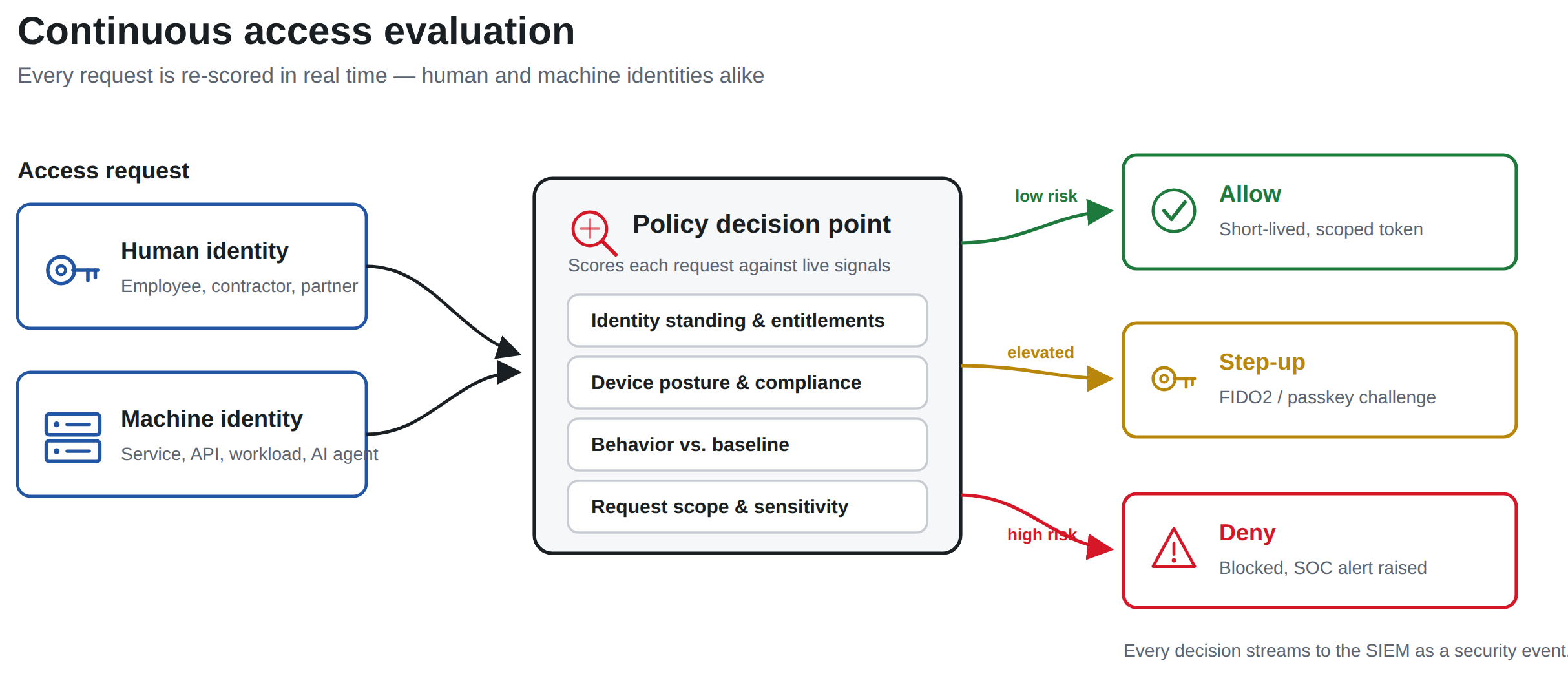 Two operational points decide whether this works. First, the signals have to be real and current, which means device posture from your endpoint management, behavioral baselines from your identity provider, and threat context from your SOC all have to feed the decision. Second, the outcomes have to reach the SOC. A denied high-risk request is a detection, and it should land in your SIEM as one. When identity decisions and security monitoring are wired together, the SOC stops chasing network noise and starts seeing the events that actually correlate with compromise.
Static gate versus continuous model
The difference between the two approaches is easiest to see side by side.
DimensionStatic authenticationContinuous, identity-first model
When trust is decided
Once, at login
On every request, re-scored continuously
Privilege model
Broad standing access
Least privilege, just-in-time, short-lived grants
Signals used
Username, password, sometimes MFA
Identity, device posture, behavior, threat context
Machine identities
Long-lived static secrets
Workload identity, rotated or issued per-session
Compromised credential impact
Full standing access until revoked
Bounded by scope, expiry, and re-evaluation
SOC visibility
Login logs, reviewed after the fact
Access decisions stream to the SIEM in real time
Most organizations sit somewhere between these columns, strong on human MFA and weak on machine identity and continuous evaluation. The honest first step is to find out where you actually are, not where the architecture diagram says you are.
Where AI helps in identity operations, and where it becomes the risk
AI in identity work cuts both ways, and it is worth being precise about each. On the operations side, the gains are concrete. Machine learning is genuinely good at user and entity behavior analytics, spotting the logins and access patterns that break from an established baseline. It can draft and refine least-privilege policies from observed access, propose the removal of permissions that have gone unused for months, and triage identity alerts so analysts spend their time on the ones that matter. The IDC report frames these as the competitive frontier for identity platforms, and in the field they translate into fewer stale entitlements and faster response.
The other side is newer and gets less attention than it should. AI agents are themselves identities now, and they are powerful ones. An agent that can call tools, query databases, and invoke other services needs credentials, and those credentials often carry broad scope because scoping an agent tightly is harder than giving it access to everything. IDC's analyst commentary makes the point that identity and access management for large-model access has become an essential requirement, specifically to prevent unauthorized access to models, identity spoofing, and privilege abuse. Treat every agent and model endpoint as a first-class identity: give it its own credential, scope it to the minimum it needs, put a human-approval step on the actions that carry real consequences, and log everything it does to the SOC. An over-privileged agent with a leaked token is a standing account with initiative, which is worse than the service-account problem you already have.
What the compliance frameworks actually ask for
Identity requirements are not vague in the standards your auditors use, and mapping your program to them saves argument later. NIST CSF 2.0 places identity management, authentication, and access control under the Protect function and expects least privilege and credential lifecycle management as named outcomes. ISO/IEC 27001:2022 covers this in Annex A controls 5.15 through 5.18 for access control, identity, and authentication, plus 8.2 for privileged access rights. PCI-DSS v4.0 Requirement 8 is explicit on unique identification, MFA for access into the cardholder data environment, and, in the current version, the management of application and system accounts, which is the machine-identity requirement stated in compliance language. CIS Controls v8 puts account management at Control 5 and access control management at Control 6, with concrete safeguards you can measure against.
The pattern across all of them is the same, and it is not a coincidence: know every identity, give each the least privilege it needs, prove who has access to what, and be able to revoke it quickly. An identity program built to that pattern satisfies the frameworks as a by-product rather than as a separate scramble before each audit.
A practical 90-day identity hardening plan
You do not fix identity by buying a platform. You fix it by working a sequence that produces evidence at each step. This is the order we use on engagements, and it front-loads the work that reduces the most risk.
- Inventory every identity, human and machine. Pull from your identity provider, cloud IAM, secrets managers, and service-account directories into one list. You cannot protect what you have not counted, and the count is almost always larger than expected.
- Find and attribute the orphans. Every service account and API key needs a named human owner and a stated purpose. Anything with neither is a candidate for disablement, monitored first, then removed.
- Kill standing privilege where it hurts most. Start with privileged and administrative access. Move it to just-in-time elevation with approval and expiry, so no one and no workload holds admin rights around the clock.
- Get secrets out of code and config. Move static credentials into a managed secrets store with rotation, and adopt workload identity, such as SPIFFE/SPIRE or your cloud's native workload identity, so services authenticate without long-lived shared secrets.
- Turn on continuous evaluation for the crown jewels. Apply adaptive, risk-based access to your most sensitive applications and data first, with phishing-resistant MFA (FIDO2 or passkeys) as the step-up.
- Wire identity events into the SOC. Stream access decisions, step-ups, and denials into your SIEM, and build detections on the high-risk ones. Identity without monitoring is a control you cannot prove.
- Bring AI agents under the same discipline. Give each agent its own scoped identity, gate its consequential actions behind approval, and log its activity like any other privileged account.
Ninety days is enough to complete the inventory, retire the worst of the orphaned access, and stand up continuous evaluation on your highest-value systems. It is not enough to finish, because identity is an operating discipline rather than a project. The point is to reach a state where new identities are governed from birth instead of discovered during an incident.
How Aydahwa Enterprise can help
Aydahwa Enterprise builds and operates identity-first security programs for organizations across the UAE and wider GCC, with hands-on experience in the sectors where getting this wrong is expensive: banking, telecom, and critical national infrastructure. Our work is grounded in real credentials rather than slideware, including ISO 27001 and PCI-DSS implementation, NIST CSF and CIS Benchmark alignment, and Microsoft Cybersecurity Architect Expert certification for Zero Trust designs on Entra and Azure.
If you want to know where your identity program actually stands, start with our free cybersecurity self-assessment and the cybersecurity readiness checklist. For a full engagement, our cybersecurity services cover identity architecture, Zero Trust rollout, and SOC integration; our cloud security and migration practice handles machine identity and workload authentication in cloud-native environments; and our managed IT and security services keep the program running after the project ends. When you are ready to scope it against your environment, get in touch and we will work from where you are, not from an idealized diagram.